On the night of 3 November 2026, the United States elected its House of Representatives and a third of its Senate. NBC News projects Democrats as the winners of both chambers, and in the Senate they have flipped seven seats. Two years after the 2024 election, the S&P 500 stands about 31 percent higher, hourly wages 6.6 percent and prices 6.7 percent. The economy is growing far faster than Germany's, and yet 75 percent of voters call it not so good or poor. My take as an entrepreneur who follows America mainly through markets and crypto: Wall Street won, everyday life did not, and the famous egg test turns out differently than I expected.
Status: 4 November 2026, 07:44 CET. Counting continues, exit polls are preliminary.
More on this topic: Politics & Society, with background, practice and every article in one place.
US Midterms 2026: The Key Facts
- 38 percent approve of Trump in the exit poll for NBC News, 62 percent disapprove.
- Up 30.9 percent: the S&P 500 since election day 2024, against 6.6 percent for hourly wages and 6.7 percent for consumer prices.
- Down 33 percent: eggs are cheaper than before the 2024 election, while gasoline costs 37 percent more and coffee 40 percent more.
- 49.2 percent of consumer spending came from the top ten percent of earners at the last reading (Moody's, second quarter of 2025).
- 3.4 percent annualized growth for the US in the third quarter of 2026; Germany grew 0.2 percent on the previous quarter.
- 62 to 35 percent: Latino voters for Democrats in the exit poll; Trump won 46 percent of them in 2024.
US Midterms: How the Election Turned Out
Both chambers go to the Democrats. In the House, NBC News projects at least 255 seats, and 218 are needed. In the Senate, they reached the majority of 51 seats at 05:26 CET and added Maine at 06:50: North Carolina, South Carolina, Texas, Ohio, Kansas, Iowa and Maine changed party, with Michigan, Nebraska and Alaska still open. All races, seat counts and calls of the night are in our live tracker at CryptoTicker. I am interested in something else here: what has really changed in this country in two years?
The Egg Test: Why Eggs Are No Longer the Problem
In the 2024 campaign, a dozen eggs was the price America used to measure inflation. I would have bet this test now goes against Trump. The numbers say otherwise: a dozen cost $3.37 on average in October 2024 and $2.27 in September 2026, 33 percent less, according to the US Bureau of Labor Statistics. Trump passed the egg test.
But nobody is standing angrily in front of the egg shelf anymore. The anger is at the gas pump: gasoline rose from $3.28 to $4.48 a gallon over the same period, coffee from $6.64 to $9.33 a pound, ground beef from $5.59 to $6.79 a pound. On election day itself, AAA showed $4.14 a gallon, the highest Election Day price on record, NBC News reports.
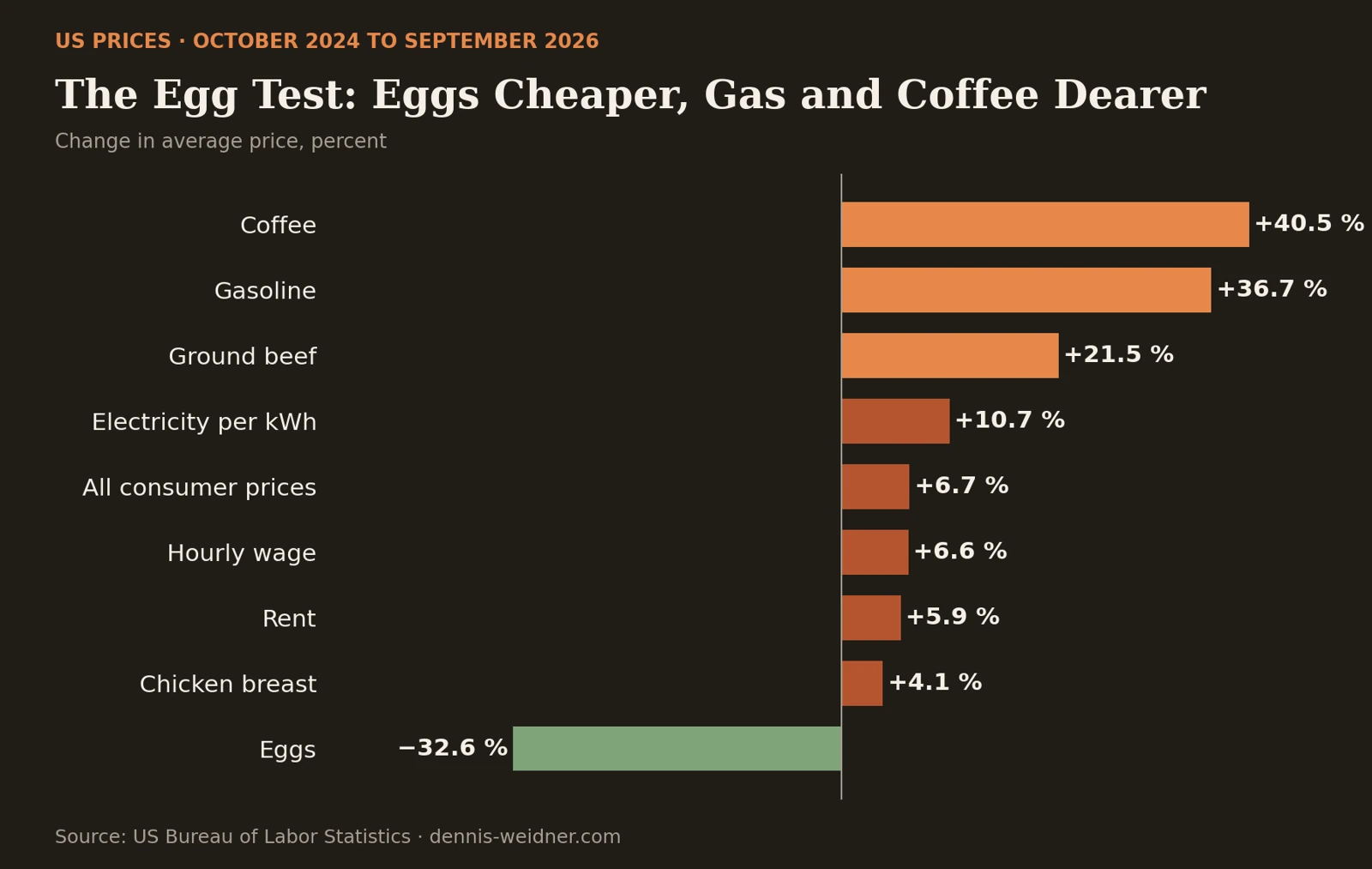
On average nobody lost, but nobody won either: hourly wages rose 6.6 percent, prices 6.7 percent. Still, in the exit poll for NBC News, 79 percent say inflation has caused them hardship, and 62 percent blame Trump's policies. An average is no comfort if you fill up every week.
Stocks Versus Wages: Who Really Gained From Two Trump Years
Since election day on 5 November 2024, the S&P 500 has gained about 31 percent and the Nasdaq Composite about 38 percent. Anyone able to invest has had two very good years. Anyone living from a paycheck with nothing to invest is roughly where they started.
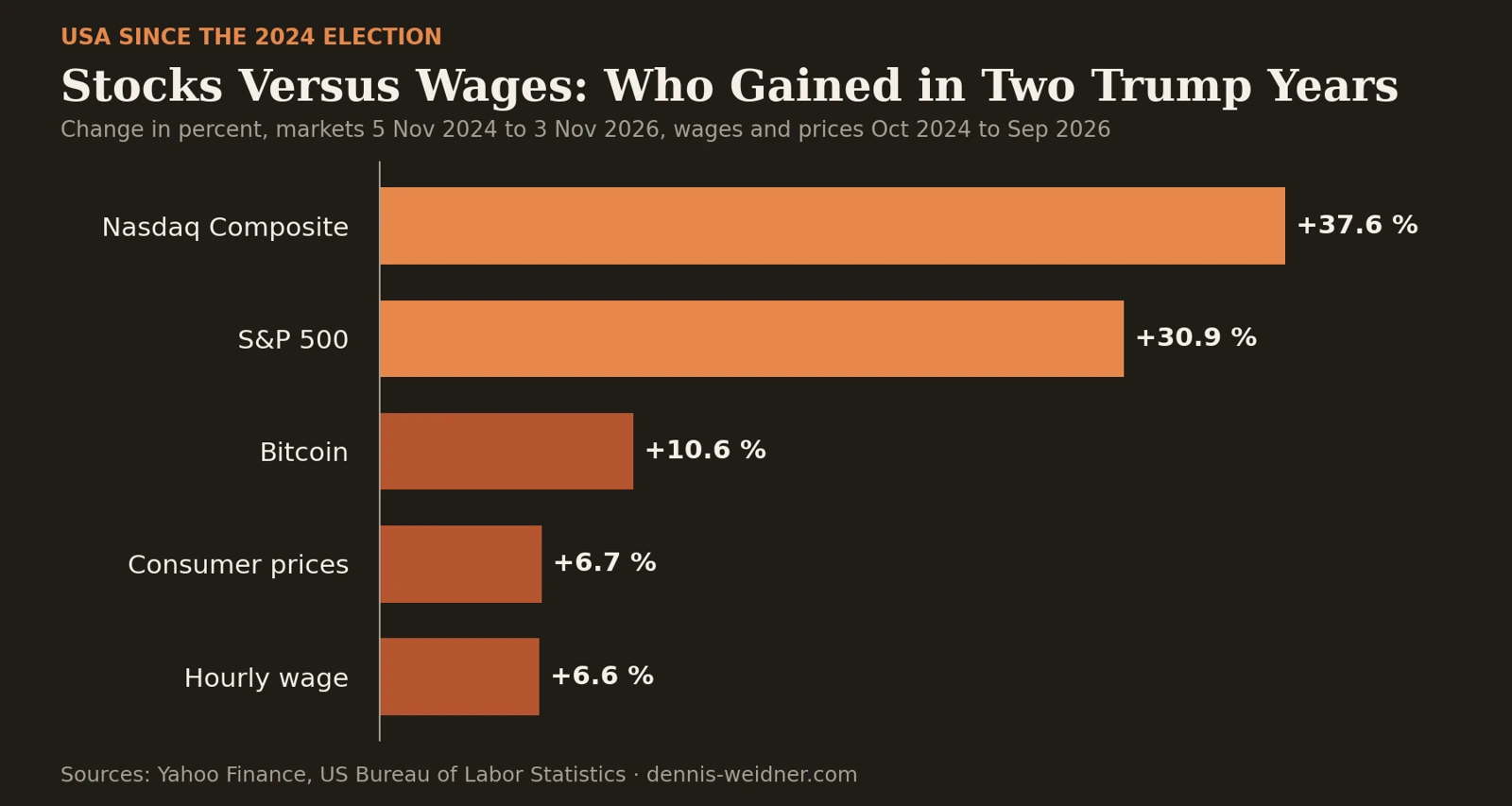
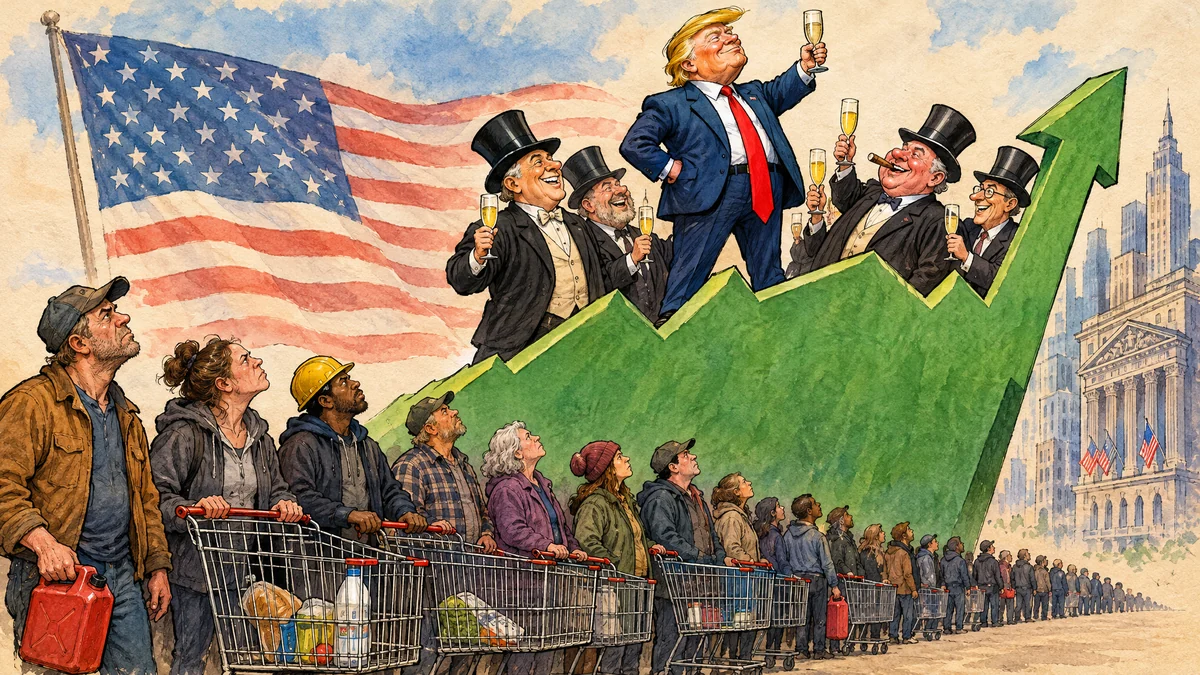
One number from Moody's shows how unevenly this is shared: the top ten percent of earners accounted for 49.2 percent of all consumer spending in the second quarter of 2025, up from about 46 percent in 2023 and about 43 percent in 2020, Yahoo Finance reports. Chief economist Mark Zandi warns that if these households pull back, they will take the whole economy with them. That is no accusation against anyone who invested. It does explain why records on Wall Street and bad moods at the checkout go together so well. In the exit poll, 69 percent say the economic system favors the wealthy.
US and German GDP: Why America Grows and Is Still Unhappy
To be fair: the US economy is running, and in Germany we can only dream of its pace. Quarterly figures are reported differently, so the table roughly annualizes Germany's.
| Real growth | United States | Germany |
|---|---|---|
| Q2 2026 | 2.2% annualized | 0.3% on the quarter, roughly 1.2% annualized |
| Q3 2026 | 3.4% annualized | 0.2% on the quarter, roughly 0.8% annualized |
| Source | Bureau of Economic Analysis | Destatis, flash estimate 30 Oct |
For all of 2025, Germany grew 0.2 percent according to Destatis. And yet only 25 percent of US voters now call the economy good, down from 68 percent in 2018, according to NBC News. For me this is the key lesson of the night: an economy can grow and the mood can still turn if the growth does not reach most people's wallets.
Latino and Black Voters: Where Majorities Are Shifting
The biggest move is among Latino voters. Trump won 46 percent of them in 2024, according to the exit poll at the time. Now they backed Democrats 62 to 35 percent in the preliminary poll. The comparison is imperfect, since 2024 elected a president and 2026 a Congress, but the Pew Research Center confirms the direction: Trump's approval among Latino voters fell from 38 percent in February 2025 to 24 percent, and even among those who voted for him in 2024 from 93 to 57 percent.
Black voters moved less, because there was little room to move: 89 to 9 percent for Democrats after 86 to 13 for Harris in 2024. The disappointment many talk about shows up mainly among the voters Trump had only just won in 2024.
Iran, Gasoline and the Question of a Distraction
In recent days I keep hearing the same theory: if Trump loses the midterms, a big strike on Iran follows, and the world talks about the bomb instead of the defeat. He had ruled out new strikes until the vote, CNN reported, according to CNBC, that the Pentagon is weighing the "mother of all bombs", and the New York Times reported joint US and Israeli plans for the time after the midterms. On election day itself, Trump told the Financial Times the US is ready, but there may be no reason for it. So a strike after the vote is realistic, but I know of no report linking it to the election result. The mood speaks against it too: 63 percent call the military action the wrong decision, and a bigger war would hit the gasoline price first. What that means for oil and gold, and why gold has not risen when oil jumped so far, is analysed with all the numbers at CryptoTicker.
What Changes for Crypto and Investors
For crypto, the main thing at stake is the CLARITY Act, which failed 49 to 50 in the Senate in September. TD Cowen's analysts do not expect it for two years under a Democratic Congress. What historical midterm patterns are worth on the markets is something I wrote about last week in my piece on the midterm pattern; my scepticism stands.
What I Take From This as an Entrepreneur
- An index is not a country. Reading America only through the S&P 500 shows half the picture. Anyone selling there, or building a plant like Audi, needs the other half too.
- Prices beat statistics. Voters do not think in averages, they think in tanks of gas. The same goes for any price increase in your own company.
- Growth needs a story for everyone. We in Germany should learn that before we even get back to 3 percent growth.
I would like to hear your view: what do you think has changed most in America? Feel free to write to me. More from this series is in Politics & Society.
Frequently Asked Questions
What are the US midterms?
The midterms are the elections halfway through a presidency. All 435 House seats and about a third of the Senate are up, 35 seats in 2026.
Are eggs cheaper in the US again?
Yes. A dozen cost $2.27 on average in September 2026, against $3.37 in October 2024. Gasoline, coffee and ground beef have become much more expensive.
Is US GDP growth higher than Germany's?
Yes. The US economy grew at an annualized 3.4 percent in the third quarter of 2026, Germany by 0.2 percent on the previous quarter, roughly 0.8 percent annualized.
Why are Latino voters disappointed with Trump?
The economy is the main issue. According to Pew, Trump's approval among Latino voters fell from 38 percent in February 2025 to 24 percent, and concern about gasoline prices is growing.
Will Trump attack Iran after the midterms?
No strike has been announced. Trump had only ruled out new strikes until the vote and said on election day that the US is ready, but there may be no reason for it. That a strike would serve to distract from a defeat is a theory with no evidence so far.
Warm regards,
Dennis Weidner
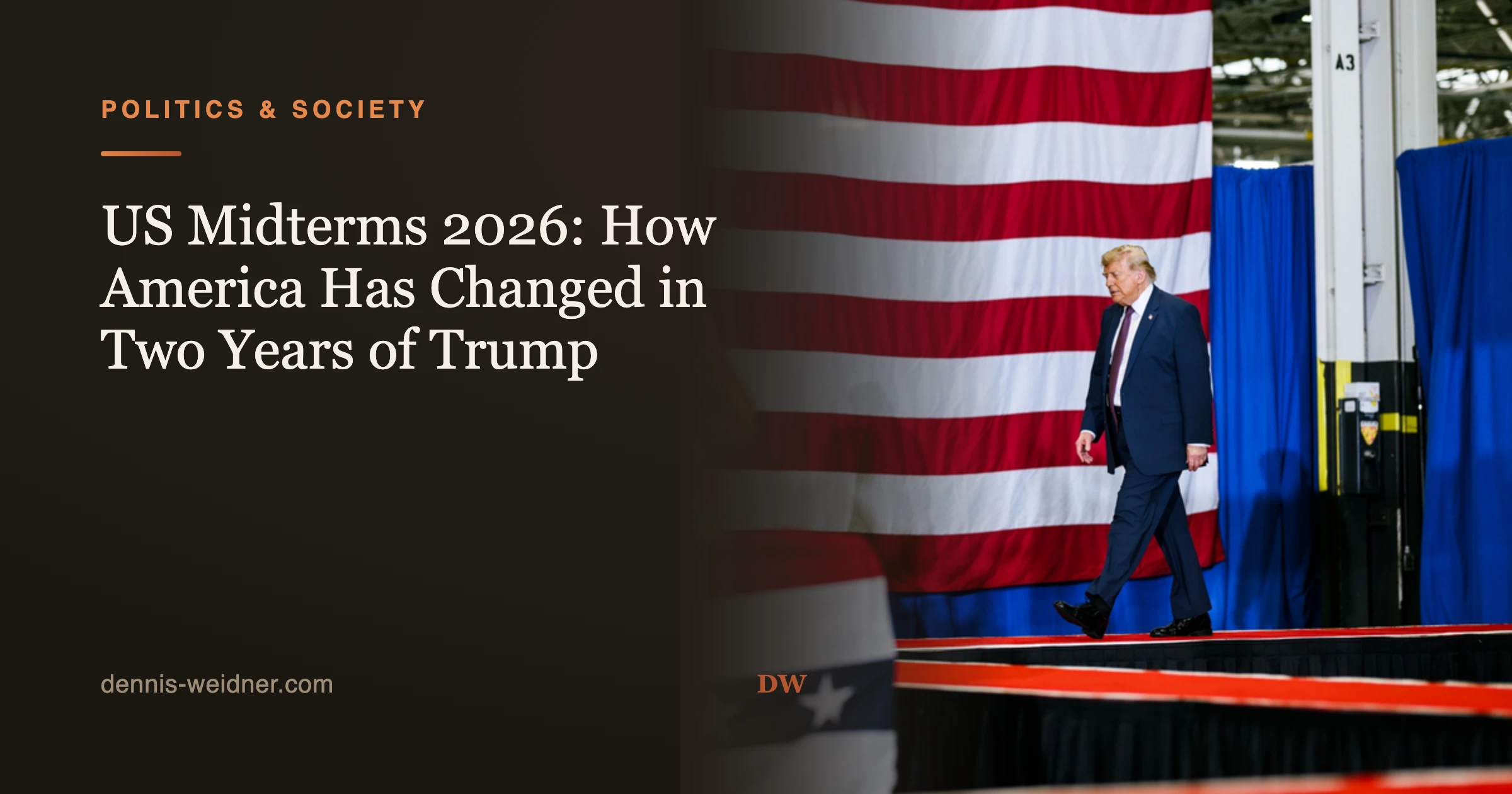
Cover photo: Donald Trump at Mack Trucks in Pennsylvania, 23 June 2026. Photo: The White House (public domain).
Note: AI tools supported me in writing this article, and some images were edited with AI. I stand behind its content and every statement with my name.