On 3 November 2026 the European Commission cleared the takeover of Ceconomy, the parent of MediaMarkt and Saturn, by the Chinese online group JD.com, subject to conditions. For ten years JD.com must deal with Ceconomy on market terms and offer warehousing, logistics and technology to other retailers on the same terms, overseen by an independent trustee. On completion JD.com will hold 59.8 percent, and 85.2 percent together with the founding Kellerhals family. To me this is more than a retail story. The case shows what China already owns in Germany, which state-owned groups stand behind it and where we still have a say. It also leads to a question for which I have found no public answer since a government press conference in September 2025: does Digital Minister Karsten Wildberger, CEO of Ceconomy until May 2025, still hold shares in his old company?
As of 5 November 2026. JD.com and Ceconomy have announced completion for the coming days, I will update this piece then.
More on this topic: Politics & Society, with background, practice and every article in one place.
MediaMarkt and JD.com: The Key Points
- 3 November 2026: The European Commission clears the deal in case FS.100253 with commitments that run for ten years. It points to preferential financing, tax incentives and grants from China.
- EUR 4.60 per share: The offer values Ceconomy at around EUR 2.2 billion. The group posted revenue of around EUR 23.1 billion in 2024/25, a preliminary EUR 24.0 billion in 2025/26, and employs around 50,000 people.
- EUR 1.59 million: According to six mandatory filings, Karsten Wildberger invested this amount in around 623,300 Ceconomy shares between 2021 and 2024. Whether he still holds them is not publicly known.
- EUR 7.03 million: This is the fair value at which Ceconomy carried his four open incentive tranches on 30 September 2025. It is an accounting figure, not a payout, and at least 70 percent of it depends on shareholder return.
- 264 companies, EUR 55 billion in revenue: These are the firms in Germany with Chinese owners, 3 percent of all foreign-owned companies. US owners account for EUR 333 billion.
- EUR 170.6 billion: This is what Germany imported from China in 2025. The bigger lever lies in the supply chain, less in ownership.
Who Owns MediaMarkt Now? The Owners of Ceconomy
MediaMarkt and Saturn belong to Ceconomy AG in Düsseldorf, and Ceconomy will be majority-owned by JD.com. Through Jingdong Holding Germany GmbH the group will hold 59.8 percent of the shares on completion. Convergenta Invest, the vehicle of the Kellerhals family that co-founded MediaMarkt, keeps 25.35 percent and is tied to JD.com by a shareholders' agreement. Together that makes 85.2 percent. The sellers included Haniel, Beisheim and Freenet, which together with Convergenta gave irrevocable undertakings for 31.7 percent.
| Date | Step |
|---|---|
| December 2023 | A JD.com stake is publicly debated, with Karsten Wildberger as Ceconomy CEO. |
| 5 May 2025 | Wildberger leaves the management board, on 6 May he becomes digital minister. |
| 30 July 2025 | JD.com announces its offer of EUR 4.60 per share. |
| 11 September 2025 | The management and supervisory boards recommend acceptance. |
| 18 September 2025 | The Federal Cartel Office clears the deal. |
| 27 March 2026 | Ceconomy reports that Austria doubts the deal can be approved. |
| 28 May 2026 | The Commission opens its in-depth subsidy review. |
| 29 June 2026 | The German economy ministry approves with conditions on data protection. |
| July and August 2026 | Brussels sends its formal statement of grounds, Beijing tells domestic bodies not to support the EU inquiry. |
| October 2026 | Austria approves with conditions on data, supply chains and personnel. |
| 3 November 2026 | The Commission clears the deal with commitments, all offer conditions are met. |
JD.com promises a lot: no domination agreement for three years, also three years without compulsory redundancies or site closures, and no material changes to the brand architecture. At the same time the group is aiming for a delisting. That removes exactly the transparency that mandatory filings, annual reports and a general meeting have provided so far. It is worth keeping in mind when we talk about control.
What the European Commission Requires of JD.com at MediaMarkt
The Commission did not block the takeover, it set a ten-year framework for it. Its finding: JD.com received preferential financing, tax incentives and grants from China that can distort the single market, for example through financing power, aggressive pricing and subsidised logistics. JD.com has denied that the deal was financed with state money. In the market test rivals reacted negatively, according to Reuters, and the commitments were strengthened afterwards.
That leaves three layers of protection from three capitals:
| Who | What applies | Who monitors |
|---|---|---|
| European Commission, 3 November 2026 | Intra-group dealings and financing on market terms. Logistics, warehousing and technology for third parties on the same terms as for Ceconomy. Term of ten years. | Independent trustee supervised by the Commission |
| German economy ministry, 29 June 2026 | Protection of personal customer data in Germany. The approval can be revoked in case of breaches. | Federal government with far-reaching control rights |
| Austrian economy ministry, October 2026 | Conditions on data, supply chains and security-relevant personnel decisions. | Ministry, details not public |
I think this is stronger than its reputation. In Vienna the first application was withdrawn in April and JD.com filed a new one in July, Brussels obtained improvements, Berlin reserves the right to revoke. One thing is missing for me, though: the wording of the German conditions is not public. The economy ministry does not comment on individual cases and cites trade secrets. So millions of customers will not learn what exactly has been agreed about their data.
August 2026 shows how seriously Beijing takes this. China's justice and commerce ministries told domestic bodies not to support the EU inquiry, and Beijing announced a resolute response. An online retailer buys an electronics chain and two ministries in Beijing step into the procedure. Anyone who still calls that purely business has not read the file. For more on Germany as a location, see my piece on the Invest in Germany Summit.
Does Karsten Wildberger Still Hold Ceconomy Shares?
That has not been answered publicly. It is documented that today's digital minister bought his own company's shares six times as Ceconomy CEO, and that his former employer attributes open incentive awards worth millions to him. What remains open is how much of this still exists today. There is no evidence of improper conduct, and I am not suggesting any. But the question is legitimate, and one sentence would settle it.
Six Mandatory Filings, EUR 1.59 Million
Board members of listed companies must report their own share transactions. Adding up Wildberger's filings, which I have not found done in this form anywhere else, gives this picture:
| Purchase date | Average price | Volume | Shares (calculated) |
|---|---|---|---|
| 15 Dec 2021 | EUR 3.5027 | EUR 301,229 | around 86,000 |
| 8 Sep 2023 | EUR 2.2270 | EUR 302,873 | around 136,000 |
| 4 Jan 2024 | EUR 2.3189 | EUR 151,423 | around 65,300 |
| 13 Feb 2024 | EUR 2.0886 | EUR 139,936 | around 67,000 |
| 15 Aug 2024 | EUR 2.5429 | EUR 343,298 | around 135,000 |
| 19 Dec 2024 | EUR 2.6491 | EUR 354,981 | around 134,000 |
| Total | EUR 2.56 on average | EUR 1,593,741 | around 623,300 |
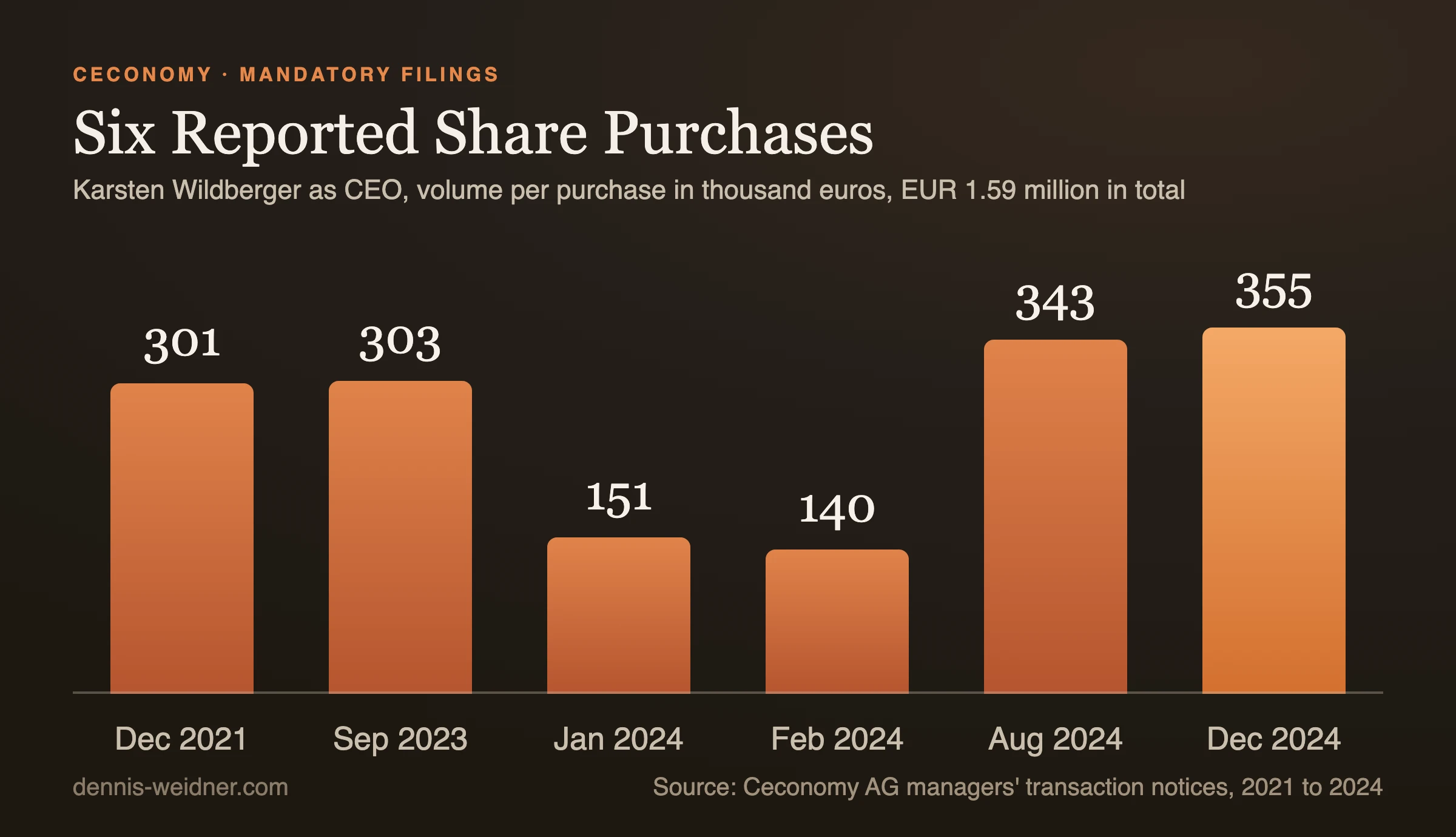
At first glance this looks like a big bet, but the context is more sober. Through a share ownership programme Ceconomy expects board members to buy shares within four years, the chairman for 150 percent of base salary. With a base salary of EUR 1.45 million that comes to just under EUR 2.2 million, of which the reported purchases reach 73 percent, and the build-up phase would have run until July 2025. So the purchases fit this requirement, because according to the report the long-term award is only paid if the holding has been proven. The obligation ends with the board mandate.
That is exactly where the uncertainty starts. Had Wildberger kept all reported shares and tendered them at EUR 4.60, they would be worth around EUR 2.87 million, around EUR 1.27 million more than he paid. Whether that happened, only he knows: I found no sale notice up to his departure, and after it there is no longer a reporting duty. The filings contain no reference to holdings by relatives, and I see no reason to speculate about that.
EUR 7.03 Million in Open Incentive Awards
Less well known than the shares are the long-term awards, the long-term incentive. The 2024/25 remuneration report lists the following IFRS fair values for Wildberger, an accounting estimate:
| Tranche | Fair value 30 Sep 2024 | Fair value 30 Sep 2025 |
|---|---|---|
| 2021/22 | EUR 675,000 | EUR 1,299,000 |
| 2022/23 | EUR 1,854,000 | EUR 2,144,000 |
| 2023/24 | EUR 1,724,000 | EUR 2,255,000 |
| 2024/25 (pro rata) | not yet granted | EUR 1,332,000 |
| Total | EUR 4,253,000 | EUR 7,030,000 |
The 2024 total leaves out the 2020/21 tranche, which has since been paid out; with it the report shows EUR 4,299,000. Three things matter here. First: at least 70 percent of this award depends on absolute and relative shareholder return, and for the 2021/22 tranche as much as 80 percent. Ceconomy itself writes that the takeover offer has had a considerable influence on the share price. The three tranches already running rose by around 34 percent within a year, although time and business performance also play a part.
Second: under the remuneration system, unpaid claims on early contract termination are paid pro rata at their original due date, and the performance period is four years. The 2020/21 tranche was paid out in fiscal 2024/25. On this pattern the 2021/22 tranche would have fallen due in fiscal 2025/26, and the last one follows in 2028/29. The 2024/25 annual bonus of EUR 533,000 was, according to the report, scheduled for January 2026, when Wildberger had long been a minister. There is also, as is usual for board members, a pension commitment with a present value of EUR 904,000.
Third: for the later tranches this would mean a sitting minister receiving payments from a company controlled by JD.com, unless the claims have long since been settled differently. In May 2025 the supervisory board resolved on a termination agreement, whose content is not public. The 2024/25 remuneration table shows no severance payment.
What the Federal Government Says
The topic is not new. At the government press conference of 5 September 2025 a journalist asked directly whether Wildberger still holds stakes or shares and whether he would take part in a possible cabinet decision on a prohibition. The spokesperson for his ministry pointed out that the investment review lies with the economy ministry and said the minister takes part in cabinet as usual and meets all legal requirements, in particular the Federal Ministers Act. That left the share question unanswered. Asked whether the chancellor saw a conflict of interest, the deputy government spokesperson called it a theoretical case. In a Tagesspiegel interview in August 2025, shortly after the JD.com offer, Wildberger said with regard to his old company that he was fully focused on his office. A parliamentary question from Julian Joswig (Greens) on conflicts of interest concerned, according to taz, the entry in the lobby register, not shares.
In fairness: the economy ministry was responsible, and the case would only have gone to cabinet in the event of a prohibition. That did not happen. There is no evidence that Wildberger took part in the procedure.
The Federal Ministry for Digital Transformation and Government Modernisation and Ceconomy had not answered my questions of 4 November by the deadline at noon on 5 November.
Why the Federal Ministers Act Does Not Help Here
The law bars ministers from holding another salaried office, running a business, practising a profession and sitting on management or supervisory boards. But Section 5 of the Federal Ministers Act contains no duty to sell or disclose shares, only gifts must be reported. "Meets all legal requirements" is therefore true and still says little. Back in April 2025 LobbyControl suggested selling any stakes voluntarily.
Brussels is further ahead: EU commissioners must disclose holdings above EUR 10,000, along with interests of spouses and minor children where they could create a conflict. That standard is missing in Berlin. I value people from business going into politics, as I have written here. That is exactly why there should be a clear rule that protects them.
Which German Companies China Owns: The List with State-Owned Groups
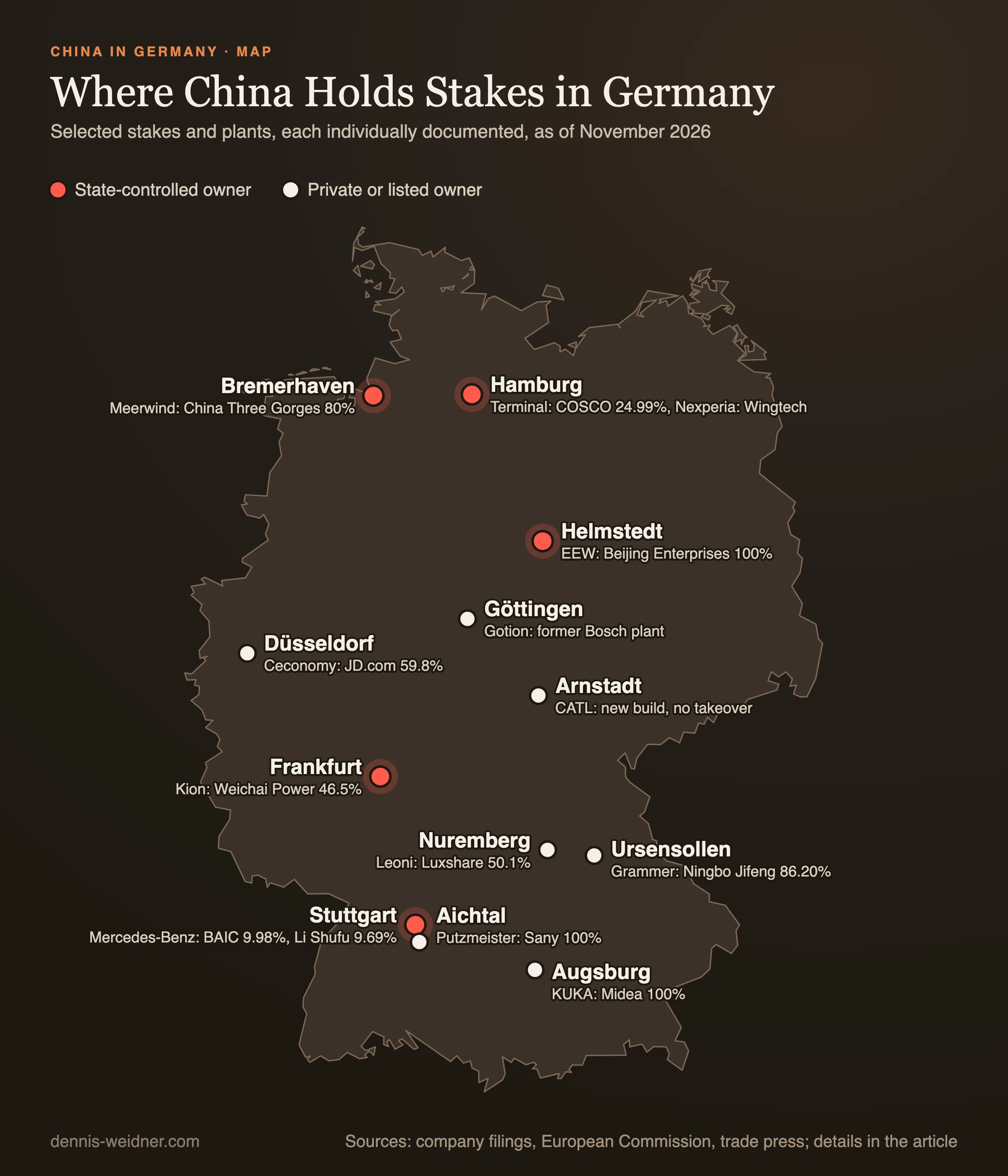
The short answer: Chinese owners sit mainly in mechanical engineering and automotive supply, the state-controlled ones also in waste incineration, offshore wind and the port. The DDW information network counts 264 such companies, 77 percent of them in industry. No complete public list exists, the data is sold commercially. These examples can each be documented:
| Company, seat | Chinese owner | Stake | State-controlled? |
|---|---|---|---|
| KUKA, Augsburg (robots) | Midea | 100% | no |
| EEW Energy from Waste, Helmstedt | Beijing Enterprises | 100% | yes, City of Beijing |
| Putzmeister, Aichtal (concrete pumps) | Sany | 100% | no |
| Grammer, Ursensollen (vehicle seats) | Ningbo Jifeng | 86.20% | no |
| Meerwind Süd|Ost, North Sea (288 MW) | China Three Gorges | 80% (purchase 2016) | yes, central state |
| Ceconomy, Düsseldorf (MediaMarkt, Saturn) | JD.com | 59.8% on completion | no, but subsidised according to the EU |
| Leoni, Nuremberg (cables) | Luxshare | 50.1% | no |
| Kion, Frankfurt (Linde forklifts) | Weichai Power | 46.5% | yes, Shandong province |
| Tollerort terminal, Hamburg | COSCO Shipping Ports | 24.99% | yes, central state |
| Mercedes-Benz, Stuttgart | BAIC | 9.98% | yes, City of Beijing |
| Mercedes-Benz, Stuttgart | Li Shufu (Geely) | 9.69% | no |
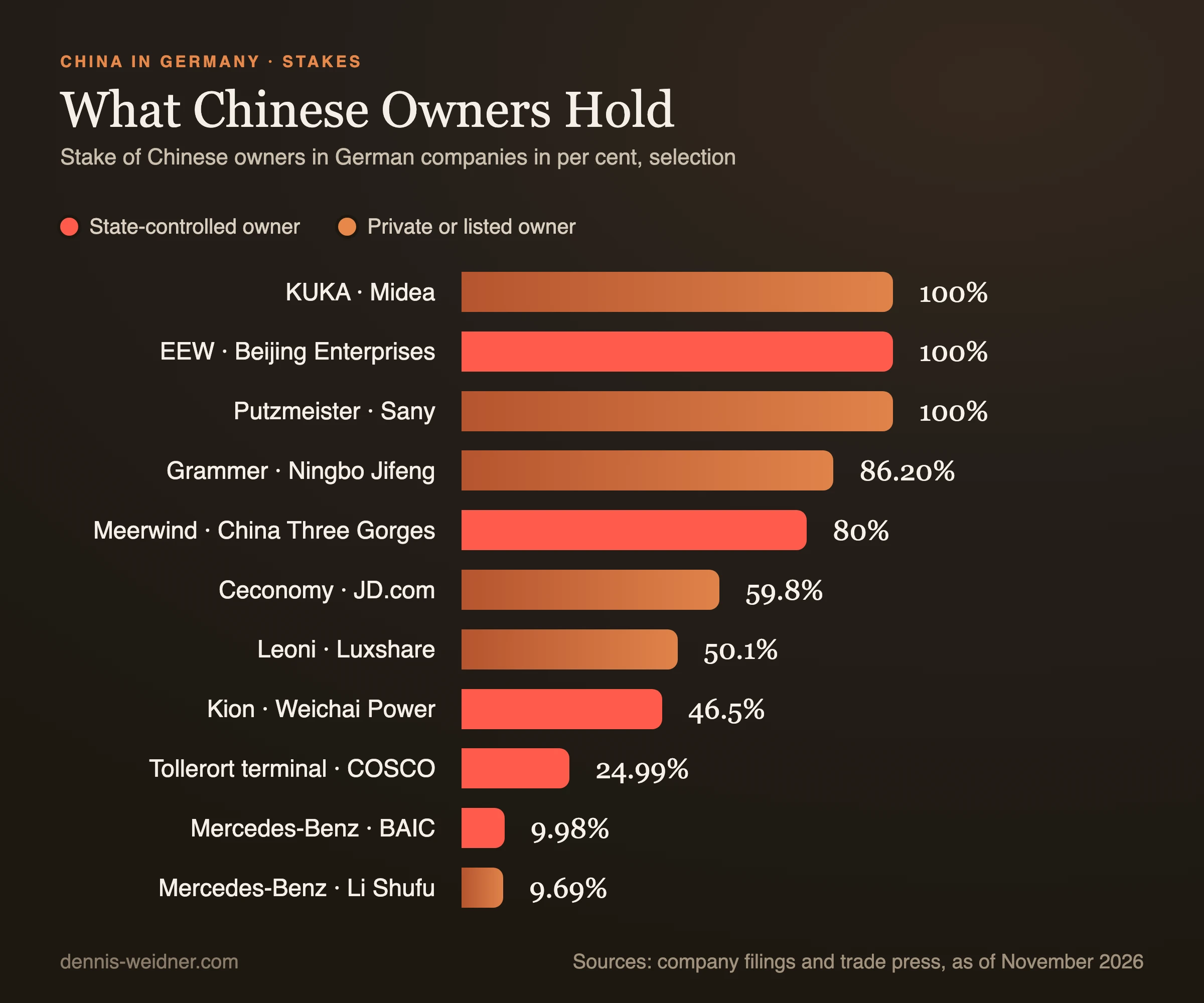
The DDW ranking also lists firms such as Preh (Joyson), SEG Automotive (Zhengzhou Coal Mining Machinery), Medion (Lenovo) and Baosteel Europe. The table shows something that often gets lost in the debate: not every Chinese buyer is a state-owned group. KUKA, Grammer and Leoni went to private companies, JD.com is listed. Admittedly that says little about how much distance a Chinese company can keep from the state when it matters, as August 2026 showed.
Hamburg Port, Waste, Wind: China in German Infrastructure
The best-known case is the port of Hamburg. COSCO wanted 35 percent of the Tollerort terminal, and after a partial prohibition the federal government allowed just under 25 percent, with control remaining at HHLA. The example shows that the state can apply the brakes when it wants to.
EEW is less well known. The Helmstedt waste incinerator has belonged to state-owned Beijing Enterprises since 2016, for around EUR 1.44 billion. EEW operates 17 plants in Germany and neighbouring countries and also treats sewage sludge: the plant in Stavenhagen has been in regular operation since March 2025 and can process up to 160,000 tonnes a year, according to the company enough for all of Mecklenburg-Western Pomerania. In the North Sea, China Three Gorges took the majority in the Meerwind wind farm in 2016.
Does China Own German Sewers and Car Parks?
You read and hear this often. It cannot be documented. The public sewer network is around 600,000 kilometres long, and under Section 56 of the Federal Water Act wastewater disposal is a task for legal persons under public law. I have found no Chinese owner of a German sewer network. The closest link is EEW's sewage sludge business, and that is treatment, not the network. Large car park operators also have other owners: Apcoa went to a US investor, Contipark belongs to Belgium's Interparking. It is worth keeping this clean, because anyone who claims the wrong things makes the real cases less credible.
CATL, Gotion and Nexperia: China in Batteries and Chips
Batteries work differently from what many assume: CATL was not taken over, and CATL took nothing over either. The world's largest battery maker built from scratch in Arnstadt near Erfurt, with around EUR 1.8 billion planned, cell production since the end of 2022 and most recently around 1,700 employees. Gotion, by contrast, bought a Bosch plant in Göttingen and has built battery packs there since September 2023. The stake also runs the other way: Volkswagen holds 18.98 percent of Gotion after a transfer in September 2026.
For policy the difference is decisive. A new build does not fall under investment screening, and it stays that way under the ministerial draft of 22 October 2026. And new builds are the trend: according to Rhodium and Merics, EUR 8.9 billion went into Chinese greenfield projects in Europe in 2025, a record, and EUR 7.9 billion into takeovers.
Nexperia shows how sensitive all this is. The Hamburg plant supplied wafers, further processing took place in Dongguan in China, and the owner is Wingtech. When the Netherlands intervened in autumn 2025 and a court suspended the Wingtech founder as CEO, this chain broke and the car industry worldwide grew nervous over simple components. The dispute continues, with Wingtech suing for damages running into the billions.
How Large China's Influence in Germany Is in Figures
Measured by ownership, China is small in Germany. The stock of Chinese direct investment including Hong Kong stood at around EUR 11 billion in 2023, the American one at EUR 164 billion. Counting by ultimate parent, the Bundesbank arrives at around EUR 9 billion from China, against around EUR 179 billion from the US. In the other direction German firms hold far more in China: with an outward stock of EUR 1,689 billion and a China share of 6.5 percent, that works out at roughly EUR 110 billion.
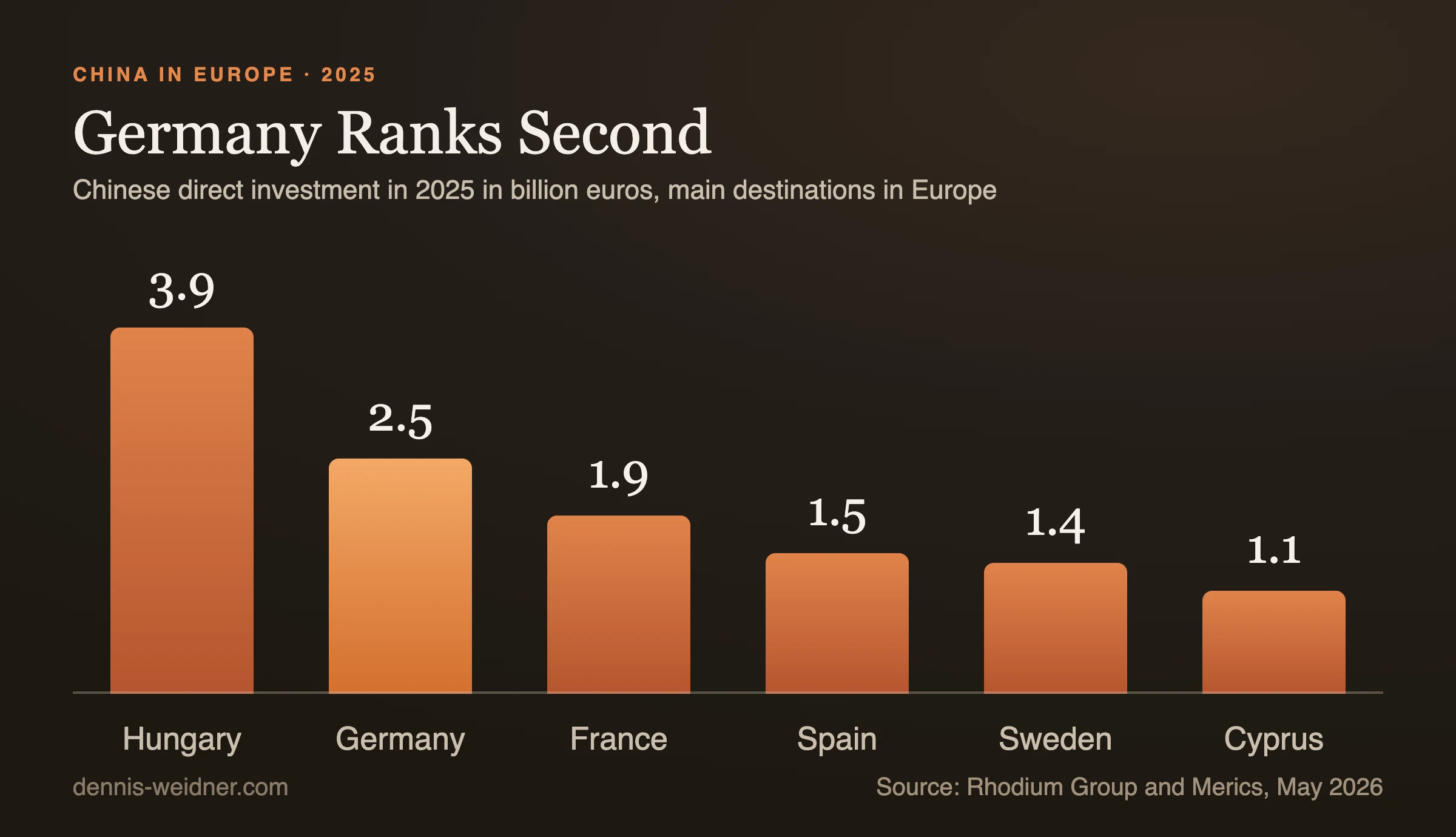
The direction is clear, though. In 2025 Chinese investment in the EU and the UK rose 67 percent to EUR 16.8 billion, the highest level since 2018. Germany accounted for EUR 2.5 billion. For takeovers by Chinese buyers, Germany Trade & Invest cites EY figures of around USD 5 billion in Germany for 2025, up 195 percent, of which USD 2.5 billion for Ceconomy.
Foreign trade shows where the real power lies. With EUR 251.8 billion China was again Germany's most important trading partner in 2025, we bought EUR 170.6 billion from there and sold EUR 81.3 billion. According to the January 2024 monthly report, almost every second industrial firm in a Bundesbank survey sources critical inputs directly or indirectly from China, and more than 80 percent of them consider replacing them difficult at the very least. For rare earths China's share of German imports in 2025 was 55.4 percent according to the Federal Statistical Office. In the EU as much as 97.3 percent of imported lanthanum compounds came from China in 2025.
Does Germany Still Have a Say Towards China at All?
Yes, but in a different place from what the headlines suggest. Anyone claiming that China is buying up Germany is wrong by the numbers. Anyone saying it is all harmless is just as wrong. Chinese owners do not sit across the board, they sit at very precise points: robots, warehouse technology, automotive supply, waste, the port, chips, and now the customer data of Europe's largest electronics retailer.
We can have a say on ownership, as Hamburg, Vienna and Brussels show. We have little say on three things: who sells, because Haniel, Beisheim and Freenet sold voluntarily, with the offer 43 percent above the three-month average. Who builds new plants, because new builds are not screened. And who supplies, because inputs cannot be replaced by decree. The independence we like to talk about is therefore decided in the supply chain, and that is where we are moving slowest.
There is something concrete in this for entrepreneurs too. Anyone selling online should look at the EU commitment: JD.com must offer logistics and technology to third parties on the same terms as Ceconomy, which can be an opportunity for German e-commerce. And mid-sized owners thinking about succession should know that many of these sales hinged on exactly that. Anyone looking for a European partner for it will find someone to talk to at Weidner Ventures.
What Germany Should Do After the MediaMarkt Case
- Ministers disclose their holdings. The EU standard of EUR 10,000 should also apply in the federal cabinet, with a rule for old contracts and awards from former board positions.
- Conditions are summarised publicly. Where customer data is affected, a readable version is needed, and the trustee reports each year on what it has checked.
- The government keeps a public list of all state-controlled foreign owners in critical sectors. It is hard to explain why this has to be bought today.
- New builds in key technologies become notifiable. The draft investment screening act leaves this out, the deadline for comments runs until 12 November 2026. The EU minimum standards only apply from 17 January 2028.
- On inputs, speed is what counts. Second suppliers, own recycling volumes and rare earth stocks achieve more than any debate about an electronics chain.
How business and politics meet in Germany will stay with me, more on this in Politics and Society and on the lobby register.
Frequently Asked Questions on MediaMarkt, JD.com and China in Germany
Is MediaMarkt Chinese now?
Yes, by majority, once the takeover is completed. Beijing-based JD.com will then hold 59.8 percent of the parent company Ceconomy, and the German Kellerhals family keeps 25.35 percent. According to JD.com's commitments the brand presence of MediaMarkt and Saturn should not change materially, and operational management stays with the management board.
What changes for MediaMarkt and Saturn customers?
Little in the short term. Ceconomy promises more choice and shorter delivery times. The federal government has tied the takeover to the protection of personal customer data in Germany and can revoke its approval in case of breaches. The exact wording of the conditions is not public.
Does Digital Minister Wildberger still hold Ceconomy shares?
That is not publicly known. According to mandatory filings he bought shares worth around EUR 1.59 million as CEO between 2021 and 2024, which fits the group's share ownership programme. Since his departure in May 2025 there has been no reporting duty. His ministry did not answer the question directly at the government press conference of 5 September 2025.
Which German companies belong to Chinese state-owned groups?
The best known include EEW (Beijing Enterprises, 100 percent), the Meerwind wind farm (China Three Gorges, 80 percent), Kion (Weichai Power, 46.5 percent) and part of Hamburg's Tollerort terminal (COSCO, 24.99 percent). BAIC holds 9.98 percent of Mercedes-Benz.
Was CATL taken over in Germany?
No. CATL is a Chinese group and built its own new plant in Arnstadt in Thuringia, its first cell plant outside China. Gotion, by contrast, bought a former Bosch plant in Göttingen.
How much of Germany belongs to China?
Measured by direct investment, little: around EUR 11 billion including Hong Kong in 2023, against EUR 164 billion from the US. That covers 264 companies with around EUR 55 billion in revenue. Dependence in trade is greater, Germany imported goods worth EUR 170.6 billion from China in 2025.
Best,
Dennis Weidner
Note: AI tools supported me in writing this article, and some images were edited with AI. I stand behind its content and every statement with my name.