Four umbrella organisations speak for business in Berlin: the employers’ confederation BDA, the industry federation BDI, the German Chamber of Commerce and Industry DIHK and the Central Association of German Skilled Trades ZDH. Alongside them, separate associations represent family firms, small and medium-sized businesses, start-ups, the liberal professions and the self-employed. The Bundestag’s lobbying register shows what they invest in it: the BDI reports up to €9.56 million and 38.75 full-time equivalents for lobbying in 2025, the association of founders and self-employed people VGSD up to €0.18 million and 1.26 full-time equivalents. The BDA and the DIHK are not in the register at all, because the law exempts them. My analysis of 7,005 register entries points to one finding above all: Germany’s 1.41 million solo self-employed have the smallest voice, even though their pension provision is about to be reorganised.
Figures as of: Lobbying Register on 14 October 2026, financial year 2025.
More on this topic: AI in the Founder's Working Day – background, practice and every article in one place.
German Employers’ Day: What the BDA Is For and Who Its Members Are
The BDA represents the common social policy interests of employers in Germany, as section 1 of its articles of association states. This covers collective bargaining, labour law, pensions and social insurance. Its members are not companies but associations, namely 14 regional employers’ bodies and 46 national sector federations. According to the BDA, around one million companies with some 30.5 million employees are linked to it through them.
How much weight that carries became visible at the German Employers’ Day on 13 October 2026 in Berlin. BDA President Rainer Dulger called on the federal government to cut red tape and lower the burden on business, while Chancellor Friedrich Merz, one day after the resignation of Labour Minister Bärbel Bas, pressed for the pension reform, whose implementation lies with the labour ministry, saying it was already taking too long for him, as ZDFheute reported from the event. Anyone watching that stage will reasonably ask who actually stands behind such an association, and who does not. That question is the starting point for this piece in my series Entrepreneurs and Politics; I assessed the political situation of that week in Germany’s Political Centre and the AfD Firewall.
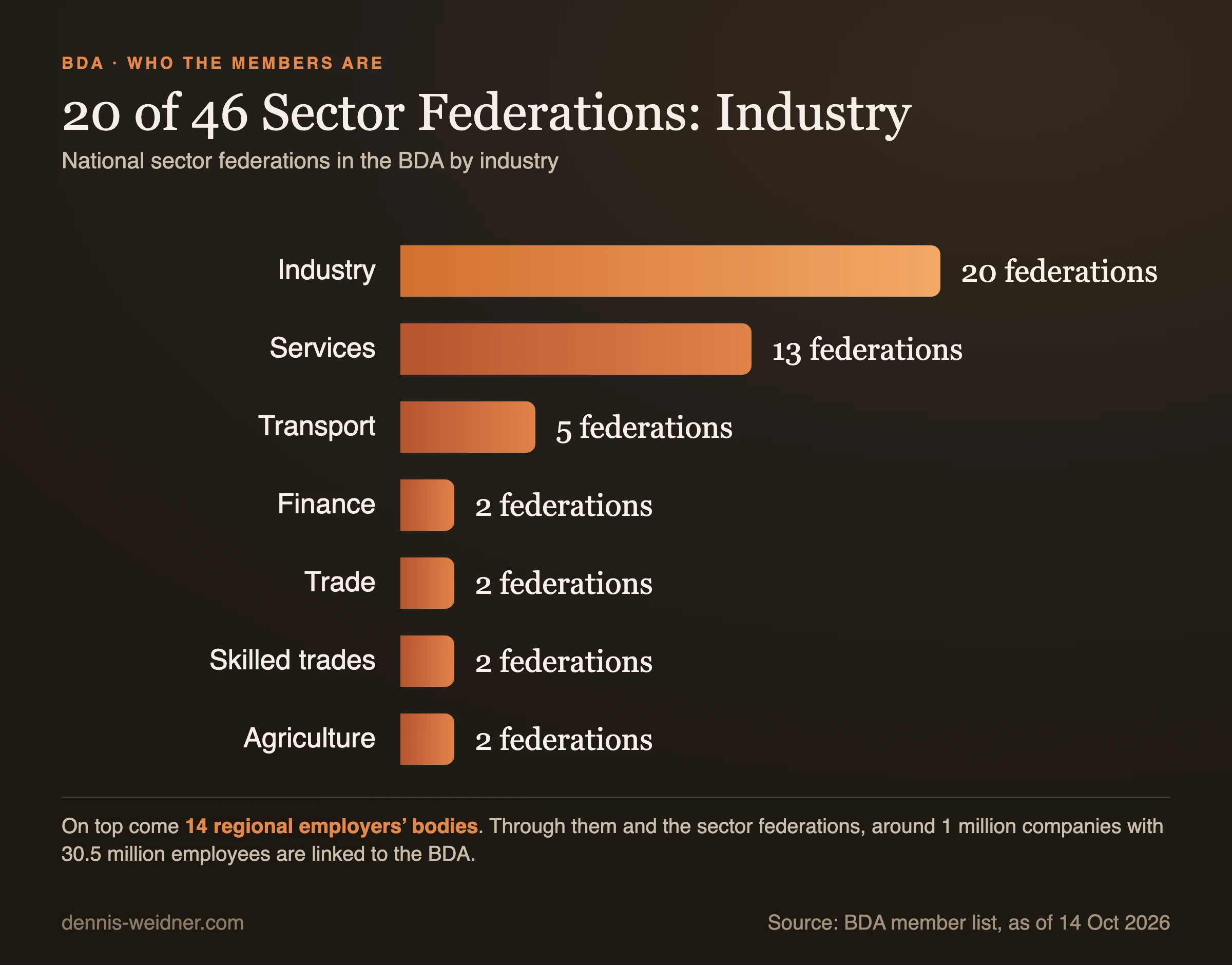
Membership of the BDA is voluntary (section 4 of its articles), and members cover its costs through their fees (section 9). The BDA member list shows how the 46 sector federations break down: 20 come from industry, including the metal and electrical employers Gesamtmetall, the chemical employers’ federation and the main association of the construction industry. 13 come from services, from care and security services to hospitality, five from transport and two each from finance, retail and wholesale, skilled trades and agriculture.
This also makes clear who the BDA does not represent. Anyone who works alone and employs nobody is not an employer and, as a rule, has no seat in an employers’ association. That is not a shortcoming of the BDA, it is its mandate. It does mean, however, that one group is missing from the big social policy talks: people who are neither employers nor employees.
German Lobbying Register: Why the BDA and the DIHK Are Not Listed
Since 2022, anyone who regularly approaches the Bundestag and the federal government to represent interests has to register in the Bundestag’s Lobbying Register. Registrants disclose who funds them, how much they spend on lobbying and how many people they employ for it. This does not apply to the BDA: section 2(2) no. 7 of the Lobbying Register Act exempts employers’ associations and trade unions insofar as they influence working and economic conditions. Number 6 exempts legal persons under public law performing public tasks, which includes the DIHK as a public-law corporation.
On 14 October 2026, the register contained no entry for the BDA or the DIHK. The German Trade Union Confederation DGB, the services union ver.di and the metal employers’ association Gesamtmetall are not listed either. The exemption is legally sound: the Act expressly ties it to freedom of association under Article 9(3) of the Basic Law, the basis of collective bargaining autonomy. Gesamtmetall appears in the register only indirectly, as a client in the entry of the Initiative Neue Soziale Marktwirtschaft, which reports spending of up to €1.43 million.
For transparency, however, a gap remains. The social partners no longer negotiate only collective agreements; they have a say in pensions, health insurance and the labour market, in other words in legislation. The law allows anyone who is exempt to register voluntarily (section 2(5)). The register itself shows that employers’ associations can disclose their figures too: nine of the BDA’s 14 regional bodies are listed, among them the Bavarian Business Association vbw and the North Rhine-Westphalian employers’ federation. In the skilled trades, the Central Association of German Skilled Trades and the German Association of Chambers of Skilled Trades, the joint body of the 53 chambers of skilled trades, are both in the register.
Lobbying Register Analysed: What Business Associations Spend on Lobbying
On 14 October 2026, the Lobbying Register held exactly 7,005 entries. Together they report between €0.88 billion and €0.93 billion a year for lobbying, mostly for financial year 2025, and around 8,500 full-time equivalents. The 749 entries in the category of business and trade associations account for €228 million to €235 million of that. With up to €9.56 million, the BDI ranks fifth among all entries; only the insurance association GDV, the Federation of German Consumer Organisations, the automotive association VDA and the energy association BDEW report more.
The table shows the associations that speak across sectors for business owners and the self-employed, with the figures from their register entries. The register asks for amounts in bands of €10,000.
| Association | Who it represents | Members (reference date) | Lobbying spend 2025 | Full-time equivalents | Membership fees 2025 |
|---|---|---|---|---|---|
| BDI | industry, economic policy | 32 member organisations (1/2026) | €9.55m to €9.56m | 38.75 | €25.14m to €25.15m |
| Die Familienunternehmer | family firms with 10+ employees | 6,400 owners (6/2026) | €2.05m to €2.06m | 10.00 | €8.39m to €8.40m |
| ZDH | skilled trades | 114 organisations (6/2026) | €1.59m to €1.60m | 15.60 | €6.10m to €6.11m |
| Der Mittelstand. BVMW | small and medium-sized firms | 28,090 (6/2024) | €1.32m to €1.33m | 12.00 | €20.61m to €20.62m |
| BFB | liberal professions | 59 chambers and associations (6/2024) | €0.67m to €0.68m | 7.13 | €0.67m to €0.68m |
| Startup Association | start-ups | 1,034 (7/2024) | €0.17m to €0.18m | 1.14 | €1.13m to €1.14m |
| VGSD | founders, solo self-employed, micro firms | 5,369 (4/2026) | €0.17m to €0.18m | 1.26 | €0.85m to €0.86m |
| BAGSV | umbrella of self-employed associations | 31 associations (7/2026) | €0.06m to €0.07m | 0.40 | €0.05m to €0.06m |
| BDA | employers, social and collective bargaining policy | 14 regional bodies, 46 sector federations | not registered, exempt under s. 2(2) no. 7 Lobbying Register Act | not stated | not stated |
| DIHK | trading businesses, compulsory membership | 79 chambers with more than 3m businesses | not registered, exempt under s. 2(2) no. 6 Lobbying Register Act | not stated | not stated |
Source: German Bundestag Lobbying Register, as of 14 October 2026; BDA and DIHK based on their own figures. Member numbers refer to the date each association states in the register.
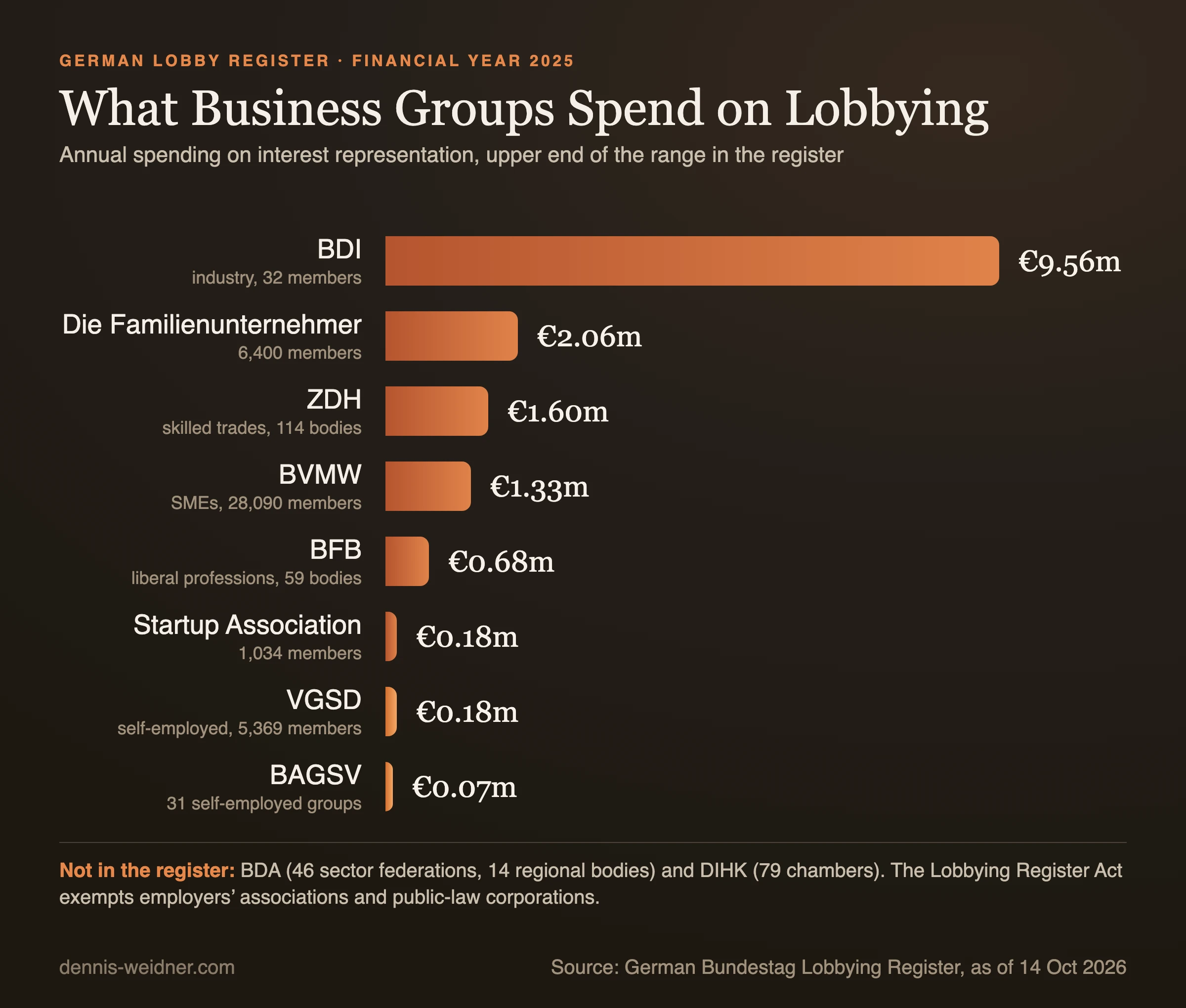
The figures measure the same thing: the spending each association itself reports for representing its interests to the Bundestag and the federal government. Each association draws the line a little differently between lobbying and member services, events or press work. The order of magnitude is nonetheless clear. The BDI uses 38.75 full-time equivalents for lobbying and has named 132 people for it. The law counts every employee on an estimated, pro rata basis who spends at least ten percent of their work on lobbying (section 3 of the Lobbying Register Act). VGSD and BAGSV, which together speak for founders and the solo self-employed, reach 1.66 full-time equivalents and at most €0.25 million. More than 1,000 entries in the register spend more than the VGSD.
BDI, Family Firms, BVMW: What German Business Associations Do and How They Are Funded
All three are funded mainly through membership fees, according to their register entries. They differ in whom they admit and how broadly they speak.
The BDI brings together the sector associations of industry and represents their economic policy concerns, from energy and trade to tax. By its own account there are 38 sector associations, including a working group of six associations that share one membership; the register lists 32 members. Its membership fees came to just over €25 million in 2025. Collective bargaining and social insurance are the BDA’s domain.
Die Familienunternehmer admits owners of family businesses with at least ten employees and €1 million in turnover that are entered in the commercial register or the register of skilled trades. Entrepreneurs under 40 find their place with Die Jungen Unternehmer. By its own account, the association represents the interests of more than 180,000 family businesses, and according to the register it has 6,400 members. With up to €2.06 million, it is among the 60 entries with the highest spending.
Der Mittelstand. BVMW is open to small and medium-sized businesses and, with 28,090 members, is the largest of the associations analysed here. In addition to membership fees of just over €20 million, it reports federal project funding totalling up to €1.49 million in 2025, among other things for SME digital centres and a cybersecurity transfer office for small businesses. The Central Association of German Skilled Trades also reports federal funds, up to €1.49 million to promote the skilled trades and up to €70,000 for international cooperation in vocational training. The register lists such funding so that everyone can see where an association’s money comes from.
German Startup Association: Who Its Members Are and What It Speaks For
The Bundesverband Deutsche Startups sees itself as the voice of start-ups towards legislators, the administration and the public. It reports 1,034 members, of which 1,015 are companies and organisations and 19 are individuals, counted in July 2024. For lobbying it uses 1.14 full-time equivalents and up to €0.18 million, funded mainly through membership fees of just over €1.1 million and its own business activities. From the federal budget it received up to €90,000 in 2025 for the German Startup Monitor, the annual survey of the founder scene (Startup Association register entry).
Start-ups are growth-oriented companies with a team and often with venture capital. Their topics are financing, employee equity and scaling, and the association represents them with great impact in public debate. The topics of a translator who works alone, or of an IT consultant without staff, are different: status determination, health insurance contributions, retirement provision.
Chambers of Commerce and Skilled Trades: Compulsory Membership for More Than Three Million Businesses
Anyone assessed for trade tax is a compulsory member of their local chamber of commerce and industry (IHK), as section 2 of the IHK Act provides. Skilled trade businesses belong to the chamber of skilled trades (section 90 of the Crafts Code). As the umbrella organisation of the 79 chambers, the DIHK represents more than three million businesses. My own companies, as GmbHs, are compulsory members of their IHK as well.
Sole traders who are not entered in the commercial register and earn a trade income of no more than €5,200 pay no fee but remain members (section 3(3) of the IHK Act). Freelancers in the liberal professions only belong to the IHK if they are entered in the commercial register. Doctors, lawyers and tax advisers have their own professional chambers.
The Federal Constitutional Court upheld compulsory membership in its decision of 12 July 2017. The DIHK itself is a public-law corporation; it is funded by the chambers, and the Federal Court of Audit examines its budget management (section 10b of the IHK Act). Its mandate is the overall interest of trading businesses, and the law expressly requires appropriate protection of minorities. Collective bargaining is not part of it; that remains reserved for employers’ associations and trade unions (section 1(5)).
For solo self-employed people with a trade outside the skilled crafts, the IHK is therefore the only representation they have automatically; in the skilled crafts it is the chamber of skilled trades. Anyone who wants a say there can stand for election to their chamber’s general assembly, which decides on the chamber’s positions.
Solo Self-Employed and Freelancers: Who Represents 1.4 Million People
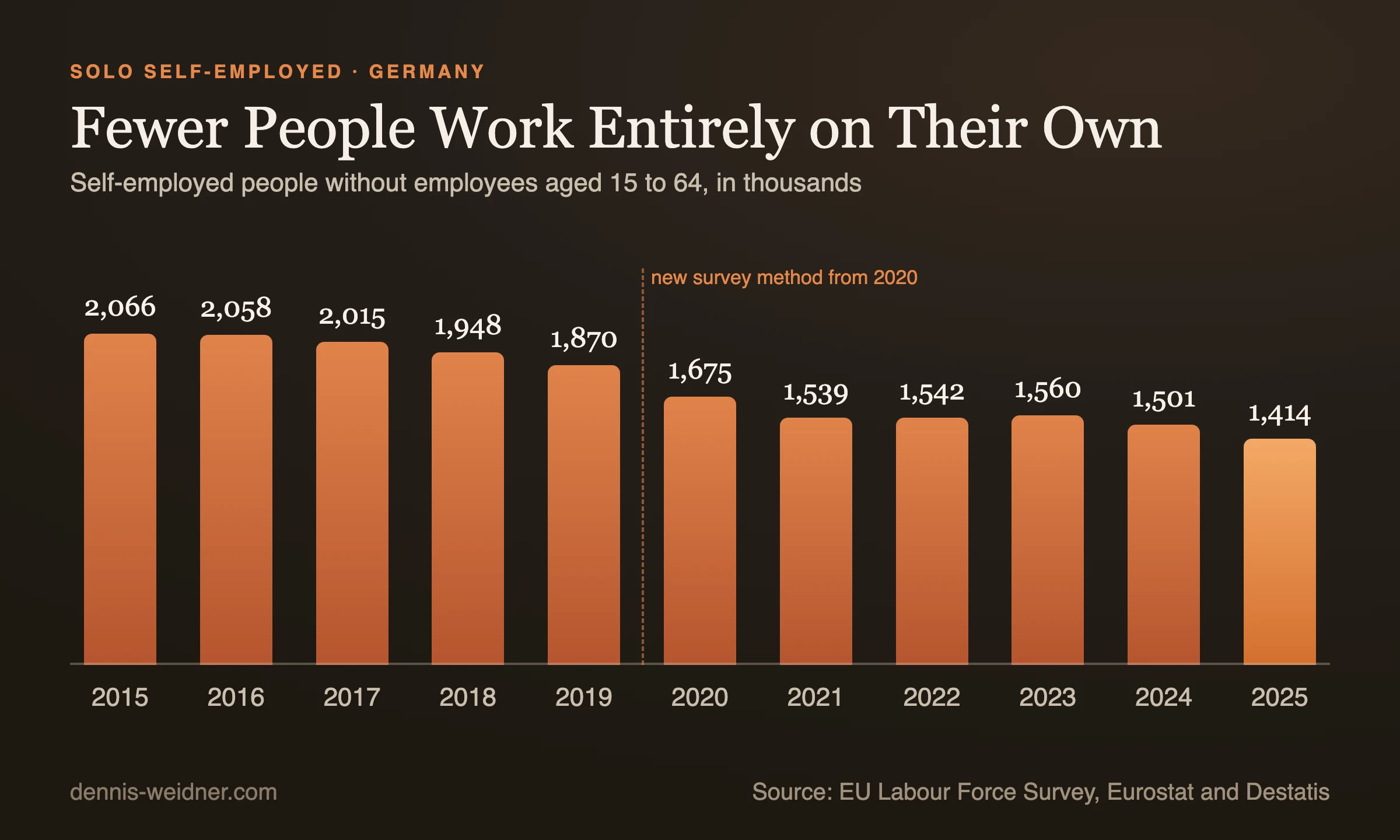
There is no umbrella organisation of their own for Germany’s roughly 1.41 million solo self-employed aged 15 to 64. Their most visible voice is the VGSD with 5,369 members, 4,592 of them individuals, according to the VGSD register entry. It has joined forces with 30 other associations in the Federal Working Group of Self-Employed Associations, BAGSV. Even if every VGSD member worked alone, that would be less than 0.4 percent of all solo self-employed people.
The group is getting smaller. In 2015, 2.07 million people in this age group worked as self-employed without employees; in 2025 it was 1.41 million. According to the Federal Statistical Office, their share of all people in work was 3.5 percent in 2025, down from 6.1 percent in 2005. Part of the decline coincides with the redesign of the survey in 2020, but the direction has been clear since 2012. In total, Destatis counted around 3.7 million self-employed people in 2025, including unpaid family workers.
The picture is different for the liberal professions. Around 1.49 million people work on their own account in a liberal profession, more than one in three self-employed people in Germany, according to the Federal Association of Liberal Professions. Many of them are organised in professional chambers, which work together with professional associations in the BFB. The BFB has 59 member organisations and uses 7.13 full-time equivalents for lobbying. Anyone practising a liberal profession without a chamber, such as a translator, journalist or designer, has no representation that stands by them automatically.
The pension reform shows what moves this group. The pension commission presented its final report on 23 June 2026. Its recommendation 22 is to bring all self-employed people who are not already covered by a mandatory scheme and who start out from a cut-off date into statutory pension insurance “on a compulsory basis and without an opt-out”. Those who are already self-employed should be able to opt out without conditions. In its statement of 6 August 2026, the BAGSV welcomes the fact that the commission reached agreement and names two conditions for success: legally certain status determination and fair contribution assessment in pension, health and long-term care insurance. The standard contribution to statutory pension insurance in 2026 is €735.63 a month. How the self-employed can already build private provision today is covered in retirement accounts for the self-employed.
Health insurance shows what a small association can achieve. Since January 2019, the minimum contribution for voluntarily insured self-employed people has been more than halved, to around €160 a month at the time, according to the Federal Ministry of Health. The VGSD lists this reduction on its website as one of its successes. With more members and more staff, even more would be possible.
Lobbying Deluxe? My Take on Interest Representation in Germany
I often hear the line: many people talk, but in the end it is lobbying deluxe. After this analysis, I see it more precisely. Interest representation is part of democracy. Those who write laws need the knowledge of those who have to apply them, and the Lobbying Register makes visible who has a say and with what resources. That is real progress compared with the time before 2022.
For me, lobbying deluxe is therefore not an accusation against individual associations but a description of the balance of weight. At the Employers’ Day, the chancellor and the employers’ president share a stage, the industry federation BDI uses almost 40 full-time equivalents for lobbying at federal level, and the umbrella organisations of the social partners, BDA and DGB, do not appear in the register at all. Anyone who works alone has neither the time nor the money for that. Every hour in Berlin is an hour without revenue.
At the same time, there is reason for confidence. The standing of entrepreneurs is rising, from 39 percent in 2022 to 48 percent in 2026 according to the citizens’ survey by dbb and forsa. And with very few staff, the self-employed associations have already contributed, for example to the reduction of the minimum health insurance contribution, which the VGSD counts among its successes. The gap is therefore not a question of arguments, but of organisation.
Lobbying for the Self-Employed: What Would Help Now
Five steps would shift the balance without anyone having to lose out:
- Transparency for everyone who helps shape legislation. The exemption in the Lobbying Register Act should apply to collective bargaining, not to statements on pensions or health insurance. Until then, voluntary registration is open to every social partner.
- A permanent seat for the self-employed. Wherever commissions and expert talks deal with pensions, health insurance and status determination, a representative of the self-employed belongs at the table alongside employers and unions.
- Reforms as a package. Compulsory pension insurance for new self-employed people works together with legally certain status determination and contributions based on actual income.
- Using the chambers as a platform. The chambers of commerce count many small traders among their members. A dedicated committee for the solo self-employed would give them an audible voice there.
- Getting organised. An association with 50,000 rather than 5,000 members speaks differently to a ministry. Anyone who is self-employed should join where their own issues are negotiated, whether in the VGSD, the BVMW or the professional association of their own sector.
I am convinced: when the self-employed pool their voice, they will be heard. Feel free to write to me via the contact form about where you are organised and what you miss in Berlin. I reply to every message.
Frequently Asked Questions
What is the German Lobbying Register?
The Lobbying Register is a public directory kept by the German Bundestag. Since 2022, organisations and individuals who regularly represent interests to the Bundestag and the federal government have to register there. They disclose their funding, their annual lobbying spend and the number of staff involved. On 14 October 2026 it held 7,005 entries.
Why is the BDA not in the Lobbying Register?
The Lobbying Register Act exempts employers’ associations and trade unions insofar as they influence working and economic conditions (section 2(2) no. 7). The DIHK is exempt as a public-law corporation under number 6. Both may register voluntarily.
Who are the members of the BDA?
The BDA’s members are 14 regional employers’ bodies and 46 national sector federations, not individual companies. 20 sector federations come from industry, 13 from services, 5 from transport and 2 each from finance, retail and wholesale, skilled trades and agriculture. Around one million companies with some 30.5 million employees are linked to the BDA through them.
How much do German business associations spend on lobbying?
The 749 business and trade associations in the Lobbying Register report a combined €228 million to €235 million a year. Among the associations compared here, the BDI leads in 2025 with up to €9.56 million, followed by Die Familienunternehmer with up to €2.06 million. Among all 749 business associations, only the GDV, the VDA and the BDEW report more than the BDI. The VGSD and the Startup Association each report up to €0.18 million.
Who represents the solo self-employed in Germany?
Across sectors, mainly the association of founders and self-employed people VGSD with 5,369 members and the Federal Working Group of Self-Employed Associations BAGSV with 31 member associations. Anyone with a registered trade is also a compulsory member of their IHK or, in the skilled crafts, of the chamber of skilled trades, and members of chamber-regulated liberal professions belong to their professional chamber.
Do self-employed people have to join the chamber of commerce?
Anyone assessed for trade tax who does not run a skilled craft automatically belongs to their IHK; skilled trade businesses belong to the chamber of skilled trades. Sole traders without a commercial register entry pay no fee up to a trade income of €5,200. Freelancers in the liberal professions are only members if they are entered in the commercial register.
Best,
Dennis Weidner
Note: AI tools supported me in writing this article, and some images were edited with AI. I stand behind its content and every statement with my name.