Since December 1990, 9 of Germany’s 144 federal ministers have resigned or been dismissed after a public allegation of personal misconduct: three from the SPD, two each from the CDU and CSU, and one each from the FDP and the Greens. Measured against the number of ministers each party has had, no governing party stands out. Prosecutions of members of parliament tell a different story: since 2017 the Bundestag has approved criminal proceedings, searches or enforcement against 14 AfD members, almost as many as against all other parliamentary groups combined (15). Such an approval is expressly not a finding of guilt. Three case studies follow: Jens Spahn and the mask procurement, Philipp Amthor and Augustus Intelligence, and Christian Wulff, who resigned in 2012 and was acquitted in 2014. My view as an entrepreneur: oversight in Germany works, but it needs reliable numbers instead of gut-feeling rankings.
As of 14 October 2026.
More on this topic: Politics & Society, with background, practice and every article in one place.
Key facts at a glance
- 9 of 144 federal ministers since December 1990 left after an allegation of personal misconduct, or 6.25 percent.
- Until 2002 all four cases were about money and favours; since 2011 all five have been about doctoral theses and official duties.
- Seven state premiers resigned after such allegations between 1991 and 2002, none since for that reason.
- Since October 2017 the Bundestag has approved criminal proceedings, searches or enforcement against 14 AfD members in 29 decisions. Counted per parliament, that is 1.90 members affected per 100 seat-years, compared with 0.25 for the CDU/CSU.
- All ten formal findings of breaches of the code of conduct since 2008 concerned nine members of the CDU, CSU or SPD, and every one was about outside activities and income declared late, imprecisely or not at all.
- Jens Spahn stepped down as leader of the CDU/CSU parliamentary group on 18 July 2026, and not over the masks; the Berlin public prosecutor general saw no grounds for an investigation there in March 2026.
Political Resignations and Investigations in Numbers: the Counting Rule
Ask which party has the most scandals and you usually get a list of prominent names. That mainly measures who governed longest and who draws the most attention. So I count only what an official body has recorded, and I count three things separately because they mean different things: a resignation, an approval to prosecute and a formally established breach of the rules.
My counting rule in one sentence: only what an official body has documented is counted, separately for resignations, approvals to prosecute and established breaches, and every figure is divided by the number of ministers or seats of the party concerned.
The sources are the Bundestag Data Handbook on ministerial resignations, the Bundestag’s parliamentary documentation system DIP with every immunity decision and every finding by the Bundestag President, plus the list of all German government members since 1949. Suspicion, proceedings and verdicts never share a column. Resigning does not make anyone guilty, and in the Bundestag’s own words an approval to prosecute contains “no finding of right or wrong, guilt or innocence”. Everyone named here is presumed innocent until a final court ruling says otherwise.
Why this matters to me as an entrepreneur I set out in Entrepreneurs and Politics: anyone who signs contracts with the state, pays taxes and applies for funding needs to trust the people who make those rules. That trust depends on how often office and private interest really collide. How sharply the mood in the country is shifting showed in the week of Bärbel Bas’s resignation.
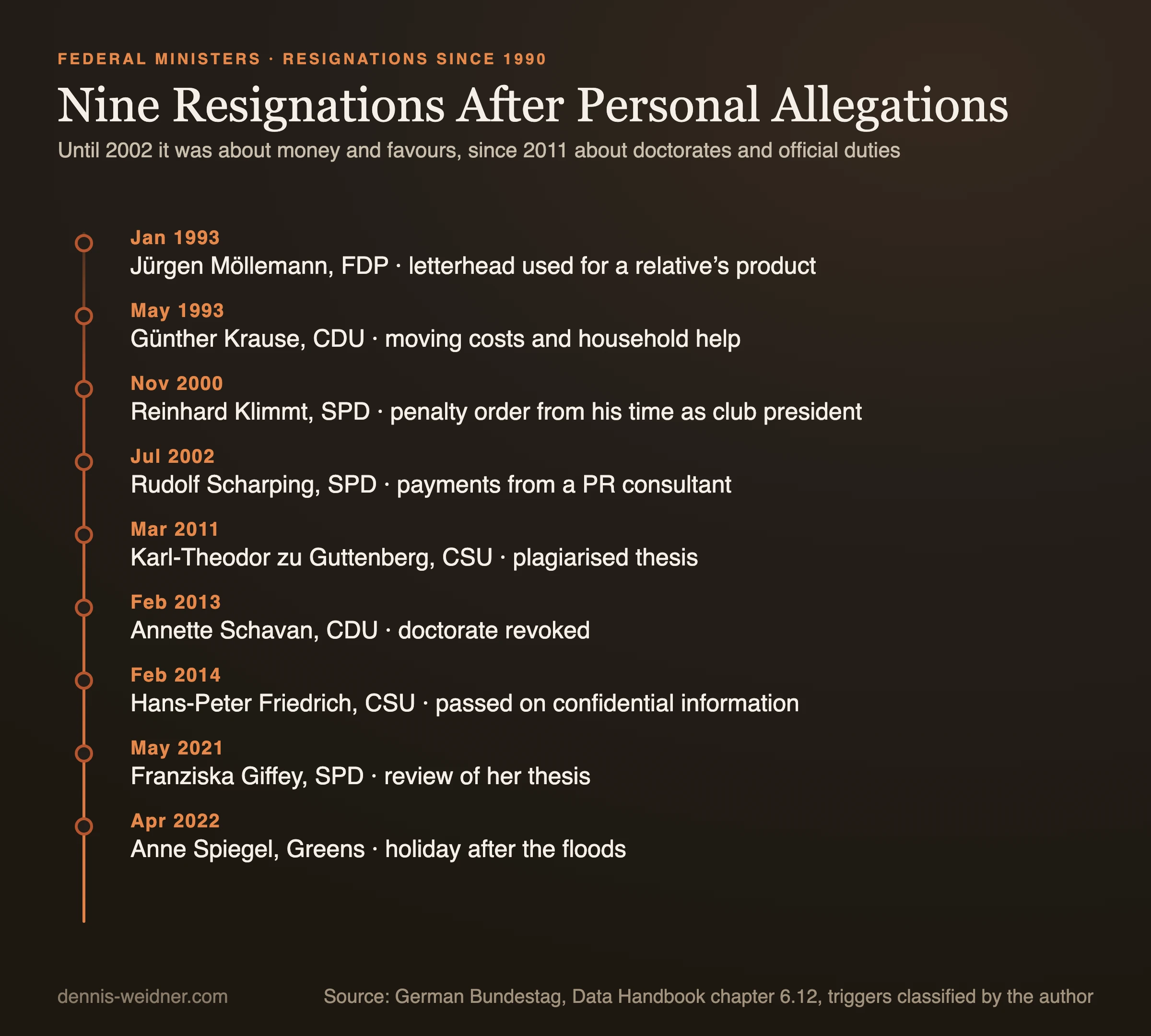
Federal Ministers Who Resigned Since 1990: Nine Cases After Personal Allegations
Since the 12th Bundestag began in December 1990, 144 people have served as federal ministers. 45 times a ministerial post ended early, through resignation, dismissal or a move to another office. In nine cases a public allegation of personal misconduct lay behind it: a benefit, a conflict of interest, a doctorate or the handling of official duties. Six more ministers left because they took political responsibility for events in their ministry, such as Rudolf Seiters after the police operation at Bad Kleinen in 1993, or Andrea Fischer and Karl-Heinz Funke during the BSE crisis in 2001. The remaining 30 cases have nothing to do with misconduct: protest, the collapse of a coalition, illness, a new office.
| Resigned | Name, party | Ministry | Trigger according to reporting and records |
|---|---|---|---|
| January 1993 | Jürgen Möllemann, FDP | Economy | Letters of recommendation on ministry letterhead for a product of a relative by marriage |
| May 1993 | Günther Krause, CDU | Transport | Allegations about moving costs and a state-subsidised household help |
| November 2000 | Reinhard Klimmt, SPD | Transport | Penalty order for aiding breach of trust from his time as president of football club 1. FC Saarbrücken, which he accepted |
| July 2002 | Rudolf Scharping, SPD | Defence | Payments from a PR consultant, dismissed by the Chancellor |
| March 2011 | Karl-Theodor zu Guttenberg, CSU | Defence | Plagiarism in his doctoral thesis, the University of Bayreuth revoked the title |
| February 2013 | Annette Schavan, CDU | Education and Research | The University of Düsseldorf revoked her doctorate |
| February 2014 | Hans-Peter Friedrich, CSU | Agriculture | Passing on confidential information from his time as interior minister, investigation later dropped |
| May 2021 | Franziska Giffey, SPD | Family Affairs | Review of her doctoral thesis, Freie Universität Berlin revoked the title in June 2021 |
| April 2022 | Anne Spiegel, Greens | Family Affairs | A holiday shortly after the 2021 floods in her previous post as a state minister |
The list shows a clear shift. Until 2002 all four cases were about money, benefits and favours. Since 2011 three of five were about doctoral theses and two about the handling of official duties. Since Rudolf Scharping in 2002, no federal minister has resigned over payments or benefits. That speaks for the rules added since then and for a public that looks more closely.
Which Party Leads on Ministerial Resignations?
In absolute terms the SPD leads with three cases, the CDU and CSU follow with two each, four for the conservative Union combined. Divided by the number of ministers each party has supplied since 1990, all five governing parties fall between 4 and 10 percent. For the Greens and the CSU a single case moves the share by several points. These numbers do not support a ranking, and that is the finding: resignations after personal allegations happen in every governing party, for one minister in sixteen.
A borderline case is Christine Lambrecht (SPD), who resigned as defence minister in January 2023. Her resignation followed months of criticism of her performance in office, including a helicopter flight with her son. I count her under political responsibility. Counting her instead gives the SPD four cases and does not change the overall picture.
| Party | Federal ministers since 1990 | Resigned after a personal allegation | Share | Resigned taking political responsibility |
|---|---|---|---|---|
| CDU | 45 | 2 | 4.4% | 3 |
| CSU | 20 | 2 | 10.0% | 0 |
| SPD | 47 | 3 | 6.4% | 2 (incl. Lambrecht) |
| FDP | 20 | 1 | 5.0% | 0 |
| Greens | 10 | 1 | 10.0% | 1 |
| AfD, Left, BSW | 0 | not measurable |
The AfD, the Left and the BSW have never supplied a federal minister. For them this category measures nothing, and anyone reading a clean record into the empty column confuses lack of opportunity with conduct. That is why a second count is needed, one that covers every parliamentary group alike.
State Premiers: Seven Resignations, the Last in 2002
At state level, seven heads of government have resigned since 1990 after allegations of personal misconduct, four from the CDU, two from the SPD and one from the CSU. Five of the seven cases fall into the years 1991 to 1993. Since Kurt Biedenkopf in April 2002, no state premier has left for such a reason. Not counted are resignations over a person’s East German past, such as Josef Duchač (CDU, Thuringia) in 1992, and resignations taking political responsibility: for Georg Milbradt (CDU, Saxony) in 2008 the crisis at the state bank was the main issue, alongside private loans from the bank.
| Resigned | Name, party | State | Trigger |
|---|---|---|---|
| January 1991 | Lothar Späth, CDU | Baden-Württemberg | Trips paid for by companies |
| July 1991 | Gerd Gies, CDU | Saxony-Anhalt | Allegation that he pressed legislators with Stasi links to give up their seats |
| May 1993 | Björn Engholm, SPD | Schleswig-Holstein | He had given untrue testimony to an inquiry into the Barschel affair |
| May 1993 | Max Streibl, CSU | Bavaria | Holidays paid for by a businessman, the “Amigo affair” |
| November 1993 | Werner Münch, CDU | Saxony-Anhalt | Excessive salaries for ministers from western Germany |
| November 1999 | Gerhard Glogowski, SPD | Lower Saxony | Benefits from companies, among them at his wedding party |
| April 2002 | Kurt Biedenkopf, CDU | Saxony | Rent at the government guest house, discounts, household staff |
Bundestag Immunity Waived: Who Leads Since 2017
Members of the Bundestag can only be prosecuted with the Bundestag’s approval. Investigations as such have been generally permitted since 1973, but the plenary decides case by case on an indictment, a search or an arrest warrant. These decisions are fully recorded in the Bundestag’s documentation system, with names and dates. I analysed every decision since the start of the 19th parliament in October 2017, the point from which all of today’s parliamentary groups have been in the Bundestag, and assigned each case to the member’s group at the time of the decision.
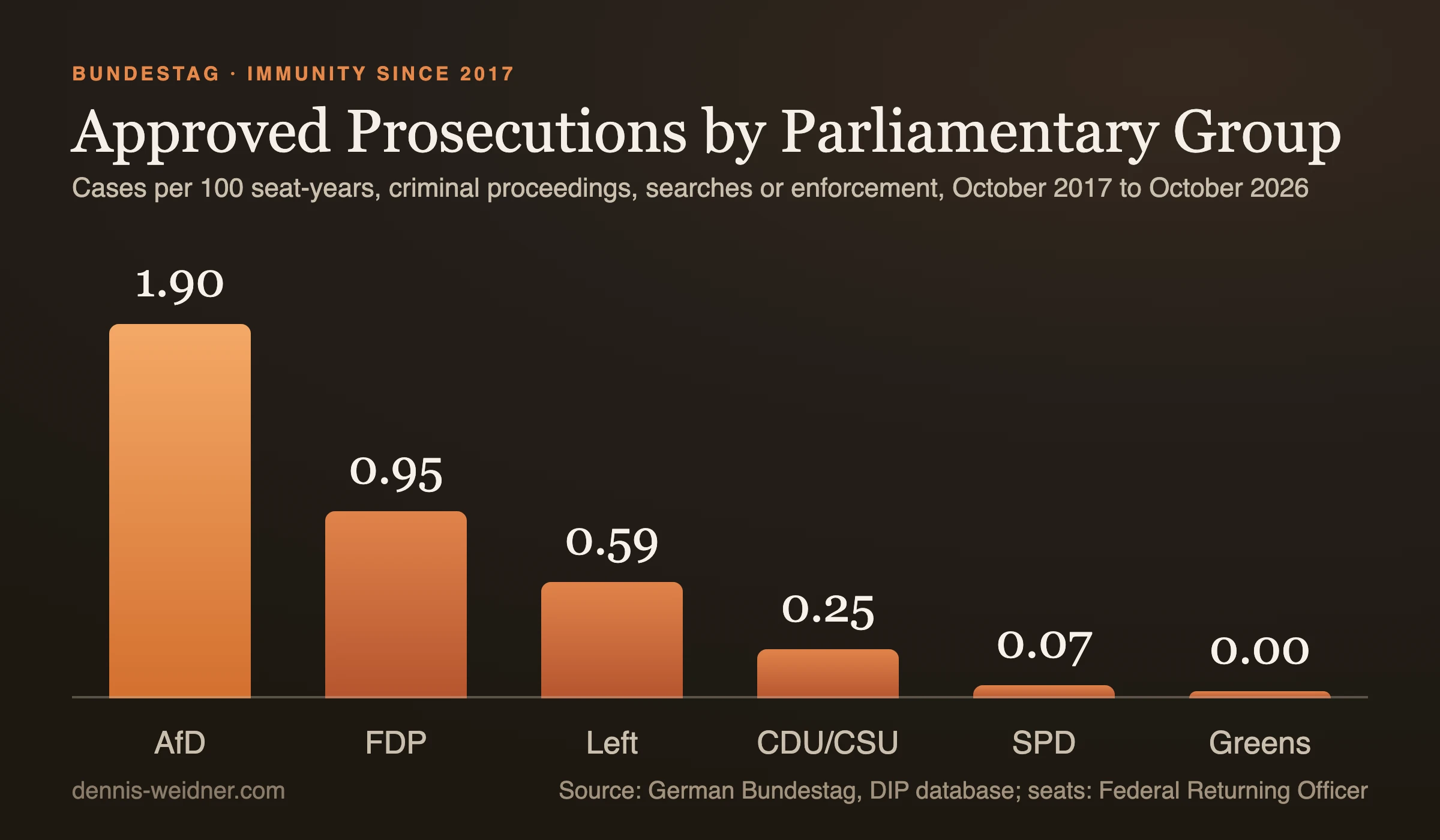
The result is clear. For 14 AfD members the Bundestag approved criminal proceedings, searches or enforcement in 29 decisions. For all other groups combined it was 15 members: six from the FDP, five from the CDU/CSU, three from the Left and one from the SPD. There was no approval for any Green member; the Bundestag refused two requests concerning Green members. Relative to seats and the length of each parliament, the AfD comes to 1.90 cases per 100 seat-years, the CDU/CSU to 0.25 and the SPD to 0.07. A case here means one member with at least one approval in a parliamentary term, so nobody counts twice because several decisions concerned them.
| Group at first decision | Members | Decisions | Cases per 100 seat-years | Professional and disciplinary law |
|---|---|---|---|---|
| AfD | 14 | 29 | 1.90 | 5 members |
| FDP | 6 | 7 | 0.95 | 1 |
| Left | 3 | 4 | 0.59 | 0 |
| CDU/CSU | 5 | 5 | 0.25 | 1 |
| SPD | 1 | 2 | 0.07 | 0 |
| Greens | 0 | 0 | 0.00 | 0 (two requests refused) |
| Independent | 2 | 4 | 0 (Petry and Kamann, both elected for the AfD; plus one decision on Georg Nüßlein after he left the CDU/CSU group) |
Three points belong with this figure. First, the Bundestag does not weigh the evidence, it only checks whether proceedings appear free of arbitrariness. Second, an approval says nothing about the outcome; many proceedings end in dismissal or acquittal. Third, according to the Data Handbook the overall number of immunity cases grows mainly through witness hearings: in the 20th parliament, 59 of 77 immunity cases were approvals to hear members as witnesses. Criminal proceedings accounted for 16 cases, among them four speech offences and two traffic offences, plus two disciplinary proceedings. The distribution by group is nonetheless a solid finding: relative to group size, prosecutors have since 2017 requested measures against AfD members, approved by the Bundestag, many times more often than against members of all other groups.
Breaches of the Code of Conduct: Ten Formal Findings
The third count concerns outside activities and income. Since 2008 the Bundestag Presidium has formally found ten times that members breached the code of conduct, and published each case as a parliamentary paper. Nine members were affected, five from the CDU, three from the SPD and one from the CSU, among them Otto Schily (SPD) in 2008 and Siegfried Kauder (CDU) in 2013, who had not fully declared income from their work as lawyers. Every case involved declarations that came late, only in income bands instead of exact amounts, or not at all. In 2019 the Presidium also imposed an administrative fine of four months’ parliamentary pay on CDU member Karin Strenz, who had among other things declared payments from a company late.
That only the Union and the SPD appear here has a simple explanation: their members more often hold outside positions on supervisory boards, in law firms and in companies, so they have more to declare. Since the 2021 reform of the Members of the Bundestag Act, outside income has been published to the euro. No new finding of this kind has appeared in the documentation system since.
The 2021 Mask Affair: Commissions and a Gap in Criminal Law
In Germany, the “mask affair” still mainly refers to the spring of 2021. CSU member of the Bundestag Georg Nüßlein and Bavarian state legislator Alfred Sauter (CSU) had brokered mask deals between suppliers and public authorities; according to the Federal Court of Justice a company run by Nüßlein received 660,000 euros, and a company attributable to Sauter more than 1.2 million euros. CDU member Nikolas Löbel gave up his seat in March 2021 after it emerged that his company had received around 250,000 euros in commissions for brokering mask contracts between private companies.
Under criminal law there were no consequences. In July 2022 the Federal Court of Justice ruled that the offence of bribing members of parliament, as it then stood, was not met, because Nüßlein and Sauter had not acted within parliament itself. Lawmakers learned from this twice: in 2021 with a ban on paid lobbying by members and the publication of outside income to the euro, and in 2024 with a new criminal offence of improper use of a mandate for third-party interests that closes exactly this gap.
How the criminal law works today is shown by the so-called Azerbaijan affair. In January 2026 the Higher Regional Court of Munich sentenced former CDU member Axel Fischer to one year and two months on probation for bribery of an office holder, and on 30 July 2025 former CSU member Eduard Lintner to nine months on probation for bribing office holders. According to the latest available information neither verdict is final; Lintner has appealed, and Fischer has announced an appeal and denies the allegations.
Jens Spahn and the Mask Procurement: What the Sudhof Report Says
Jens Spahn was Germany’s federal health minister from 14 March 2018 to 8 December 2021. In the first weeks of the pandemic in 2020 his ministry bought protective equipment on a large scale, partly through a so-called open-house procedure: every supplier able to deliver FFP2 masks got a contract at a fixed price of 4.50 euros net per mask. The Federal Court of Audit put a figure on the consequences in July 2025: 5.8 billion masks for around 5.9 billion euros, of which only 1.7 billion were distributed in Germany, while more than half had to be or still have to be destroyed. Managing the surplus alone had cost 517 million euros by the end of 2024, on top of around 100 lawsuits from suppliers claiming a combined 2.3 billion euros, according to ZDFheute’s account of the audit report.
Spahn’s successor Karl Lauterbach commissioned former state secretary Margaretha Sudhof to investigate in July 2024. Her report concludes that Spahn moved into procurement on a large scale “against the advice of his specialist departments”, even though experienced procurement agencies were available and had warned him. A logistics company from Spahn’s home region, Fiege from Greven in the Steinfurt district, was hired without a tender. Health Minister Nina Warken (CDU) accused the report of methodological flaws and initially gave the budget committee only a redacted version; in June 2025 the transparency platform FragDenStaat published the full text.
Spahn himself said he had a clear conscience and acknowledged that with today’s knowledge he would decide some things differently, especially regarding the open-house procedure. On 25 June 2025 he answered the budget committee’s questions for around two hours. The Berlin public prosecutor general examined more than 170 criminal complaints alleging breach of trust and acceptance of benefits and in March 2026 found no sufficient factual indications of a criminal offence. That is the legal position: no investigation, no charge by any court.
Committee of Inquiry or Commission of Inquiry
Politically, the review remains open. On 10 July 2025 the Bundestag set up a study commission on the Covid pandemic and rejected a committee of inquiry requested by the AfD group (paper 21/573). The Greens and the Left want a separate committee of inquiry on the masks. That requires a quarter of all members, 158 of 630, and together they hold 149 seats. Unlike a committee of inquiry, a study commission cannot compel witnesses to testify. FragDenStaat is now suing the health ministry for the files behind the footnotes of the Sudhof report.
Resignation as Parliamentary Leader in July 2026
Spahn had led the CDU/CSU parliamentary group since May 2025. On 18 July 2026 he stepped down from that post for a different reason: in mid-July it had become known that his and his husband’s child had been born to a surrogate mother in the United States, which is not permitted in Germany. After criticism, including from within his own party, Chancellor Friedrich Merz called the resignation unavoidable. A decision about a child is private, and it has nothing to do with the mask procurement. Thorsten Frei became the new group leader on 29 July.
In early September 2026 the group nominated Spahn to the budget committee. After he missed a committee meeting in late September and criticism came from the CDU/CSU budget working group, he gave up the seat on 28 September. His team said he had been excused for family reasons. Spahn wrote that everything surrounding him was “currently so politicised that normal work will hardly be possible”, according to ZDFheute. He has kept his seat in the Bundestag.
Philipp Amthor and Augustus Intelligence: Lobbying for a Start-up
In June 2020 Der Spiegel reported that Philipp Amthor, then a 27-year-old CDU member of the Bundestag, had lobbied Economy Minister Peter Altmaier by letter in October 2018 on behalf of the US company Augustus Intelligence. A few months later he became a director there and received stock options, according to Nordkurier, which published the letter. Amthor called his involvement a mistake, ended the work and withdrew his candidacy for the CDU state chairmanship in Mecklenburg-Western Pomerania.
Legally, nothing remained. In July 2020 the Berlin public prosecutor general declined to open an investigation because it saw no initial suspicion of bribery, stating that income unconnected to the mandate is in principle not a prohibited benefit, according to LTO’s report on the decision. According to Amthor, the Bundestag administration also closed its review in August 2020 without finding a breach. His own conclusion at the time: “Not everything that is legally possible is also politically wise.” His career continued. In 2025 he became parliamentary state secretary in the new digital ministry, and since 29 July 2026 he has been Minister of State at the Federal Chancellery responsible for cooperation between the federal and state governments.
The Amthor case is the textbook example of the gap between law and appearance. What he did was permitted. That it still cost him a candidacy shows that the public’s standard is stricter than the criminal code. The 2021 reform of the Members of the Bundestag Act has since tied exactly this kind of side activity to stricter disclosure rules.
Christian Wulff: Resignation in 2012, Acquittal in 2014
Christian Wulff was Federal President from June 2010 to February 2012. From December 2011 the debate concerned a private loan of 500,000 euros for his house from his time as premier of Lower Saxony, holidays with businessmen he knew and a call to the editor-in-chief of the Bild newspaper. When the Hanover public prosecutor asked for his immunity to be lifted, he resigned on 17 February 2012.
In the end a single charge went to court: accepting a benefit of around 720 euros that a film producer friend is said to have covered in 2008 for a hotel and a visit to the Oktoberfest. On 27 February 2014 the Hanover Regional Court acquitted Wulff. The prosecutors withdrew the appeal they had initially lodged in June 2014, and the acquittal is final. Measured against the public force of the affair, that is a remarkably small result, and it deserves to be told just as clearly as the resignation itself.
Wulff published his account in 2014 in the book “Ganz oben, ganz unten” (C.H. Beck). Today he works as a lawyer in Hamburg, is president of the German Choir Association and chairs the board of the Deutschlandstiftung Integration; in summer 2026 he represented Germany at two presidential inaugurations in South America, according to his own website. For me his is the most important case in this analysis: a resignation is not a verdict, and anyone who writes about political affairs has to report an acquittal as loudly as the allegation.
Other Cases: Where Office and Private Interest Meet
Not every case ends in a resignation. In May 2023 Economy Minister Robert Habeck sent his state secretary Patrick Graichen into temporary retirement. Graichen had sat on the selection panel that proposed his best man as head of the German Energy Agency, and had approved funding for an environmental association on whose board his sister sat. Habeck called it “the one mistake too many”. State secretaries are not part of my ministerial count, but the case shows how quickly closeness becomes a problem, even without any financial benefit.
Conversely, some cases cause great damage without any personal benefit. The failed car toll under Transport Minister Andreas Scheuer (CSU) cost the federal government 243 million euros in compensation to the intended operators after an arbitration, and a committee of inquiry examined it. Scheuer stayed in office until the end of the parliamentary term. On the current legal position, the mask procurement also belongs in this group: high costs and disputed decisions, but according to the public prosecutor general no indication of a criminal offence.
What Has Changed Since the Affairs
The good news of this analysis: every major affair has improved the rules. Since 2022 the Bundestag has had a lobby register, tightened in 2024. Since 2021 members may no longer lobby the federal government or the Bundestag for pay, and their outside income is published to the euro. Since 2024 it has been a criminal offence for an office holder to use their influence outside parliament for third parties in return for money. And for more than twenty years no federal minister has had to resign over financial benefits.
My View as an Entrepreneur
I know the state as a contracting partner, as an auditor and as a funder. What I want from it is what every customer expects from my companies: traceable decisions, clean records and clear responsibilities. The mask procurement shows what happens when, in an emergency, the ministry buys for itself, awards the logistics without a tender and creates the files only afterwards. Even in 2025 the health ministry expected risks of 480 million euros for that year alone from contract settlement and litigation. Emergencies justify fast decisions, but not an exemption from documentation.
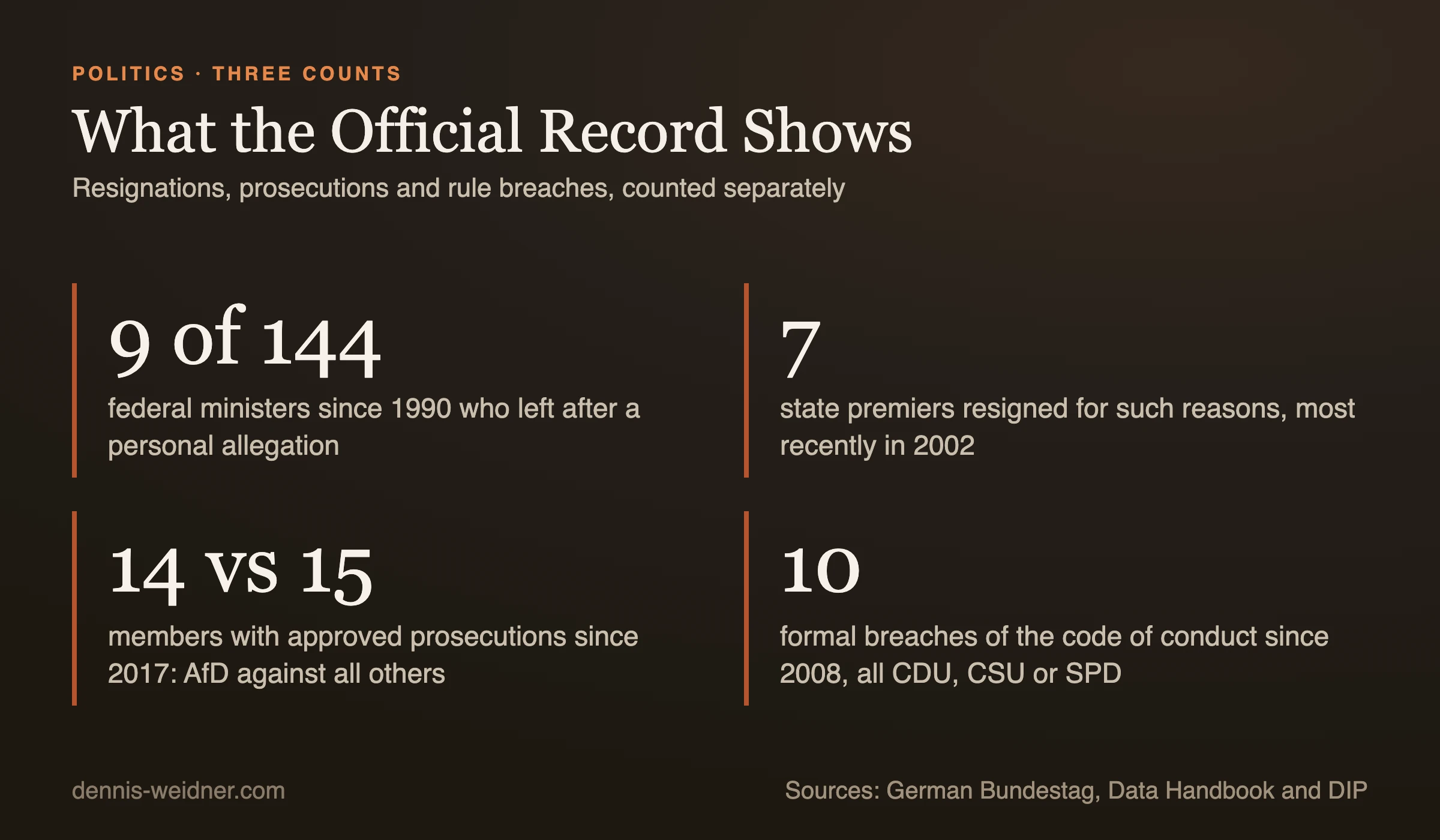
The numbers are more reassuring than the headlines. Nine of 144 federal ministers in 36 years, no ministerial resignation over financial benefits since 2002, ten formal rule breaches that all came down to late, imprecise or missing declarations. That is the picture of a system in which the audit office, the courts, the Bundestag presidency and the press do their work. Anyone who wants to portray one party as especially prone to misconduct finds no evidence in the ministerial statistics. Anyone who looks at prosecutions in the Bundestag, by contrast, sees one group that clearly stands out. Both belong side by side, soberly, with a source, a reference figure and the presumption of innocence.
How people perceive politics today and why trust in the political centre is suffering is something I described in Political Discontent in Germany. I look forward to your feedback via the contact form, especially if you know of a case missing from my count. I check every tip against the source.
Frequently Asked Questions
How many German federal ministers have resigned over misconduct allegations since 1990?
Since December 1990, 9 of 144 federal ministers have resigned or been dismissed after a public allegation of personal misconduct: three from the SPD, two each from the CDU and CSU, and one each from the FDP and the Greens. Six more took political responsibility for events in their ministry, for example during the BSE crisis in 2001.
Which party has had the most immunity waivers in the Bundestag?
Since October 2017 the Bundestag has approved criminal proceedings, searches or enforcement against 14 AfD members, and against 15 members of all other groups combined. Per 100 seat-years that is 1.90 members affected for the AfD and 0.25 for the CDU/CSU. An approval is not a finding of guilt.
Why did Jens Spahn resign?
Spahn stepped down as leader of the CDU/CSU parliamentary group on 18 July 2026 after criticism that his child had been born to a surrogate mother in the United States. The resignation had nothing to do with the mask procurement. In late September 2026 he also gave up his seat on the budget committee; he has kept his seat in the Bundestag.
What does the Sudhof report say about Jens Spahn?
Special investigator Margaretha Sudhof concludes that in 2020 Spahn moved into mask procurement on a large scale against the advice of his specialist departments and hired a logistics company from his home region without a tender. Spahn rejects the allegations, and the Berlin public prosecutor general saw no sufficient indications of a criminal offence in March 2026.
Was Christian Wulff convicted?
No. On 27 February 2014 the Hanover Regional Court acquitted Wulff of accepting a benefit, the prosecutors withdrew their appeal in June 2014 and the acquittal is final. Wulff had resigned as Federal President in February 2012.
What was the Amthor case?
In 2018 Philipp Amthor (CDU) lobbied Economy Minister Peter Altmaier by letter on behalf of the US company Augustus Intelligence, where he later became a director and from which he received stock options. In 2020 he called this a mistake and ended the work. The Berlin public prosecutor general saw no initial suspicion, and the Bundestag administration closed its review.
Best,
Dennis Weidner
Note: AI tools supported me in writing this article, and some images were edited with AI. I stand behind its content and every statement with my name.