
On Saturday, 24 October 2026, Donald Trump brought Audi CEO Gernot Döllner on stage at a campaign rally in Perry, Georgia. Audi is building its first US plant there: around 4 billion US dollars, up to 200,000 SUVs a year, around 4,500 jobs, with production starting in the early 2030s. In Germany, the same company is cutting around 7,500 jobs by the end of 2029. My verdict: the appearance was a mistake, the plant is not. And the plant is what should concern us far more than the stage.
As of 28 October 2026.
More on this topic: Politics & Society, with background, practice and every article in one place.
Audi's US Plant: Key Facts at a Glance
- 24 October 2026: ten days before the US midterm elections, Trump announces Audi's first US plant in Perry, Georgia, with Döllner beside him on stage.
- Around $4 billion, up to 200,000 vehicles, around 4,500 jobs: construction from 2027, production in the early 2030s, and the Volkswagen supervisory board still has to approve.
- €1.2 billion is what US tariffs cost Audi in 2025, with 15 percent due on every imported car.
- 7,500 jobs will go at Audi in Germany by the end of 2029, while compulsory redundancies are ruled out until the end of 2033.
- $3,307 in labour costs goes into a car built in Germany, $1,341 into one built in the US and $597 into one built in China.
- €203.7 billion in new borrowing is planned by the German federal government for 2027; including the special funds, that is almost one in every three euros it spends.
Audi's US Plant: What Was Announced in Georgia
Audi is building an entirely new factory on the Middle Georgia Mega Site near Perry for large premium SUVs developed for customers in North America. That is what Audi's press release of 25 October says. According to the German public broadcaster ZDF, the Q7, Q8 and Q9 are to be built there.
| Key facts | Audi plant in Georgia |
|---|---|
| Location | Middle Georgia Mega Site near Perry, Georgia |
| Investment | around $4 billion, Trump cited $4.2 billion |
| Capacity | up to 200,000 vehicles a year |
| Jobs | around 4,500 |
| Models | large premium SUVs, according to ZDF the Q7, Q8 and Q9 |
| Timeline | construction from 2027, production in the early 2030s |
| Decision status | approval by the Volkswagen supervisory board pending |
Audi's reasoning is matter-of-fact: the US is the world's second-largest premium market, a plant of its own reduces trade and currency risks, and North America is to become the third production pillar alongside Europe and China. In the release, Döllner says this is about a stronger Audi business in America, not just a factory. The plant is not final yet: the supervisory board of the Volkswagen Group, which wholly owns Audi, has to approve it.
Döllner at Trump's Rally: Why the Appearance Was a Mistake
Because it was not a plant opening, it was a campaign event. Ten days before the midterm elections on 3 November, the head of a German company stood on a party leader's stage and thanked him for his support. Audi's own code of conduct from April 2026 rules out high-profile public appearances with parties or politicians in the three months before an election, ZDF reports.
Criticism came from the left, from the centre and from the workforce. Christiane Benner, head of the IG Metall union, called the appearance "highly embarrassing, politically unacceptable". Daniela Cavallo, who chairs Volkswagen's group works council, spoke of active campaign support, Dennis Radtke, head of the CDU's labour wing, of a disturbing appearance, and Luigi Pantisano, co-leader of Die Linke, called for Döllner to resign. Lower Saxony's state premier Olaf Lies, who sits on Volkswagen's supervisory board, said a campaign rally was simply the wrong place, according to the dpa overview published by AUTOHAUS. Audi stated that the appearance had not been an expression of support for any party, but that it had been perceived as a political signal and the company took that very seriously. Döllner himself told Reuters, in essence, that when the American president invites you, you accept (Motor1).
I understand the thinking. Anyone investing four billion dollars in a country needs a good line to its government. But a meeting at the White House and a campaign stage are two different things, and every board member knows the difference. When Daimler CEO Dieter Zetsche, VW CEO Herbert Diess and BMW CFO Nicolas Peter travelled to the White House in December 2018 over threatened tariffs, that was industrial diplomacy. A rally before an election is taking sides. Whoever stands up there is not just selling a factory, they become part of the show.
What bothers me most is the timing. Applause for 4,500 new jobs in Georgia in the very week in which employees in Ingolstadt and Neckarsulm are working out whether their job is one of the 7,500. That is no criticism of the investment. It is a sense of proportion that a group CEO cannot afford to lack.
Why Audi Still Has to Build a Plant in the US
Because without one, the numbers no longer add up. Every car Audi ships to the US from Europe or Mexico carries a 15 percent tariff, which cost Audi €1.2 billion in 2025. US sales fell by 16 percent in the same year, even though Audi sells one in ten of its cars there (ZDF). Even Daniela Cavallo, the appearance's sharpest critic, concedes that the plant could make sense in purely commercial terms because of the tariffs (dpa).
Audi is late to this. BMW has been building in Spartanburg, South Carolina, since 1994 and produced exactly 412,799 vehicles there in 2025; according to the US Department of Commerce, the plant is the largest automotive exporter in the US by value (Carscoops). Mercedes-Benz has been building in Alabama since 1997, Volkswagen in Tennessee since 2011. Together, German manufacturers built 817,300 passenger cars in the US in 2025, around twice as many as they shipped there from Germany (VDA). Audi, by contrast, brings its cars to the US from Europe and from San José Chiapa in Mexico, where the Q5 has been built since 2016, and pays tariffs on them.
| Plant | Since | Vehicles per year | What is built there |
|---|---|---|---|
| BMW Spartanburg, South Carolina | 1994 | 412,799 (2025) | X models, around 200,000 of them for export |
| Mercedes-Benz Tuscaloosa, Alabama | 1997 | around 260,000 (2024) | GLE, GLS, EQE and EQS SUV |
| Volkswagen Chattanooga, Tennessee | 2011 | around 150,000 (2025) | Atlas |
| Audi San José Chiapa, Mexico | 2016 | 146,784 (2025) | Q5 and Q5 Sportback |
| Audi Perry, Georgia | from the early 2030s | up to 200,000 planned | large SUVs, according to ZDF the Q7, Q8 and Q9 |
Sources: Carscoops (BMW), Mercedes-Benz Group, Volkswagen Newsroom, Audi México, Audi and ZDF (Georgia)
For Germany this means two things. The vehicles that will be built in Georgia will be missing from European production: according to ZDF, almost 30,000 Q7 and Q8 models a year go to the US from Bratislava alone. And the decision follows a pattern that is older than Trump. Cars are built where they are sold and where the costs work. Which brings us to the real issue.
Germany as a Manufacturing Location: Labour, Power and Tax Costs Compared
Germany is expensive on three counts: labour per car built, electricity and taxes. On non-wage labour costs, on the other hand, we sit in the European middle, contrary to what is often claimed.
Labour costs: expensive per hour, even more so per car
An hour of work in German manufacturing cost €49.50 in 2025, 41 percent more than the EU average, according to the Federal Statistical Office. In the Czech Republic it was €20.20, in Hungary €15.60 (Eurostat). In the US, an hour in manufacturing costs the equivalent of around €42 (US Bureau of Labor Statistics, June 2026), just under 15 percent less than here.

The big difference to America therefore lies less in the price of an hour than in what that hour produces. At exchange rates, US manufacturing productivity is 44 percent higher than Germany's, according to calculations by the German Economic Institute (IW). The result: unit labour costs in the US are 32 percent below ours, while Germany sits 22 percent above the average of 27 industrialised countries (2024 data).
And the figure that comes up on every talk show, that labour here is five or six times as expensive? It holds if you calculate per car. The consultancy Oliver Wyman analysed more than 250 assembly plants: a car built in Germany contains $3,307 in labour costs, one from the US $1,341, one from China $597 and one from Mexico $305 (country figures via Carscoops). That is a factor of 5.5 compared with China, almost 11 compared with Mexico and 2.5 compared with the US.

Two more figures put this in context. People in work in Germany put in an average of 1,332 hours a year, compared with 1,800 in the US and 2,205 in Mexico (OECD), although the OECD itself cautions against a direct comparison because so many people here work part-time. And non-wage costs are not the main reason: their share of labour costs in German manufacturing is 23.7 percent, below the EU average of 24.7 percent. The problem is the trend. In 2026, social security contributions add up to 42.3 percent of gross pay, and without reform they will keep rising as society ages.
Industrial electricity: twice as expensive as in the US
According to the BDEW electricity price analysis, mid-sized industrial companies in Germany pay around 17 to 18 cents per kilowatt hour in 2026. Companies using 20 to 70 gigawatt hours a year paid 14.6 cents in the first half of the year, excluding recoverable taxes (Eurostat). In the US, industrial electricity cost an average of 9.09 US cents from January to August 2026, and 8.67 US cents in Georgia, the equivalent of around 7.5 to 8 euro cents (US Energy Information Administration). For China, a study for the Bavarian business association vbw also puts the figure at around 8 cents. Electricity in Germany therefore costs roughly twice as much as at its two biggest competitors. Within the EU, however, we are no longer the most expensive country: Hungary, Poland, Slovakia and the Czech Republic were higher in the first half of 2026, while Spain came in at 10.5 cents.
The federal government has responded: the electricity tax for manufacturing is permanently at the EU minimum of 0.05 cents per kilowatt hour, grid fees are subsidised and the gas storage levy has been abolished, together around €10 billion of relief (Federal Government). On top of that comes an industrial power price for energy-intensive sectors, €3.8 billion for 2026 to 2028, with applications from early 2027 (Gleiss Lutz on the EU approval). That helps, but it is a temporary discount, not a permanently lower price. Anke Rehlinger, state premier of Saarland, warned back in the spring that relief of around one cent per kilowatt hour would not be enough to compete internationally (dpa).
Taxes, red tape and subsidies
Companies in Germany pay a nominal rate of around 30 percent tax on their profits (PwC). In the US it is 21 percent federal tax plus state tax, around 25 percent combined in Georgia (Tax Foundation), and in China 25 percent, with high-tech companies paying only 15 percent (PwC). The corporate tax cut Germany has passed only takes effect from 2028 and will bring us to just under 25 percent by 2032. Until then, declining-balance depreciation until the end of 2027 is the most important lever. Since 2025, the US has permanently allowed machinery to be written off in full immediately.
More expensive than any tax rate is red tape. The ifo Institute puts the economic output Germany loses to it every year at up to €146 billion, measured against a level of bureaucracy like Sweden's.
And subsidies? What Georgia is offering Audi has not yet been published; what is known is that the state is building a training centre for the future workforce (FOX 5 Atlanta). Hyundai received around $1.8 billion from the state and local authorities for its plant in Georgia. China supported its electric vehicle industry with a total of $230.9 billion between 2009 and 2023 (CSIS). Germany pledged €9.9 billion for Intel's chip plant in Magdeburg, which was never built, and has around €600 million at risk at Northvolt in Heide through a KfW convertible bond. Covering up structural disadvantages with one-off subsidies often means paying for nothing in the end. Cheaper electricity, lower taxes and faster permits, on the other hand, help everyone. I have broken down what lies behind big investment pledges using the example of the Invest in Germany Summit and its €230 billion.
| Cost item | Germany | US | China | Eastern Europe (EU) |
|---|---|---|---|---|
| Labour cost per manufacturing hour, 2025 | €49.50 | around €42 | no official figure | €15.60 (Hungary) to €20.20 (Czech Republic) |
| Labour cost per car built, 2024 | $3,307 | $1,341 | $597 | $663 (Poland) to $830 (Slovakia) |
| Industrial electricity per kilowatt hour | 14.6 to 18 euro cents | around 7.5 to 8 euro cents | around 8 euro cents | 15.4 (Czech Republic) to 17.6 euro cents (Hungary) |
| Tax on corporate profits, nominal | around 30% | around 25% (Georgia) | 25%, high-tech 15% | 9% (Hungary) to 24% (Slovakia) |
| Hours worked per person in work and year | 1,332 | 1,800 | no official figure | 1,619 (Slovakia) to 1,824 (Czech Republic) |
Sources: Destatis, Eurostat, BLS, Oliver Wyman, Carscoops, BDEW, EIA, vbw study, PwC, Tax Foundation, OECD; reference dates as given in the text
German Car Industry: How Many Jobs Are Being Lost
Far more than the debate about Audi suggests. At the end of June 2026, 691,500 people still worked in the German car industry, 5.8 percent fewer than a year earlier and fewer than at any time since 2005, according to the Federal Statistical Office. The audit firm EY counts around 111,000 fewer jobs since 2019, almost 50,000 of them in 2025 alone (EY industry barometer). Suppliers are hit hardest: employment at parts manufacturers fell by 7.6 percent within a year.
| Company | Announced job cuts | Period |
|---|---|---|
| Volkswagen | more than 35,000 jobs in Germany, plus, following the savings package of September 2026, an estimated 50,000 or so more worldwide, about half of them in Germany | 35,000 by 2030, further cuts without a set period |
| Audi | 7,500 jobs in indirect functions | by the end of 2029 |
| Porsche | 1,900 jobs and around 2,000 fixed-term contracts, plus another 5,000 | by 2035 |
| BMW | around 8,000 jobs worldwide | by the end of 2027 |
| Mercedes-Benz | voluntary severance programme, second round from December 2026 | open |
| Bosch | 13,000 additional jobs, plus 9,000 from earlier programmes | by 2030 |
| ZF | up to 14,000 jobs in Germany | ongoing, drivetrain division by 2030 |
| Schaeffler | 4,700 jobs, 2,800 of them in Germany | ongoing, 3,715 implemented by September 2026 |
Sources: ZDF and Stuttgarter Zeitung (VW), Audi, electrive (Porsche), Euronews (BMW), Der Aktionär (Mercedes), AUTOHAUS (Bosch), electrive (ZF), Industriemagazin (Schaeffler)
None of this comes as a surprise. Passenger car production in Germany peaked in 2011 at 5.87 million vehicles; in 2025 it was 4.15 million, and the German Association of the Automotive Industry expects 4.11 million for 2026. Anyone who sat on a supervisory board, in a ministry or in a state chancellery over the past fifteen years knew how many jobs depend on combustion engines and how long the transformation would take. Action came too late and too timidly, in politics as in the boardrooms.
There is another side, and it belongs in the picture: after China, Germany builds more electric vehicles than any other country, around 1.7 million battery electric cars and plug-in hybrids in 2025 (VDA). In September 2026, one in three new passenger cars registered in Germany was fully electric (electrive, based on KBA data). The technology is there. What is missing is volume at costs that can hold their own in the world market.
Global Car Production: Where Cars Are Built and Which Markets Are Growing
Above all in China. In 2025, 96.4 million vehicles rolled off production lines worldwide, 34.5 million of them in China, more than in the US, Japan, India and Germany combined (OICA production statistics). With 4.15 million passenger cars, Germany is just ahead of South Korea and Mexico.
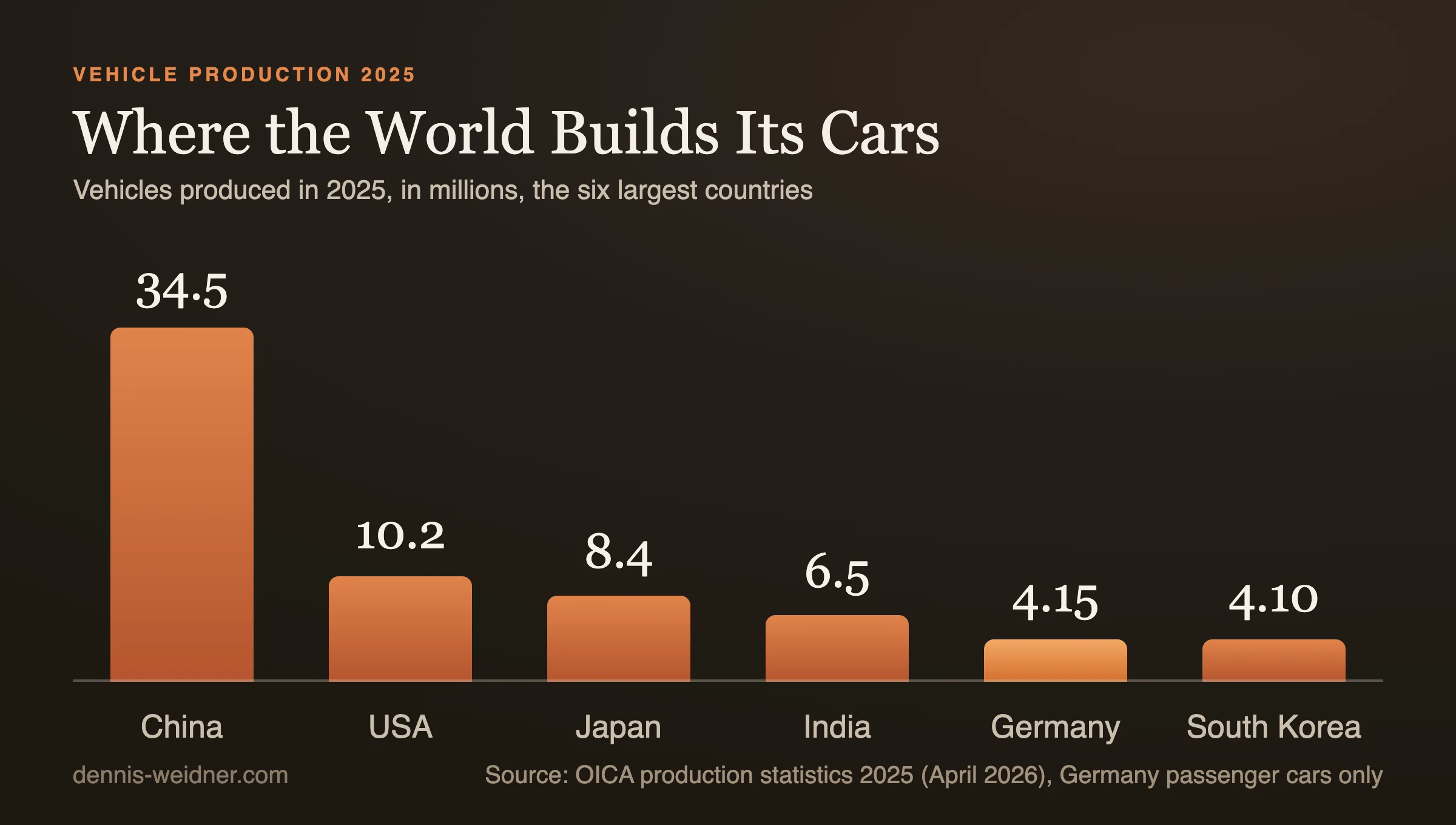
Among carmakers, Toyota leads with 11.3 million vehicles sold, ahead of the Volkswagen Group with just under 9 million and Hyundai-Kia with 7.3 million. With BYD, SAIC and Geely, three Chinese manufacturers are now among the ten largest in the world (CarNewsChina). BYD sold around 2.25 million battery electric cars in 2025, Tesla 1.64 million. In the world's most important single market, the German brands have lost their lead: their market share in China fell from 26 percent in 2019 to 16 percent in 2025, and Volkswagen is now only number three there, behind BYD and Geely (S&P Global Mobility via CarExpert).
| Market | New registrations 2025 | Change from 2024 | Electric share 2025 |
|---|---|---|---|
| China | 34.4 m | +9.4% | just under 55% |
| US | 16.7 m | +2.1% | around 10% |
| Europe (EU, EFTA, UK) | 15.5 m | +0.7% | 28% |
| India | 5.5 m | +5.5% | just under 4% |
| Japan | 4.6 m | +3.3% | under 3% |
| Southeast Asia (ASEAN) | 3.2 m | +0.6% | just under 20%, Vietnam almost 40% |
| Brazil | 2.7 m | +2.1% | 9% |
| World | 99.8 m | +4.7% | 25% |
New registrations of all vehicle types according to OICA; share of battery electric cars and plug-in hybrids in new passenger cars according to the IEA Global EV Outlook 2026
The table explains Audi's decision better than any speech. In the US, only around one in ten new cars is electric, and what people buy are large SUVs. Those are exactly what Audi wants to build in Georgia. In Europe, more than half of all new cars in 2024 were SUVs, 54 percent to be precise (JATO). And China, long the growth engine of the German carmakers, is even shrinking in 2026: from January to September, 12 percent fewer electric and hybrid cars were sold there than a year earlier, although in September two out of three new cars were electrified (CnEVPost, based on CPCA data). Growth in volume is on offer in India and Southeast Asia, but at prices set by Chinese manufacturers.
Car Industry and Defence: What Tanks Do for Germany's Growth
Less than the headlines suggest. When car plants become defence plants, that saves jobs, and I think it is right that Germany is spending more on its security. But defence is insurance, not a business model for an economy.
The conversion is already under way. Car production at Volkswagen's Osnabrück plant ends in 2027; under the key terms agreed in September, the investor Aurelius and the state of Lower Saxony will take a majority stake, and the first anchor project planned is the production of air defence components with the Israeli manufacturer Rafael. That gives 1,200 to 1,400 of the around 1,800 employees a future (ingenieur.de). Rheinmetall makes ammunition parts at the former Pierburg plant in Berlin-Wedding, and Schaeffler is working with the defence start-up Helsing; CEO Klaus Rosenfeld considers one billion euros in defence revenue achievable within five years, up from around 100 million today (dpa-AFX). For the people at these sites, that is good news. As an industrial strategy for an entire country, it falls short: converting car plants into defence plants manages a retreat instead of building the next growth industry.
The federal government is raising the defence budget from €82.7 billion in 2026 to €109.8 billion in 2027, according to the government's draft budget for 2027. Of the €118.7 billion in new borrowing in the core budget, €85.4 billion runs through the debt brake exemption for defence and security, a good 70 percent. Most of the rearmament is therefore financed on credit.
Even so, the money works, and noticeably. According to calculations by the German Economic Institute, higher defence spending lifts economic output by around 0.7 percent in 2026 and around 0.9 percent in 2027 above where it would otherwise be. Against expected growth of 1.3 percent, that is no marginal effect. The idea that defence is currently helping to hold the economy up is therefore not far-fetched.
It is expensive growth, though. Until 2021, around 70 percent of defence spending in EU countries went on running costs, roughly half of it on personnel alone, and whatever is imported has its effect abroad. In the short term, according to estimates by the European Central Bank, one euro spent on the military therefore generates only about 50 cents of additional economic output or less, while the IW arrives at about one euro (overview by the Federal Agency for Civic Education). The Kiel Institute for the World Economy is more optimistic: 0.9 to 1.5 percent more economic output in Europe if defence spending rises from 2 to 3.5 percent and is financed through borrowing. It expects lasting productivity gains above all if Europe develops and builds the systems itself. Even so, I consider every euro for grids, railways and bridges the better growth investment, because it makes companies more productive for good.
And Ukraine? Around €11.6 billion in military support is planned for 2027. With economic output of just under €5 trillion, that is a little over 0.2 percent. The bigger lever is Germany's own rearmament, not aid to Kyiv. Both support individual companies, and both are built on credit. An economy that draws its growth from defence makes it dependent on the next conflict. That is not the role I wish for Germany, even though I believe higher spending on our defence is right.
German Economy: What Growth Is Resting On Right Now
On the state, on borrowing and on a one-off effect. In their joint economic forecast of autumn 2026, Germany's leading economic research institutes expect growth of 1.3 percent this year, 1.1 percent in 2027 and only 0.4 percent in 2028. The report's title says almost everything: "Upswing with structural problems, fiscal policy going astray".
Look more closely and the picture becomes uncomfortable. Exports and industry grew in the first half of 2026 partly because competitors from the Gulf region dropped out as a result of the Iran war. Government consumption rose sharply, while private investment and consumption remained weak. The number of people in work falls to 45.7 million in 2026, and the general government deficit grows from 4.1 percent of economic output this year to 4.7 percent in 2028. The upswing rests on a narrow foundation, says Oliver Holtemöller of the Halle Institute for Economic Research (IWH), because high energy prices and structural problems weigh on it.
The federal budget tells the same story. For 2027, the federal government plans spending of €555.4 billion in the core budget, plus the special funds for infrastructure and the armed forces. Altogether it is taking on €203.7 billion in new borrowing, almost one in every three euros it spends. Interest payments alone rise by €11.6 billion to €41.9 billion in 2027, while investment in the core budget comes to €56.3 billion (Bundestag).
I consider debt for bridges, grids and schools justifiable, because it pays for tomorrow's growth. Debt that covers running costs only buys time. The question every budget politician should be asking is therefore not whether we can afford this, but what we do with the time we are buying.
Germany as an Industrial Location: What Has to Change Now
The structure, not just the budget. On the evening of Tuesday, 27 October, Michael Bröcker, editor-in-chief of Table.Briefings and from 2019 to 2023 editor-in-chief at Gabor Steingart's Media Pioneer, sat next to Saarland's state premier Anke Rehlinger on the ZDF talk show Markus Lanz. His verdict, paraphrased: energy and labour are too expensive, Germany is no longer competitive as a location, and savings alone will not solve that, it takes structural change. Five days earlier on the same programme, Lower Saxony's state premier Olaf Lies had admitted that there is no competing with the subsidised costs in China, and the investor Christian Miele asked how Germany intends to produce battery cells competitively at all. Handelsblatt editor-in-chief Sebastian Matthes considered Chinese cars technically better by now as well (WEB.DE recap).
I share that diagnosis, and I draw five conclusions from it that go beyond Audi.
- Make energy permanently cheaper instead of subsidising it for a limited time. Grid fees, levies and the build-out of grids and storage will decide the price of electricity for the next twenty years. Mid-sized companies can already lock in prices today with a long-term power purchase agreement.
- Cut taxes now, not only from 2028. Bringing forward the corporate tax cut would be the strongest signal to anyone deciding on a location today.
- Make labour more productive instead of cheaper. Germany will never compete with Mexican wages, and it should not try to. Audi's 7,500 jobs are going in indirect functions, not on the assembly line but where automation and AI agents will change the most in the coming years. Companies that adopt these tools early cut costs per car without cutting wages. That also means reforming social security before contributions rise any further.
- Cut red tape measurably. Up to €146 billion of lost economic output a year is a stimulus programme that costs the state nothing.
- Compete where we can win. In the mass market for low-cost electric cars and battery cells, we will not beat China on cost for the foreseeable future, not even with cheaper electricity. We can in premium vehicles, production technology, software, energy and security technology. Christian Miele put it roughly like this: Europe has to become a powerhouse of innovation. Germany already builds the second-most electric vehicles in the world. Something can be made of that.
Audi's US Plant: What I Take From It as an Entrepreneur
In Döllner's position, I would build the same factory. I just would not go on that stage. A company has to produce where its customers buy and where the costs work, and every founder learns that sooner or later. A country, on the other hand, cannot choose its location, it has to make it attractive.
Germany has more going for it than the mood suggests: engineers, research, the world's second-largest production of electric vehicles and a state that is putting a great deal of money on the table right now. The question is whether we spend it on structures or on time. I would like structures. And I would like the next big plant announcement by a German carmaker to take place in Ingolstadt, Wolfsburg or Zwickau again. Without a campaign stage. I collect more articles on questions like these under Politics and Society.
Frequently Asked Questions
Where is Audi building its plant in the US?
On the Middle Georgia Mega Site near Perry in the US state of Georgia. Construction is to begin in 2027, with production starting in the early 2030s. Up to 200,000 SUVs a year and around 4,500 jobs are planned. The Volkswagen Group's supervisory board still has to approve.
Why is Audi building a plant in the US?
Mainly because of tariffs: every imported car is charged 15 percent, which cost Audi €1.2 billion in 2025. Add to that the size of the US premium market and the aim of reducing trade and currency risks. BMW and Mercedes-Benz have been building in the US since the 1990s.
How many jobs is Audi cutting in Germany?
Around 7,500 by the end of 2029, in so-called indirect functions, not in production. Compulsory redundancies are ruled out until the end of 2033 under the job security agreement. At the same time, Audi plans to invest around €8 billion in its German sites.
Why was Döllner's appearance with Trump controversial?
Because it took place at a campaign rally ten days before the US midterm elections. Audi's own code of conduct rules out high-profile public appearances with parties or politicians in the three months before elections. Criticism came from the IG Metall union, Volkswagen's works council and politicians from several parties.
How expensive is Germany as a manufacturing location?
An hour in manufacturing cost €49.50 in Germany in 2025, the equivalent of around €42 in the US and €15.60 in Hungary. At 15 to 18 cents per kilowatt hour, industrial electricity costs roughly twice as much here as in the US and China. Corporate profits are taxed at a nominal rate of around 30 percent, compared with around 25 percent in the US including state tax.
Are labour costs in Germany five times higher than in China?
Per car built, yes: according to an analysis by Oliver Wyman, a car built in Germany contains $3,307 in labour costs, one built in China $597, a factor of 5.5. Compared with the US, the factor is 2.5, while per hour worked Germany is only just under 15 percent more expensive.
Does defence spending help the German economy?
Yes, noticeably: according to IW calculations, higher defence spending lifts economic output by around 0.7 percent in 2026 and around 0.9 percent in 2027. In the short term, however, one euro spent on the military generates only about 50 cents to one euro of additional output. The defence budget rises to €109.8 billion in 2027 and is mostly financed through borrowing.
This article is a personal assessment. It does not contain a recommendation to buy or sell shares in individual companies.
Best,
Dennis Weidner
Note: AI tools supported me in writing this article, and some images were edited with AI. I stand behind its content and every statement with my name.