Anthropic is owned mainly by Amazon, Google and its seven co-founders, who also keep voting control. After the IPO, Amazon holds about 14.5 percent of the 13.37 billion shares and Google about 13.3 percent, both without voting rights, while the co-founders hold about 12.5 percent and 50.1 percent of all votes. On Friday, 20 November 2026, the second trading day, the stock fell to $83.05 on Nasdaq, five cents above its $83 IPO price, and closed at $88.91. So who sold? The prospectus shows that each co-founder sold 3,378,378 shares in the offering, almost $2 billion in total, and that employees were allowed to sell up to 315 million shares from day one. Whether they did will start to show in filings from Monday. I read the filings with the SEC and sorted what is proven and what is not.
Anthropic stock in numbers (as of the New York close, 20 November 2026)
- $83 IPO price, 1.127 billion shares including the overallotment, $93.5 billion raised.
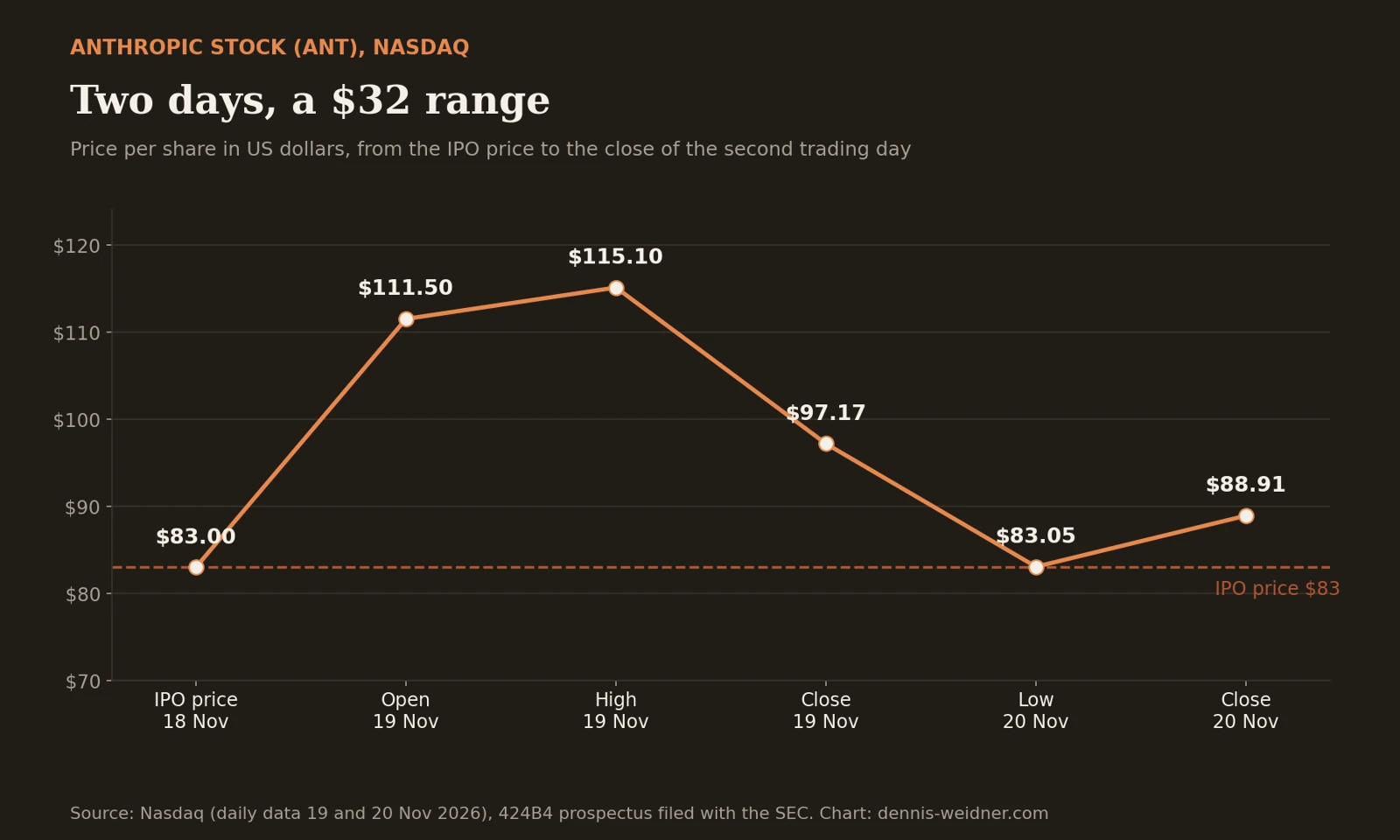
- $111.50 opening price on 19 November, high $115.10, close $97.17.
- $83.05 low on 20 November, close $88.91, market value just under $1.19 trillion.
- 1.26 billion shares changed hands on the first two trading days.
- 23,648,646 shares were sold by the seven co-founders in the IPO, 3,378,378 each.
- 15 December 2026: the next lockup release of up to 303 million shares.
Who owns Anthropic after the IPO
After the IPO, the concurrent private placement and the overallotment, Anthropic has 13.37 billion shares outstanding. The largest single holders are Amazon with 1.94 billion and Google with 1.77 billion shares, according to the final prospectus (424B4). Both hold only non-voting Class N stock. If Amazon converted its convertible notes in full without the agreed ownership cap, it would reach 23.6 percent of the capital. The seven co-founders together hold about 1.67 billion shares, and IPO buyers 1.127 billion.
More on this topic: Finance & Crypto Assets, with background, practice and every article in one place.
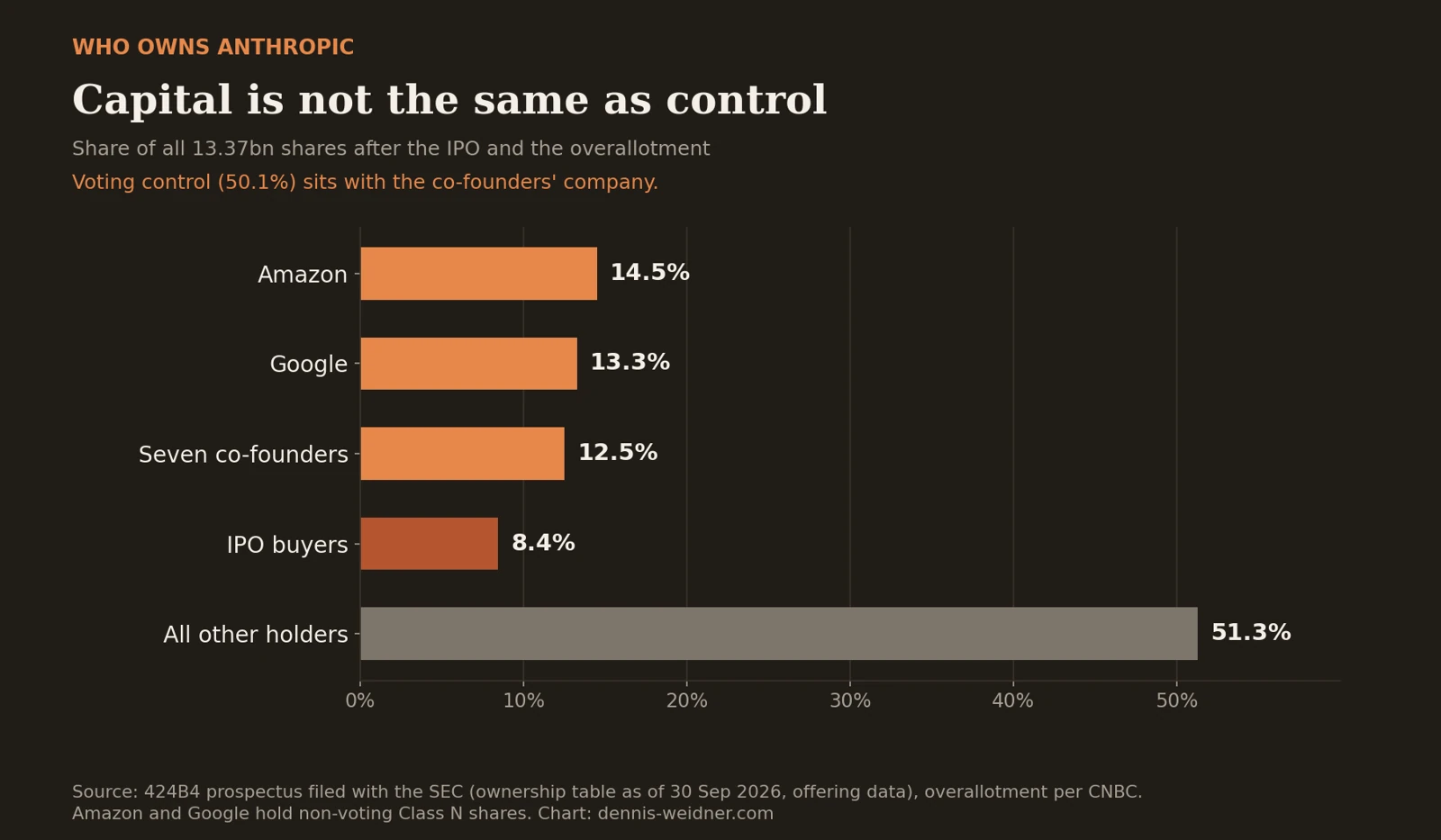
Control is a different matter. A special Class F share, held by a company of the co-founders, carries 50.1 percent of all votes. A special Class T share belongs to the Long-Term Benefit Trust, a body of independent trustees that elects the majority of the board. Anyone buying Anthropic stock on Nasdaq buys capital, not much of a say. For founders, it is an instructive model of raising money without giving up control. How founders in Germany usually hold their stakes, through a holding company, is explained in my piece on the holding company for founders.
Why I think this IPO matters for founders beyond the share price, I wrote on listing day in GTA 6 and the Anthropic IPO. The minute-by-minute story of the first day is in the live ticker on cryptoticker, the day-one balance in its market cap report.
Anthropic stock on day two: almost back to the IPO price
On Thursday the stock opened at $111.50, according to CNBC, rose to $115.10 and closed at $97.17. On Friday it kept falling. Nasdaq's daily data show an open at $89.86, a low at $83.05 and a close at $88.91. At the low, the stock was five cents above the IPO price, as 24/7 Wall St. also noted.
That means two things for investors. Anyone allocated shares at $83 is still up 7.1 percent. Anyone who bought at Thursday's open has lost about a fifth. Over the two days, 857 million and 400 million shares traded, more than were issued in the entire IPO.
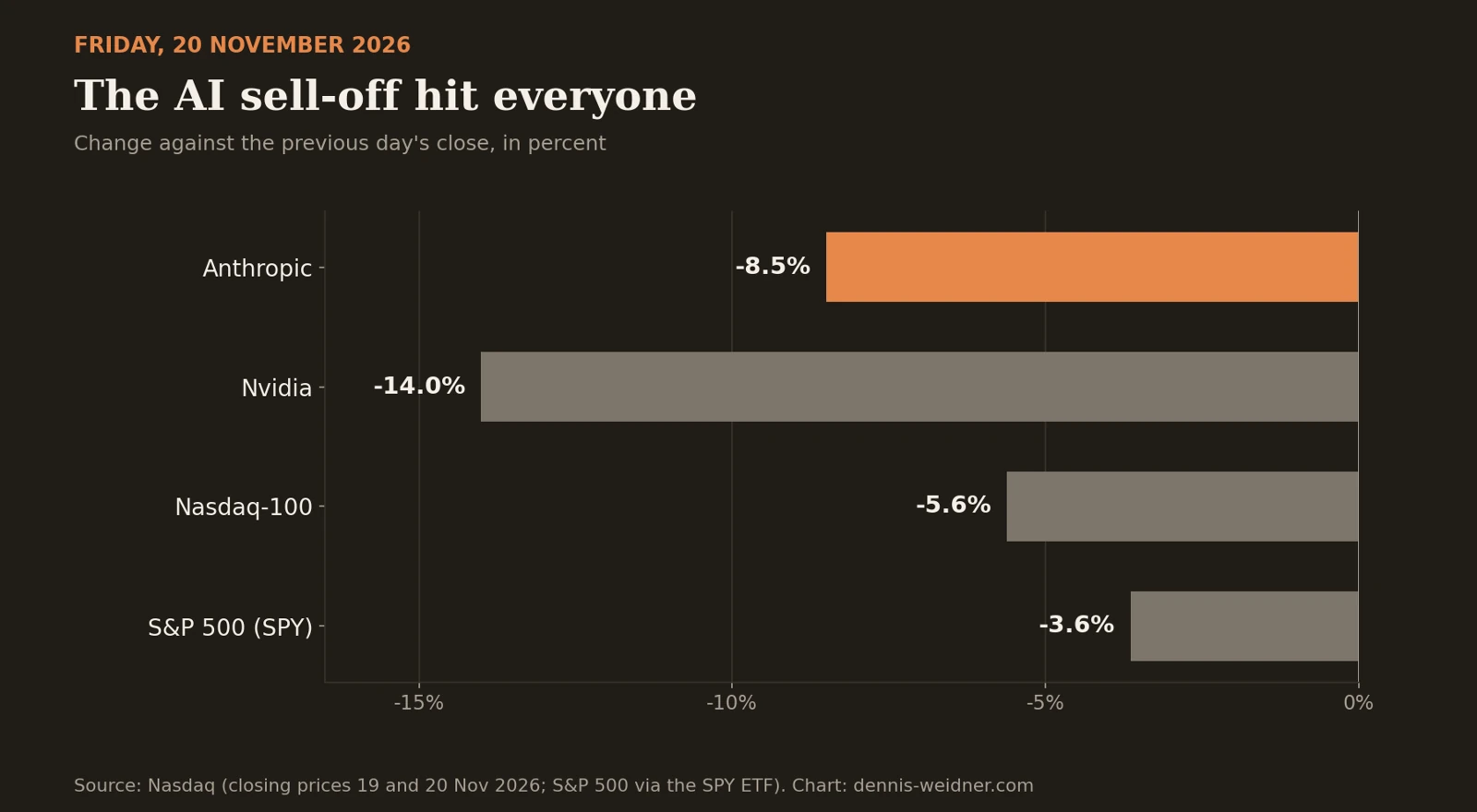
The drop has one main cause, and it is not Anthropic. On Friday Nvidia fell 14 percent to $125.53 after Reuters reported that the SEC is examining the chipmaker's accounting, as summarized by The Motley Fool. CNBC also points to worries that rising rates make the data center build-out more expensive, and to the leadership change at Nvidia. The Nasdaq-100 lost 5.6 percent on Friday and 10.4 percent over the week. Anthropic fell less than Nvidia.
Who sold Anthropic stock: what is proven and what is open
The short answer: only the sales in the IPO itself are documented. Anything that happened on the exchange afterwards can be traced from Monday at the earliest, and only for a small circle of insiders.
| Who | What is documented | What is open |
|---|---|---|
| Seven co-founders | sold 3,378,378 shares each at $83 in the IPO, $1.96 billion in total | further sales only after the lockup, up to 365 days for co-founders |
| Anthropic itself | 1.1 billion new shares including the overallotment, $91.6 billion before costs, plus $26 billion from a private placement | nothing open: this is fresh capital, not profit-taking |
| Employees, officers, directors other than founders | allowed to sell up to 315 million shares from the first trading day | officers' filings due 23 and 24 November; other employees do not report |
| IPO buyers | could sell from the first minute; brokers penalize flipping | names and amounts are not published |
| Underwriters | overallotment option exercised in full, Morgan Stanley is the stabilization agent | whether they supported the price at $83 on Friday is not disclosed |
| Amazon, Google, private placement partners | still holding, their shares are locked up or not freely tradable | first Class N shares unlock from 15 December |
Source: 424B4 prospectus dated 18 November 2026, CNBC on 20 November 2026.
The co-founders sold 1.4 percent of their Anthropic shares in the IPO
The prospectus lists all seven co-founders as selling stockholders: Dario and Daniela Amodei, Tom Brown, Jack Clark, Jared Kaplan, Sam McCandlish and Christopher Olah. Each sold exactly 3,378,378 shares. At $83 that is $280.4 million per person before the underwriting discount. Anthropic receives nothing from these sales.
| Co-founder | Shares before | Sold | Share of own stake |
|---|---|---|---|
| Dario Amodei | 240,637,980 | 3,378,378 | 1.4% |
| Daniela Amodei | 241,408,940 | 3,378,378 | 1.4% |
| Tom Brown | 244,173,040 | 3,378,378 | 1.4% |
| Jack Clark | 242,271,840 | 3,378,378 | 1.4% |
| Jared Kaplan | 242,351,170 | 3,378,378 | 1.4% |
| Sam McCandlish | 243,383,850 | 3,378,378 | 1.4% |
| Christopher Olah | 242,882,420 | 3,378,378 | 1.4% |
| Total | 1,697,109,240 | 23,648,646 | 1.4% |
Source: 424B4 prospectus, table "Principal and Selling Stockholders", holdings as of 30 September 2026.
The price is worth a look. The co-founders sold at the IPO price, not at the open. At Thursday's opening price, each would have received about $96 million more. That is normal in an IPO, because selling stockholders place their shares in the same offering as the company. I still read it as a signal: whoever keeps 98.6 percent of their shares and commits the rest for up to a year believes in the value. According to CNBC, Treasury Secretary Scott Bessent said one co-founder plans a large gift to the new "Trump Accounts" for children in the coming weeks; a person briefed on the plans named Tom Brown.
Anthropic itself sold 956,351,354 new shares. The underwriters exercised their option on 147 million more shares in full, according to CNBC, which lifted the deal to $93.5 billion. At the same time, AMD, Broadcom, Google, Micron, Microsoft, Nvidia and TSMC bought $26 billion of non-voting shares at the IPO price. Those shares are unregistered and cannot simply be sold on the exchange. This is fresh capital for the company, not an exit.
Could Anthropic employees sell right away? Yes, up to 10 percent
This is where Anthropic differs from almost every large IPO. Under the prospectus, directors, officers and current and former employees and consultants who are not founders may sell up to 10 percent of their locked-up shares from the first trading day. That is up to 315 million shares, about $28 billion at Friday's close. The chief financial officer and the chief accounting officer are named explicitly. On 19 November, Anthropic also filed a separate resale prospectus covering 121.9 million shares from its employee stock plan.
Whether that door was used, nobody outside the company knows yet. Directors and officers must report every sale within two business days on Form 4, so by Monday for Thursday's trades and by Tuesday for Friday's. As of Saturday noon, the SEC database showed no such filing, only eight initial Form 3 filings from 19 November. Ordinary employees do not have to report anything. Mathematically, insiders can have sold at most a quarter of the 1.26 billion shares traded.
There is a hint from the spring. In February, Anthropic let employees sell shares to investors at a $350 billion valuation. According to Bloomberg, many preferred to hold on. Today the company is worth more than three times as much, and according to CNN, almost all employees are now millionaires. If some sell a slice now to pay taxes or buy a home in San Francisco, that would be normal.
Who else sold Anthropic stock: IPO buyers, funds and fast traders
The largest group of potential sellers are the IPO buyers. Demand was so strong that more than half of institutional bidders got nothing, according to a Bloomberg report summarized by Newsquawk. About 15 percent went to retail investors, according to the Wall Street Journal. Those who were shut out bought at Thursday's open, which explains the jump above $110. Allocated investors who sold right away pocketed 34 percent at the open and almost 39 percent at the high.
Retail investors face a rule that discourages this: brokers often pass over customers who flip IPO shares quickly. According to CNBC, Fidelity counts sales within 15 days, Robinhood within 30 days. Funds face no such rule. Which firms sold is not published. Large money managers disclose their holdings only in quarterly 13F filings, for the fourth quarter by mid-February 2027.
Over the weekend, trading continues only on substitute markets, through perpetual futures on crypto exchanges. On Saturday at noon, the Bitget contract stood at $87.97, measured by the cryptoticker live ticker. Before Thursday's listing, these contracts traded at around $104. Anyone who bet on falling prices there is up about 15 percent, more with leverage. How this trading works and what the risks are is explained in the guide trade Anthropic stock.
Did the banks defend Anthropic's IPO price?
The $83.05 low raises the question of whether someone supported the IPO price. The prospectus names Morgan Stanley as the stabilization agent. Underwriters may allocate more shares than the offering contains and close that gap either through the overallotment option or by buying in the market. Under Regulation M, stabilizing bids may not exceed the offering price.
After the option was exercised in full, as CNBC reported on Friday, there is no covered short left that the banks would have to close by buying shares. They could only support the price through an additional, naked short position. Whether there was one is not disclosed anywhere. The stock turned exactly where stabilization would start. There is no proof of it. For comparison, Facebook closed about 10 percent below its IPO price on its second trading day in 2012. Anthropic held the line.
Anthropic lockup: when the next shares unlock
About 15.5 billion shares are covered by lockup agreements, according to the prospectus, generally for 180 days, and for co-founders and holders of more than 0.5 percent for up to 365 days. Anthropic does not release them on a single date but in more than 15 steps. That avoids the one big wave of selling many IPOs see after six months.
| Earliest sale date | Maximum released | Value at $88.91 |
|---|---|---|
| 19 November 2026 (first trading day) | 315m shares | $28.0bn |
| 15 December 2026 | 303m shares | $26.9bn |
| 5 January 2027 | 303m shares | $26.9bn |
| 19 January 2027 | 353m shares | $31.4bn |
| 2 February 2027 | 353m shares | $31.4bn |
| Second trading day after the FY2026 results | 1.7bn shares | $151.1bn |
| Then on the 13th, 27th, 41st, 55th and 69th day | 480m shares each | $42.7bn each |
| After the Q1 2027 results, at the latest after the close on 17 May 2027 | 3.0bn shares | $266.7bn |
| Then on the 34th, 48th, 62nd and 76th day | 447m shares each | $39.7bn each |
Source: 424B4 prospectus, section "Shares Eligible for Future Sale"; values at the 20 November 2026 close.
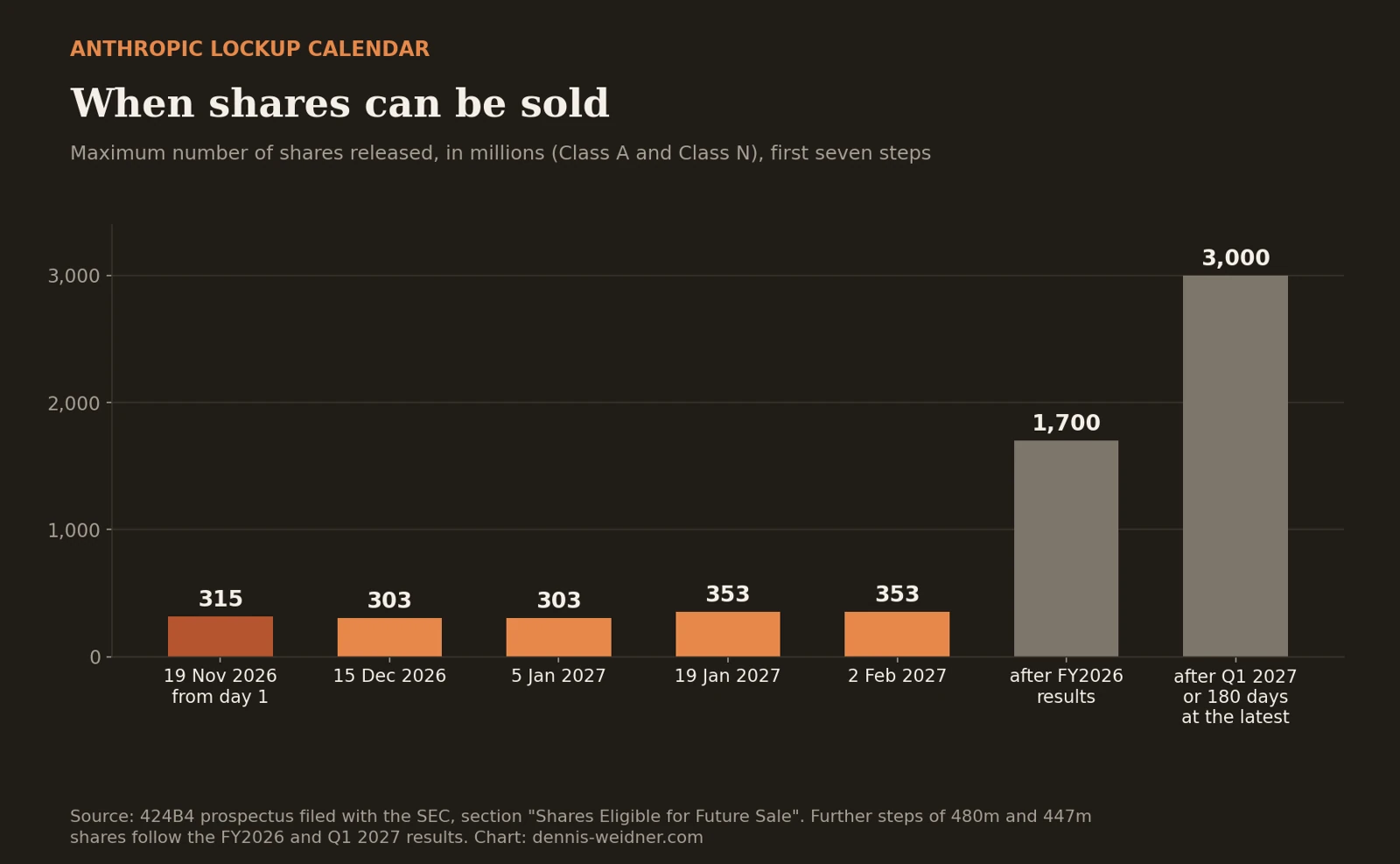
What comes next for Anthropic stock
- Monday, 23 November, and Tuesday, 24 November: deadlines for directors' and officers' Form 4 filings covering Thursday and Friday. Then we will know whether the CFO sold.
- 15 December: first release after the listing, up to 303 million shares, 129 million of them Class N.
- 21 December: according to a Bloomberg report cited by StockAnalysis, Anthropic could join the Nasdaq-100 under the new fast entry rule, which would force index funds to buy. Nasdaq has not confirmed this yet.
- FY2026 results: no date yet. Two trading days later, up to 1.7 billion shares unlock, the largest step before May.
- By mid-February 2027: 13F filings show which large funds held Anthropic at year-end.
Analysts disagree. Seaport Research rates the stock neutral, according to CNBC, and says growth must be much higher over the next two years to justify the valuation. William Blair rates it outperform and sees Anthropic as a highly profitable business over time.
My take: who did not sell Anthropic stock tells you more
With any IPO, I first look at who does not sell. The co-founders keep 98.6 percent and are locked up for up to a year. Amazon and Google cannot sell. Nvidia, Microsoft and the other partners put in another $26 billion at the IPO price on the same day. That is not a picture of people heading for the exit.
Friday's slide is mostly the market to me: when Nvidia loses 14 percent in a day, every AI stock goes down with it. The real test comes with the first results, because a large part of the locked-up shares unlock afterwards. I like the staggered release. It gives employees some liquidity early and spreads the selling pressure over many small dates instead of one big one. Smaller companies that give their staff equity should take note.
This article is not investment advice. Ways to buy, fees and savings plans are covered in the cryptoticker guide how to buy Anthropic stock. How I think about stakes and postponed IPOs as an investor is in postponed IPOs from a holding company's perspective.
Cover photo: Nasdaq MarketSite in New York, photo by Luca Marfè/Italia all'ONU, via Wikimedia Commons, licensed under CC BY 2.0, cropped.
Frequently asked questions about Anthropic stock
Who owns Anthropic?
The largest single shareholders are Amazon with about 14.5 percent and Google with about 13.3 percent of the 13.37 billion shares, both without voting rights. The seven co-founders hold about 12.5 percent together and, through their own company, 50.1 percent of the votes. The Long-Term Benefit Trust elects the majority of the board.
Who sold shares in the Anthropic IPO?
Besides Anthropic itself, the seven co-founders sold 3,378,378 shares each at the $83 IPO price, 23,648,646 shares in total for about $1.96 billion. That is about 1.4 percent of each founder's holding. The prospectus names no other selling stockholders.
Can Anthropic employees sell their shares?
Yes, but only part of them at first. Employees, officers and directors who are not founders may sell up to 10 percent of their locked-up shares from the first trading day, up to 315 million shares in total. Sales by officers appear as Form 4 filings with the SEC within two business days.
When does the Anthropic lockup expire?
The lockup ends in steps. The next release is on 15 December 2026, with up to 303 million shares. Large steps follow after the FY2026 results and after the Q1 2027 results, at the latest after 17 May 2027. For co-founders, the lockup lasts up to 365 days.
Why did Anthropic stock fall on its second day?
Mainly because of the AI sell-off on 20 November 2026. Nvidia lost 14 percent after a report that the SEC is examining its accounting, and the Nasdaq-100 fell 5.6 percent. Anthropic dropped 8.5 percent to $88.91, with a low of $83.05.
Warm regards,
Dennis Weidner
Note: AI tools supported me in writing this article, and some images were edited with AI. I stand behind its content and every statement with my name.