In Germany, direct marketing (Direktvermarktung, selling solar power on the exchange through a specialised trader) is mandatory for PV systems above 100 kilowatts. Below that threshold, owners can choose between the fixed feed-in tariff and direct marketing and switch every month. Doing it voluntarily rarely pays today: on a 30 kWp commercial roof, direct marketing with the market premium earns about €103 a year less than the fixed tariff, because service fees exceed the 0.4 cent per kilowatt hour bonus. It becomes interesting with a battery, with a buyer next door, and from 2027, when new small systems will be pushed into the market anyway.
As of 25 September 2026.
More on this topic: Battery Storage & Energy, with background, practice and every article in one place.
At what size is direct marketing mandatory for solar in Germany?
The obligation starts above 100 kilowatts. The law does not phrase it as a ban but as the limit of the fixed tariff: under Section 21(1) no. 1 of the Renewable Energy Sources Act (EEG), the feed-in tariff is only available for systems with an installed capacity of up to 100 kilowatts. Larger systems sell through a direct marketer and receive the market premium (Marktprämie) under Section 20 EEG. A fallback tariff cut by 20 percent exists, but only for a maximum of three consecutive months.
Below the threshold, the operator chooses a sales route (Veräußerungsform) under Section 21b EEG: fixed feed-in tariff, direct marketing with market premium, unsubsidised "other" direct marketing, or the tenant electricity bonus. How the fixed tariff has fallen over two decades is covered in Feed-in Tariffs in Decline.
How direct marketing with the market premium works
In direct marketing, the operator receives two payments: the exchange revenue from the direct marketer and the market premium from the grid operator. The premium closes the gap between the market value of solar power and the statutory reference price, the "applicable value" (anzulegender Wert). For systems commissioned since 2023, the law uses the annual market value rather than the monthly one: Annex 1 no. 4 EEG simply sets the premium as applicable value minus annual solar market value.
In direct marketing, the applicable value is 0.4 cents per kilowatt hour higher than the fixed tariff, because Section 53 EEG deducts this amount from feed-in payments. For a 30 kWp rooftop system commissioned between August 2026 and January 2027, the Federal Network Agency's tariff table gives a blended 7.41 cents in direct marketing and 7.01 cents under the fixed tariff. Those 0.4 cents have to pay the direct marketer.
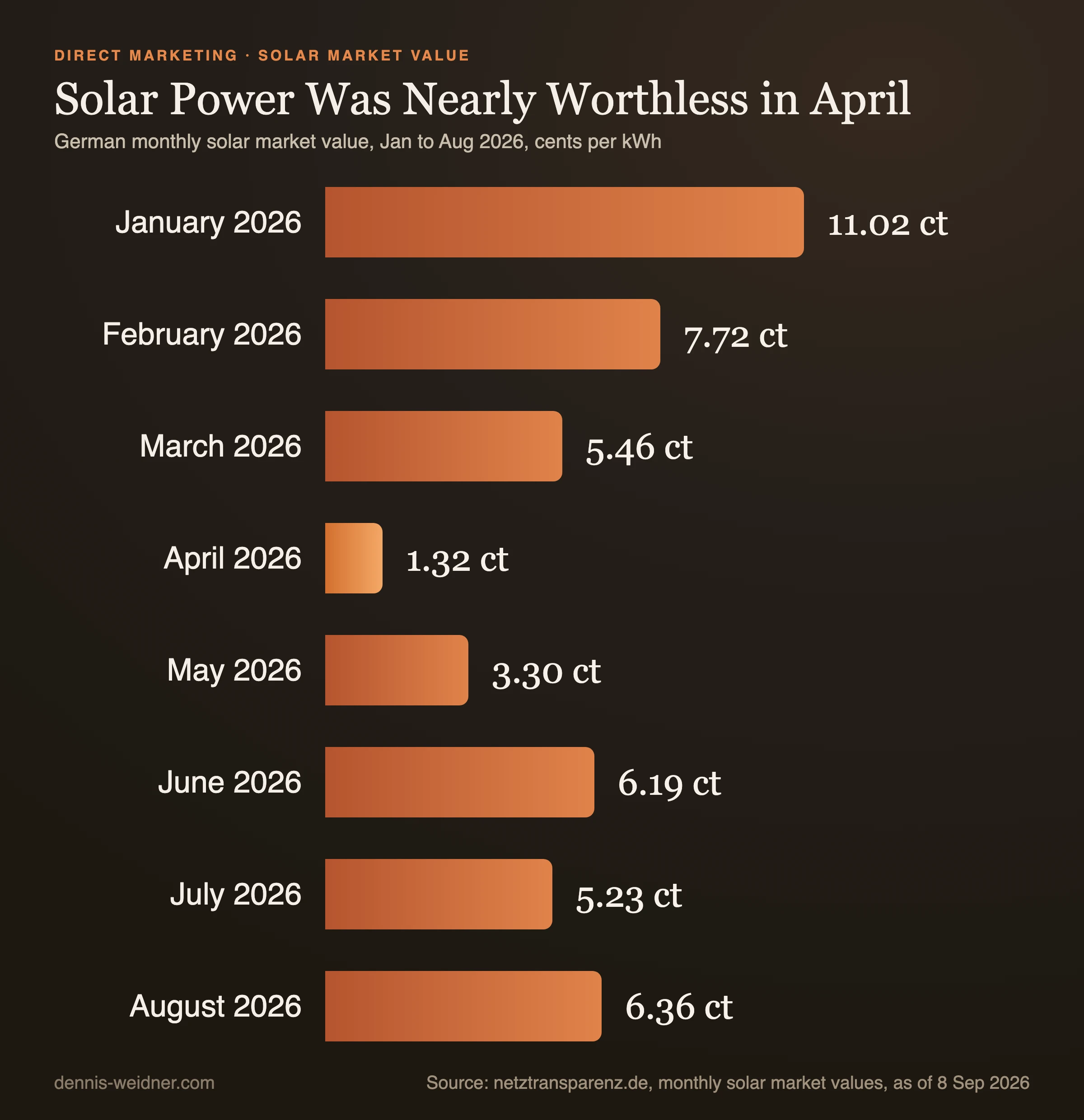
How little solar power is worth on the exchange alone is visible in the monthly market values that the four transmission system operators publish on netztransparenz.de. In April 2026 the value was 1.32 cents, in January 11.02 cents. For 2025 as a whole, the annual solar market value was 4.508 cents, against an average of 8.932 cents across all hours. Solar earns roughly half of what an average kilowatt hour fetches, because every system delivers at the same midday hours.
What Germany's 2025 solar peak law changed for direct marketing
Since 25 February 2025, the so-called solar peak law (Solarspitzengesetz) has applied three rules to new systems. First, the applicable value drops to zero whenever the exchange price is negative (Section 51(1) EEG), under the fixed tariff and in direct marketing alike. Systems below 100 kilowatts are only affected from the end of the year in which a smart meter is installed. In return, the support period is extended by half of the lost time, converted into full-load quarter hours (Section 51a EEG).
Second, systems between 25 and 100 kilowatts on the fixed tariff must cap their feed-in at 60 percent of capacity until a smart meter and control unit are installed and successfully tested (Section 9(2) EEG). In direct marketing this cap does not apply. Instead, the direct marketer must be able to control the system remotely under Section 10b EEG, from 2028 via the smart meter gateway.
Third, the number of affected hours has grown. According to the Federal Network Agency, the wholesale price was negative in 573 of 8,760 hours in 2025, up from 457 in 2024. Overlaying the hourly generation and price data from SMARD, the agency's data platform, shows that just over 24 percent of German solar output in 2025 fell into exactly those hours. For a new system with a smart meter, almost a quarter of its feed-in earns no support.
What direct marketing costs for a small PV system
Solid figures come from the analysis Vom Hausdach in den Strommarkt ("From the rooftop into the power market"), prepared by Fraunhofer ISE for the think tank Agora Energiewende in summer 2026. For small systems it assumes a one-off set-up fee of €200, a fixed service fee including balancing costs of €142.80 a year, and a variable fee of 3 percent of market revenue. The authors see direct marketing as attractive for small rooftops only once fixed costs fall to €30 to €50 a year.
Two items depend on the system. Remote control for the direct marketer needs hardware if none is installed. The smart meter, by contrast, is not an extra cost of direct marketing: it is planned anyway for systems above 25 and up to 100 kilowatts, and Section 30 of the Metering Point Operation Act caps the connection user's share at €140 a year. Why installation still often drags on is explained in Germany's Smart Meter Rollout 2026.
Worked example: direct marketing for a 30 kWp commercial solar roof
The table compares one operating year. Assumptions: 30 kWp on a commercial building, commissioned in autumn 2026, 950 kilowatt hours per kWp per year (the specific yield Fraunhofer ISE uses in its solar fact sheet), 30 percent self-consumption, smart meter installed, share of negative hours as in 2025, direct marketing costs as in the Agora analysis, annual solar market value as in 2025.
| Item | Fixed feed-in tariff | Direct marketing with market premium |
|---|---|---|
| Annual yield (30 kWp × 950 kWh) | 28,500 kWh | 28,500 kWh |
| Fed into the grid (70 percent) | 19,950 kWh | 19,950 kWh |
| Rate per kWh | 7.01 ct | 7.41 ct (exchange revenue plus premium) |
| Revenue before deductions | €1,397.83 | €1,477.63 |
| No payment in negative hours (24.13 percent) | −€337.30 | −€356.55 |
| Fixed service fee | €0.00 | −€142.80 |
| Variable fee (3 percent of €682.33 market revenue) | €0.00 | −€20.47 |
| Result per year | €1,060.53 | €957.81 |
| One-off | €0.00 | €200.00 set-up |
Direct marketing trails the fixed tariff by €102.72 a year, plus the set-up fee. Without negative hours the gap would be €89.98, so the loss is driven by fixed costs, not negative prices. Working backwards, direct marketing breaks even at these costs from about 71,000 kilowatt hours fed in per year. At the same self-consumption rate, that is a system of roughly 107 kWp, almost exactly the size at which it becomes mandatory anyway.
Without a smart meter, the negative-hours line disappears under the fixed tariff, but the 60 percent cap applies instead. The fixed tariff stays ahead.
Switching to direct marketing: monthly, with notice
Operators of systems up to 100 kilowatts can switch between sales routes on the first calendar day of any month, and back again (Section 21b(1) EEG). They must notify the grid operator before the start of the preceding calendar month (Section 21c(1) EEG). Anyone who wants to move into direct marketing on 1 January 2027 must therefore notify before 1 December 2026, including the direct marketer's balancing group. The whole feed-in must be measured in quarter-hour intervals (Section 21b(3) EEG).
Direct marketing for small solar from 2027: the government bill
The federal government introduced the EEG 2027 on 7 September 2026 as Bundestag printed paper 21/7867; the first reading took place on 24 September 2026. It is meant to take effect on 1 January 2027. For small solar systems the bill provides:
- No fixed tariff for new systems. It is replaced by a temporary transition payment for up to 36 months, 1 cent below the applicable value. It is open to systems below 50 kilowatts commissioned before 2028, below 25 kilowatts until the end of 2028, and below 7 kilowatts until the end of 2030.
- One flat rate. The applicable value for solar outside the auctions is to be a uniform 6.2 cents; the size classes for rooftop systems disappear.
- A direct marketing bonus. Under the new Section 50c, systems below 25 kilowatts in unsubsidised direct marketing receive 1.5 cents per kilowatt hour fed in, for a maximum of 48 months.
- A permanent feed-in cap. New rooftop systems below 100 kilowatts may feed in no more than 50 percent of their capacity, regardless of smart meter and sales route.
Under the bill, systems commissioned before 1 January 2027 stay under the current rules, including the monthly right to switch. What else remains of solar support is covered in Solar Subsidies: What Is Left in 2026.
Who benefits from voluntary direct marketing of solar power
Without a battery and without a buyer of my own, I would keep a system below 100 kilowatts on the fixed tariff today: a 0.4 cent bonus on 20,000 kilowatt hours does not cover €143 in fixed costs.
Three cases look different. With a battery, the system can charge at noon and feed in during the evening, when prices are several times higher. Because the premium is calculated against the annual market value of all solar systems, any revenue the own power earns above that average stays, in principle, with the operator. Second, the fixed tariff rules out supplying neighbours: according to the Federal Network Agency, the feed-in tariff and energy sharing under Section 42c of the Energy Industry Act exclude each other, so anyone who wants to share must assign the system to a form of direct marketing. Third, the calculation tips anyway from 2027, because new systems lose fixed payments after 36 months.
My conclusion: direct marketing is not a business for the pure feed-in system but for the controllable one. Anyone planning a roof with storage should factor it in from the start. How storage earns money in the power market is collected under BESS and Energy Storage.
Frequently Asked Questions
From what size is direct marketing mandatory for solar in Germany?
Above an installed capacity of 100 kilowatts. Up to and including 100 kilowatts, Section 21 EEG grants the fixed feed-in tariff; above that, only the market premium through a direct marketer is available.
How much does a direct marketer charge for a small PV system?
The Fraunhofer ISE and Agora Energiewende analysis from summer 2026 assumes €200 for set-up, €142.80 a year in fixed fees and 3 percent of market revenue. Offers vary, and according to the same analysis only a few providers offer direct marketing for systems below 100 kWp at all.
Can I switch back from direct marketing to the feed-in tariff?
Yes, for systems up to 100 kilowatts, on the first of any month. The grid operator must be notified before the start of the preceding month. Under the government bill, new systems from 2027 will no longer have a fixed tariff.
Do I still get paid for solar power when prices are negative?
Not for systems commissioned since 25 February 2025 once a smart meter is installed; for systems below 100 kilowatts this applies from the end of the installation year. Half of the lost time is added to the end of the support period.
Does direct marketing pay off with a battery?
More likely than without. The battery shifts feed-in from midday into pricier evening hours, and extra revenue above the annual solar market value stays with the operator. Whether that covers the fixed costs depends on battery size and control.
Note: This article is not legal advice. It describes Germany's EEG 2023 as of 25 September 2026 and the government bill for the EEG 2027, which may still change in parliament. The worked example simplifies: a real system's feed-in profile differs from the national average, the extension of the support period under Section 51a EEG is not included, and direct marketers' terms vary. Next review of this article: after the Bundestag vote on the EEG 2027.
Best,
Dennis Weidner
Note: AI tools supported me in writing this article, and some images were edited with AI. I stand behind its content and every statement with my name.