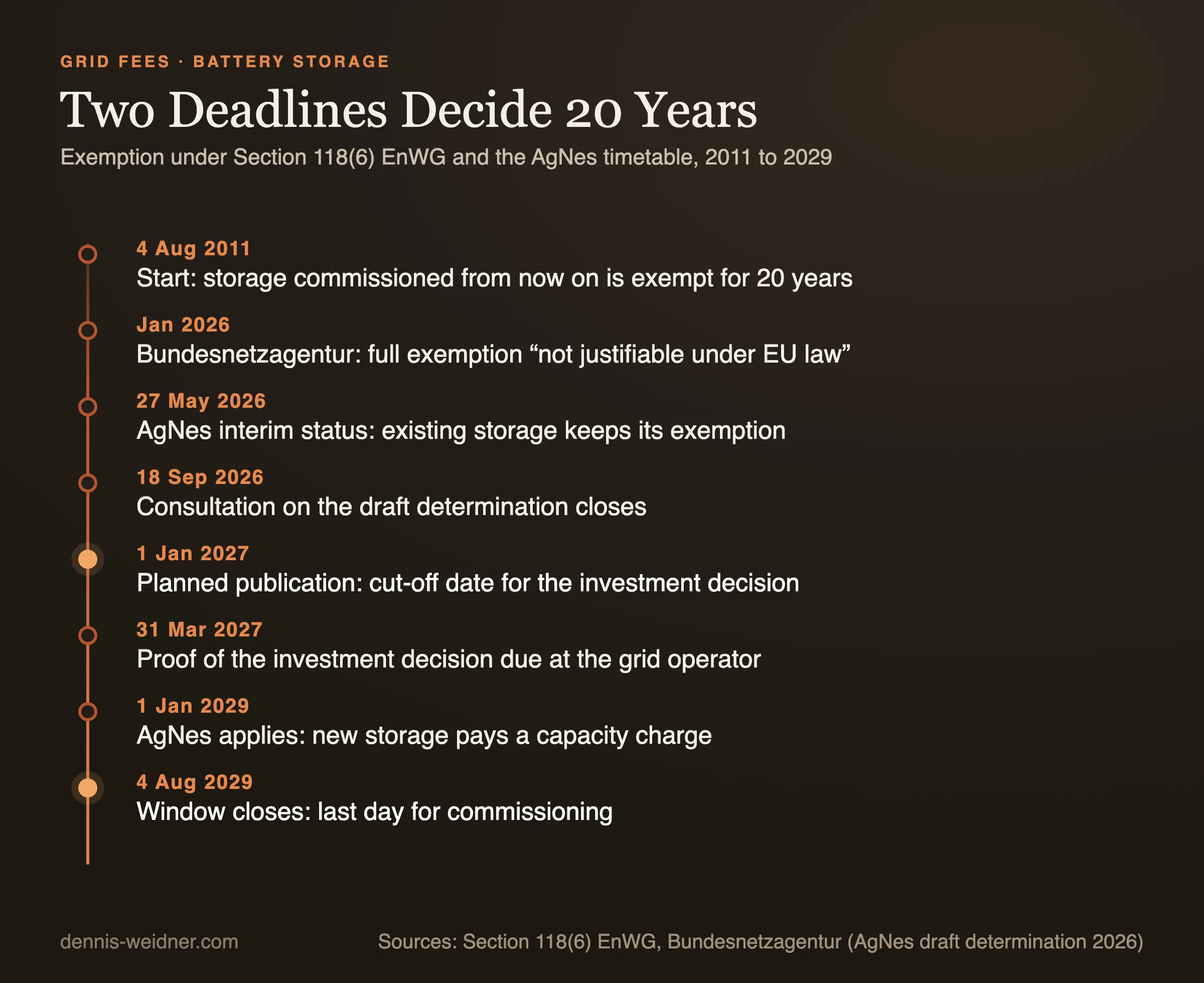
In Germany, battery storage commissioned by 4 August 2029 is exempt from grid fees on its charging power for 20 years under Section 118(6) of the Energy Industry Act (EnWG). Under the regulator's draft determination from summer 2026, that date alone is no longer enough: the exemption only survives for projects whose final investment decision is taken before the new tariff framework, AgNes, is published, planned for 1 January 2027. All other storage pays a capacity charge from 2029, expected at 4 to 7 euros per kilowatt per year.
As of 25 September 2026. Not legal advice, see the note at the end.
More on this topic: Battery Storage & Energy, with background, practice and every article in one place.
What the grid fee exemption for battery storage under Section 118(6) EnWG covers
The grid fee exemption frees storage from network charges on the electricity it draws to charge. According to Section 118(6) sentence 1 EnWG (German statute text), it applies to facilities commissioned within 18 years from 4 August 2011, for 20 years from commissioning. The window therefore closes in early August 2029. Parliament has not extended it. If you plan against the last day, plan for 3 August 2029, not the 4th.
Sentence 6 defines commissioning as the first draw of electricity for trial operation, not the start of commercial operation. That distinction is worth real money in any construction schedule, because the first trial draw can come weeks before acceptance.
Only the charging energy is exempt. Feeding power into the grid carries no network charge in Germany anyway (Section 15(1) of the Electricity Network Charges Ordinance, StromNEV). Connection cost contributions and metering are separate items. How the exemption interacts with electricity tax and the origin of the power is covered in my piece on grey, green and mixed storage.
Which volumes the grid fee exemption for storage applies to
The exemption only applies to the extent that the stored energy is fed back, with a time delay, into the same grid (sentence 3). Since an amendment in December 2025, sentence 3 also refers to Section 21 of the Energy Financing Act (EnFG). The Federal Network Agency (Bundesnetzagentur) reads this as extending the exemption to storage that returns only part of its output to the grid. Before, a battery that also supplied a consumer on site was a problem case.
For allocating volumes, the reference imports the EnFG logic: grid withdrawal and storage consumption are compared for every quarter hour, and the lower value counts. For a pure grid-connected battery that charges from and discharges to the grid only, this is straightforward. For co-located systems, metering decides what is exempt. Section 21(4) EnFG requires the volumes to be measured or separated in line with calibration law. Surplus or shortfall volumes that cannot be allocated this way are not privileged and go through normal grid fee billing.
Grid fees for storage from 2029: what the regulator plans under AgNes
AgNes stands for Allgemeine Netzentgeltsystematik Strom, the general grid tariff framework for electricity. Because the StromNEV expires at the end of 2028, the Bundesnetzagentur will set grid tariffs itself from 1 January 2029. The proceeding has been running since May 2025 under file number GBK-25-01-1#3. In January 2026, the ruling chamber wrote in its guidance paper on storage that a full exemption was "not justifiable under EU law". It even considered treating existing storage the same from 2029. The statute gives it the power to do so: sentence 12 allows the regulator to deviate from the exemption, explicitly including its time scope.
The interim status of 27 May 2026 (in German) reversed course: existing storage only starts paying once its Section 118(6) exemption runs out. New storage pays a "moderate capacity price" equal to the charge for generators, whose feed-in charge is expected to start at 4 to 7 euros per kilowatt per year. Dynamic grid fees for storage are to come no earlier than 2030, ideally by 2033.
Grid fee exemption for battery storage: the new cut-off is the investment decision
The Bundesnetzagentur published the full AgNes draft determination in August 2026, with comments accepted until 18 September 2026. Operative item 17.5 contains the sentence that moves project plans: the Section 118(6) exemption is only granted to storage whose final investment decision was taken before the determination is published. Publication is planned for 1 January 2027.
The draft defines a final investment decision narrowly. Binding orders must cover at least half of the investment volume, and the operator must be unable to exit those contracts without substantial financial loss. In its reasoning, the chamber assumes such a loss at least when exiting would cost 25 percent or more of the investment volume. Proof is due at the grid operator by 31 March 2027.
A battery that orders cells and inverters in spring 2027 and connects in summer 2028 would not be exempt under the draft, even though it is commissioned before August 2029.
Worked example: grid fees for a 50 MW battery without the exemption
A published tariff sheet shows what a battery would pay if charged like an ordinary large consumer. The 2026 tariff sheet of enercity Netz, the Hanover grid operator, lists for the high-voltage level below 2,500 utilisation hours an annual demand charge of 5.58 euros per kilowatt and an energy charge of 4.94 cents per kilowatt hour. A two-hour battery stays below that threshold: even at two full cycles a day it reaches only 1,460 hours. Why 2,500 hours switches the tariff system is explained in the piece on load profiles and demand charges.
Assumptions: 50 megawatts of power, 100 megawatt hours of capacity, an annual peak of 50 megawatts, 100 megawatt hours of grid withdrawal per full cycle, losses not added separately. The revenue benchmark is the Battery Revenue Index of RWTH Aachen University. For a two-hour battery it stood at about 259,000 euros per megawatt in 2025, which scales to 12.95 million euros for 50 megawatts.
| Cycles per year | Grid withdrawal | Demand charge | Energy charge | Total grid fees | Share of 2025 revenue |
|---|---|---|---|---|---|
| 200 | 20,000 MWh | €279,000 | €988,000 | €1,267,000 | 9.8% |
| 300 | 30,000 MWh | €279,000 | €1,482,000 | €1,761,000 | 13.6% |
| 365 | 36,500 MWh | €279,000 | €1,803,100 | €2,082,100 | 16.1% |
| 450 | 45,000 MWh | €279,000 | €2,223,000 | €2,502,000 | 19.3% |
| 550 | 55,000 MWh | €279,000 | €2,717,000 | €2,996,000 | 23.1% |
| 730 | 73,000 MWh | €279,000 | €3,606,200 | €3,885,200 | 30.0% |
In this tariff band the demand charge barely matters. What counts is the energy charge on every kilowatt hour charged, and it grows with each cycle. A battery that trades up to twice a day, as the index assumes, would hand almost a third of its 2025 revenue to the grid operator. Based on the weak first quarter of 2026, annualised at 132,000 euros per megawatt or 6.6 million euros, it would be 59 percent. That is why the exemption exists.
What losing the grid fee exemption means for project economics
The tariff sheet, however, describes a world that new storage will not face. The StromNEV ends in 2028, AgNes follows. The table compares the regimes that can actually apply, again for 50 megawatts at high voltage.
| Regime | Grid fees per year | Share of 2025 revenue | Share of Q1 2026 revenue |
|---|---|---|---|
| Exemption under Section 118(6) EnWG | €0 | 0% | 0% |
| AgNes draft, capacity charge €5/kW (range €4 to €7) | €250,000 (€200,000 to €350,000) | 1.9% | 3.8% |
| Individual charge under Section 19(4) StromNEV (until end of 2028) | €570,814 | 4.4% | 8.6% |
| Standard tariff sheet, 365 cycles | €2,082,100 | 16.1% | 31.5% |
The AgNes line is based on the contracted connection capacity and does not depend on cycles. The draft sets no energy charge on charged volumes for grid-connected storage. In its reasoning, the chamber itself works with a rolling average of 4.92 to 5.14 euros per kilowatt. The Section 19(4) StromNEV line shows what a non-exempt battery can claim as an individual charge until the end of 2028: the upper-band demand charge of 117.09 euros per kilowatt, reduced to the share of power not returned to the grid. The example assumes 9.75 percent losses, matching the 90.25 percent efficiency used by the revenue index.
Over 20 years, a capacity charge of 5 euros per kilowatt adds up to 5 million euros, nominal and without price increases. That hurts, but it does not break a project that works on today's revenues. The second stage is still open: dynamic incentive charges between 2030 and 2033 at the latest, whose level nobody knows yet. They can burden a battery that runs against grid conditions and reward one that relieves the grid. Where the revenues come from in the first place is broken down in the piece on the revenue stack of a grid battery.
The grid fee exemption as a value driver: my view for developers
In my view, the grid fee exemption is no longer a commissioning question in 2026, it is a procurement question. Anyone with a grid connection offer and secured land should check whether binding orders for at least half of the investment volume can be placed by year end, and structure the contracts so that walking away is costly enough to count as final. That costs flexibility on cell prices, but buys 20 years without grid fees. For 50 megawatts, that is about 250,000 euros a year under the draft.
The commissioning date remains the second hurdle. A project that decides in time but first draws trial power on 5 August 2029 still loses the exemption. I would keep at least six months of buffer before August 2029 in any schedule, because grid connections and substations rarely arrive on time.
For projects that can no longer make the cut-off, the news is better than its reputation. Under the draft, losing the exemption costs roughly 2 to 4 percent of revenue, not 30. A business plan that uses the standard tariff sheet undervalues such projects. More on storage is collected under BESS and energy storage.
Frequently Asked Questions
By when must a battery be commissioned to be exempt from German grid fees?
Under Section 118(6) EnWG, within 18 years from 4 August 2011, so by early August 2029. The first draw of power for trial operation counts as commissioning. Under the AgNes draft, the investment decision must also have been taken before 1 January 2027.
How long does the grid fee exemption for storage last?
20 years from commissioning. A battery commissioned in July 2029 stays exempt until July 2049, to the extent it feeds the charged power back into the same grid.
What will a battery pay from 2029 without the exemption?
Under the Bundesnetzagentur's draft, an annual capacity charge on the contracted connection capacity, equal to the feed-in charge for generators. It is expected to start at 4 to 7 euros per kilowatt, and the draft sets no energy charge on charged power.
What counts as a final investment decision under AgNes?
Binding component orders covering at least half of the investment volume, which the operator cannot exit without substantial financial loss. The draft requires proof at the responsible grid operator by 31 March 2027.
Is co-located storage with solar exempt from grid fees?
Proportionally, since sentence 3 of Section 118(6) was amended in December 2025: grid withdrawal is exempt to the extent the power goes back to the grid. Allocation follows Section 21 EnFG and requires quarter-hourly metering.
Note: This article is not legal advice. It describes German law as of 25 September 2026. The AgNes determination only exists as a draft, and the cut-off date, the definition of the investment decision and the level of the capacity charge may still change before publication. The worked example simplifies: it uses a single tariff sheet, ignores losses in the tariff sheet case and relies on a revenue index based on backtests with known prices. Next review of this article: after the AgNes determination is published.
Best,
Dennis Weidner
Note: AI tools supported me in writing this article, and some images were edited with AI. I stand behind its content and every statement with my name.