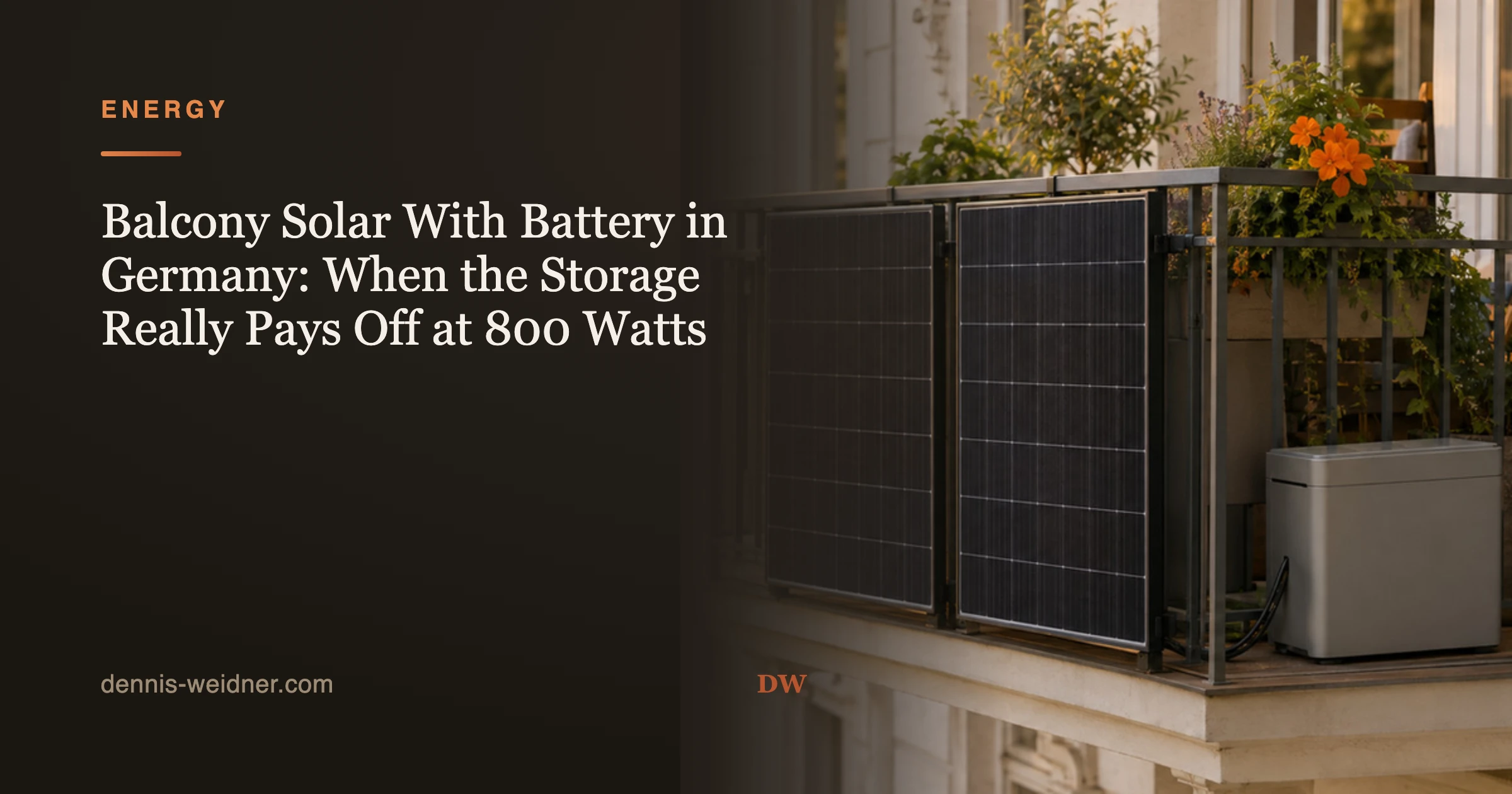
In Germany, a balcony solar system with an 800 watt inverter and four panels saves a household that uses 2,500 kilowatt hours a year about €197 annually at a power price of 37 cents, and about €350 with a 2 kWh battery. The battery, at roughly €750, pays for itself in just under five years. With only two panels it takes nine to thirteen years, which makes it marginal at best.
As of 25 September 2026. Not legal advice, see the note at the end.
More on this topic: Battery Storage & Energy, with background, practice and every article in one place.
Balcony Solar in Germany 2026: What the 800 Watt Rules Allow
German law allows up to 2,000 watts of panel capacity and 800 volt-amperes of inverter output per household. Both limits have been in Section 8(5a) of the Renewable Energy Sources Act (EEG) since the Solar Package I of May 2024. Below those limits, the only paperwork is an entry in the Marktstammdatenregister, the federal register of all power plants run by the Federal Network Agency: five technical details, filed within one month of first plugging in. The grid operator may not demand any separate notification; the agency informs it.
Three more rules make the start easy. An old analogue meter may keep running until it is replaced, even if it spins backwards when the panels produce a surplus; Section 10a(3) EEG treats its readings as correct until then. The metering operator then installs a bidirectional meter without the household having to order it. What that means for your meter cabinet is covered in my piece on Germany's smart meter rollout. Since October 2024, tenants and flat owners have a legal claim to approval: Section 554 of the Civil Code (BGB) and Section 20(2) no. 5 of the Condominium Act (WEG) list plug-in solar among privileged alterations. And private buyers pay no VAT on the purchase.
The catch is technical. The product standard DIN VDE V 0126-95, in force since December 2025, allows an ordinary household plug (the German Schuko plug) only up to 960 watts of panel capacity. Anything above that, up to the legal 2,000 watts, requires a dedicated energy socket installed by an electrician, according to the guidance of the standards body DKE. The standard applies to new devices only; systems already running are unaffected.
Balcony Solar With Battery: Still a Special Case in German Law
Add a battery and the system currently drops out of the simplified legal route. The Clearingstelle EEG|KWKG, the federal body that clarifies EEG disputes, states in its version of 23 September 2026 that plug-in solar and battery combinations are not covered by the legal definition of a plug-in solar device in Section 3 no. 43 EEG. Since March 2026 the grid code VDE-AR-N 4105 does offer a simplified connection process up to 800 VA, including very small batteries, but it requires a notice to the grid operator. The consumer advice centre Verbraucherzentrale recommends asking your own grid operator; some waive the notice for plug-in batteries. The battery must be entered in the Marktstammdatenregister in any case.
That is set to change in 2027. The government bill for the EEG 2027 (Bundestag printed paper 21/7867 of 7 September 2026) adds a storage unit operated "behind the same inverter" to the definition. The capacity limits would then apply to the panels only, not to the battery. The new rule capping feed-in of new solar systems at 50 percent would not apply to balcony systems. The Bundestag debated the bill at first reading on 24 September 2026 and referred it to the Committee on Economic Affairs and Energy. The planned start date is 1 January 2027. Buyers should therefore look for DC coupling, meaning a battery that sits between the panels and the same inverter.
How Much Power an 800 Watt Balcony Solar System Produces
A balcony system with four panels produces between 1,070 and 1,560 kilowatt hours a year, depending on orientation. The figures come from the calculation model behind the plug-in solar simulator of HTW Berlin, a university of applied sciences, which uses minute-by-minute weather data from the Lindenberg observatory in Brandenburg and 41 measured household load profiles. For comparison, Fraunhofer ISE puts a new south-facing solar plant with good irradiation at around 1,080 kilowatt hours per kilowatt.
On a balcony the yield is lower. Vertical mounting on the railing loses irradiation, and with 2,000 watts of panels the 800 watt inverter clips the midday peaks. Tilted south, that leaves 778 kilowatt hours per kilowatt of panel capacity; vertical and facing south, 610. Two panels with 960 watts combined deliver 665 kilowatt hours vertical facing south and 553 facing east.
Balcony Solar Self-Consumption With and Without a Battery
Without a battery, a household using 2,500 kilowatt hours a year consumes only 44 percent of what four vertical south-facing panels produce. The rest flows into the grid during the day, unpaid: German plug-in solar devices are assigned to free acceptance by the grid operator. Why feeding in barely pays anyway is explained in Feed-in Tariffs in Decline.
A 2 kWh battery lifts the self-consumption rate in the HTW model to 78 percent. The household then covers 38 instead of 21 percent of its own demand. With two panels the effect is smaller, because 57 percent is used directly anyway and little surplus is left for the battery.
What Balcony Solar With a Battery Costs in 2026
A set with two standard panels costs €200 to €300 according to the Verbraucherzentrale, two additional panels €100 to €200, and mounting €50 to €100 per panel. For a four-panel set with mounting I therefore assume €700. The Verbraucherzentrale puts the extra cost of a battery at €500 to €1,000; I use €750. Its Lower Saxony branch quotes €200 to €400 per kilowatt hour of storage capacity, which supports that range.
Worked Example: Balcony Solar With Battery Versus Without
The table compares four panels with 2,000 watts, mounted vertically on a south-facing balcony, 800 watt inverter, no shading, household demand of 2,500 kilowatt hours. Every kilowatt hour used on site saves 37.0 cents, the average German household power price for 2026 according to the BDEW electricity price analysis.
| Item | Without battery | With 2 kWh battery |
|---|---|---|
| Annual yield | 1,219 kWh | 1,219 kWh |
| Used on site | 532 kWh (44%) | 947 kWh (78%) |
| Share of demand covered | 21% | 38% |
| Purchase cost | €700 | €1,450 |
| Savings per year | €196.84 | €350.39 |
| Payback | 3.6 years | 4.1 years |
| Net result after 10 years | +€1,268.40 | +€2,053.90 |
The battery alone adds 415 kilowatt hours used on site, worth €153.55 a year. Its €750 comes back after 4.9 years. That matters because the HTW model assumes a plug-in battery system is replaced after ten years. Until then there is €785 of headroom for extra costs such as an energy socket or an electrician handling the grid notice before the battery turns into a loss.
Balcony Solar Battery: When It Pays Off and When It Does Not
A battery pays off when there is enough surplus, and that depends above all on the number of panels. I ran the same calculation for six variants. With four panels the battery is paid off after 4.4 to 5.9 years, whether the balcony faces south, east or west. With two panels, the Schuko limit under the product standard, it takes 8.9 years on a south balcony and 12.9 years on an east balcony. In the south that leaves little margin before replacement after ten years; in the east the battery is worn out before it has earned its money back.
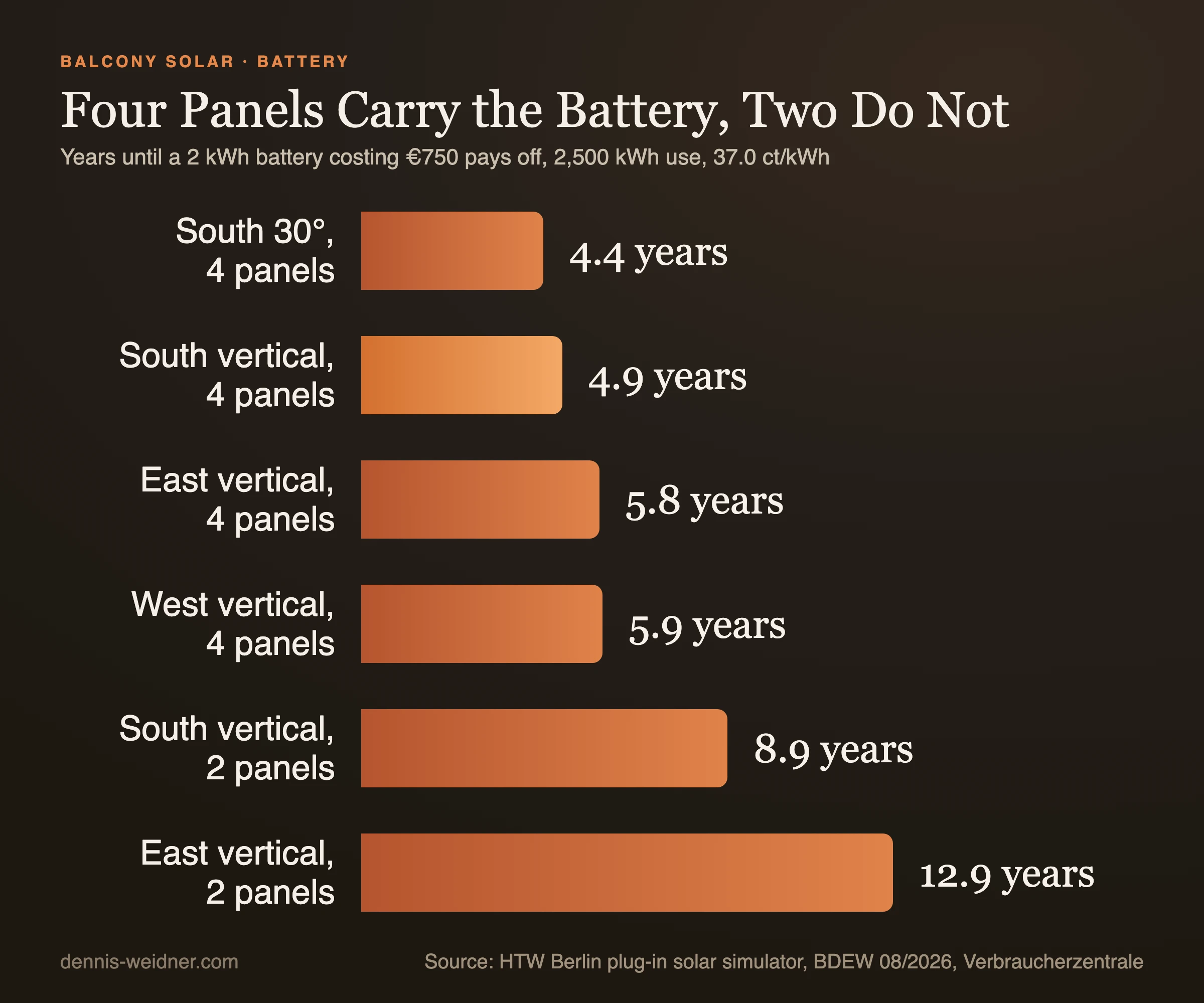
Three points make real life a little worse than the model. According to its documentation, the HTW model covers neither standby consumption nor control deviations of the battery. The 37 cents include a share of the fixed monthly charge, so the energy price actually saved per kilowatt hour is slightly lower. And anyone connecting 2,000 watts needs the dedicated energy socket.
The model also explains why older calculators make the battery look worse: the HTW default settings assume 29 cents and battery prices extrapolated from a 2020 market survey. Both assumptions are outdated in 2026. My verdict: with two panels on an east or west balcony, skip the battery. With four panels and evening demand, buy it with the set and insist on DC coupling. The calculation charges the battery with own solar power only; whether cheap exchange hours add anything depends on the tariff, which I worked through in Dynamic Electricity Tariffs 2026. More on storage of every size is collected under BESS and Energy Storage.
Frequently Asked Questions
Do I have to register a balcony solar battery in Germany?
Yes, in the Marktstammdatenregister together with the balcony system. Under current law a notice to the grid operator is also required, because combinations with a battery fall outside the definition of a plug-in solar device. Some grid operators waive it, so ask yours.
Can I connect 2,000 watts of panels to a normal Schuko plug?
Under the product standard DIN VDE V 0126-95, only up to 960 watts of panel capacity. Above that the standard requires a dedicated energy socket installed by an electrician. The law itself allows 2,000 watts.
How big should a balcony solar battery be?
The Verbraucherzentrale Lower Saxony gives a rule of thumb of one kilowatt hour of capacity per 1,000 kilowatt hours of annual consumption. A household using 2,500 kilowatt hours therefore fits 2 to 2.5 kilowatt hours.
Do I get paid for the power I feed into the grid?
No. Plug-in solar devices up to 2,000 watts and 800 VA are assigned to free acceptance by the grid operator. The EEG 2027 bill does not provide any transition payment for them either.
Can my landlord ban a balcony power plant in Germany?
Only if it is unreasonable for the landlord. Since October 2024 tenants have a claim to permission under Section 554 BGB, flat owners under Section 20(2) no. 5 WEG. In a condominium, the owners decide by resolution how it is carried out, for example the mounting.
Note: This article is not legal advice. It describes the situation in Germany as of 25 September 2026 and simplifies: the calculation ignores panel degradation, power price changes and standby losses and is based on one weather year in Brandenburg; shading reduces yields considerably. The EEG 2027 has not been passed yet, and the rules for batteries may change on 1 January 2027. Next review of this article: January 2027.
Best,
Dennis Weidner
Note: AI tools supported me in writing this article, and some images were edited with AI. I stand behind its content and every statement with my name.