Anyone selling to consumers in Germany via livestream is bound by the same rules as an online shop, only under time pressure: total prices and shipping costs under the Price Indication Ordinance, a 14-day right of withdrawal even for live auctions, clearly labelled advertising and giveaways without a purchase requirement. A sales stream only needs a broadcasting licence once it averages 20,000 concurrent viewers. The real risks lie elsewhere: discounts without the 30-day lowest price, and mystery boxes designed close to gambling.
As of 25 September 2026. Not legal advice, see the note at the end.
More on this topic: E-Commerce & Live Commerce, with background, practice and every article in one place.
Live shopping legal requirements at a glance: which rules apply on stream
There is no dedicated live shopping law in Germany or the EU. Sellers face a bundle of consumer law, unfair competition law, media law and platform regulation that has grown noticeably denser over the past six years. The stream is advertising and shop floor at the same time, while the contract is usually concluded with a tap in an app. That double role is what makes the obligations hard to follow: some apply to the video, some to the product card, some to the seller profile.
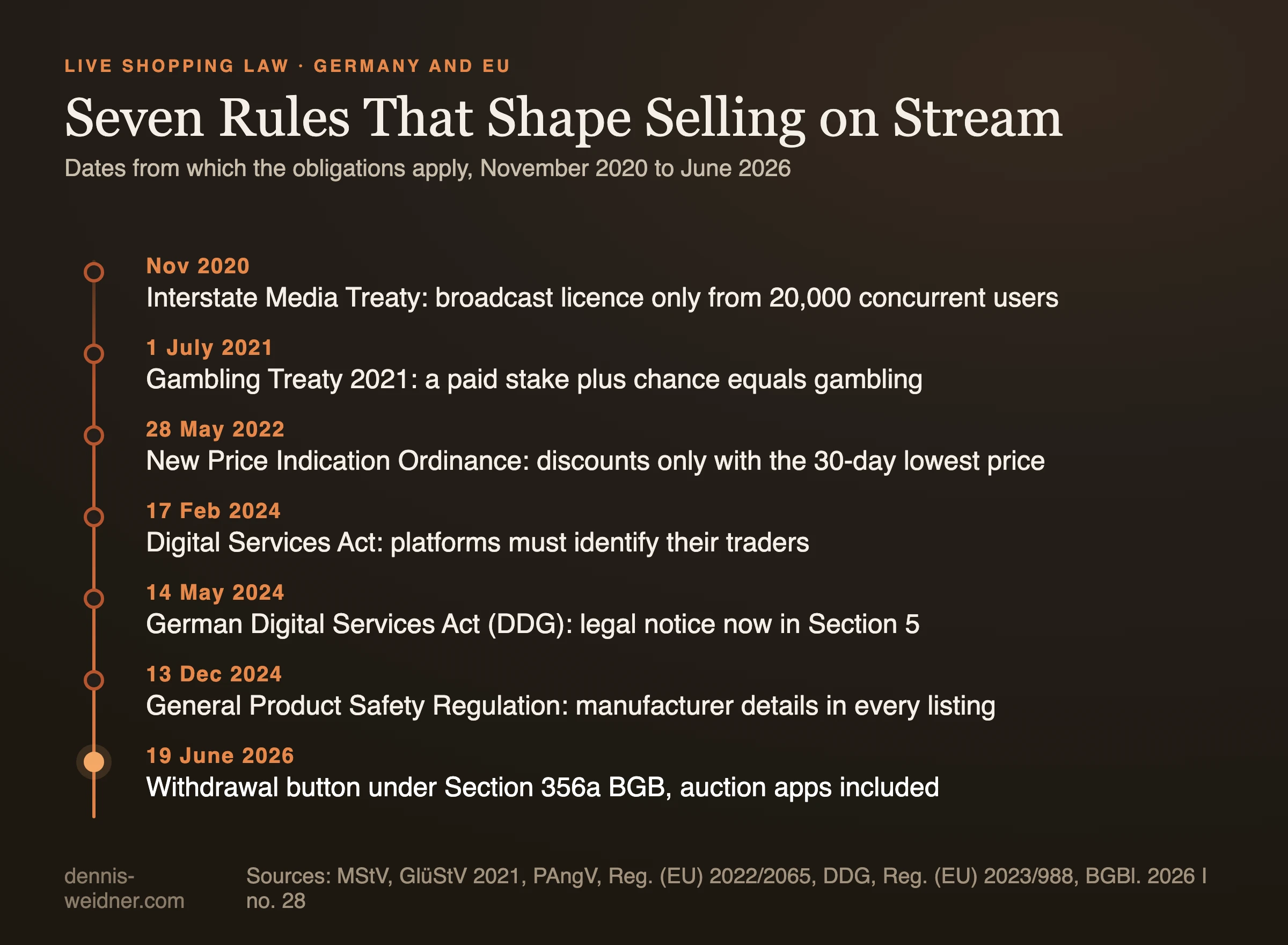
The table below maps each obligation to its legal basis and translates it into what has to happen during a stream. German abbreviations: PAngV is the Price Indication Ordinance, BGB the Civil Code, EGBGB its Introductory Act, UWG the Unfair Competition Act, MStV the Interstate Media Treaty, GlüStV the Interstate Gambling Treaty, DDG the German Digital Services Act.
| Obligation | Legal basis | What to do on stream |
|---|---|---|
| State the total price | Section 3 PAngV | Show the final price including VAT, not a net or instalment figure. |
| Disclose shipping costs | Section 6 PAngV | Shipping costs on the product card before the first bid, not only at checkout. |
| Unit price | Section 4 PAngV | Only for goods sold by weight, volume, length or area; trading cards sold per item need none. |
| Discount with reference price | Section 11 PAngV | For "was … now …" claims, name the lowest price of the past 30 days. |
| Pre-contractual information | Art. 246a Sections 1, 3 EGBGB; Section 312j BGB | Main characteristics, seller, total price, withdrawal right next to the bid button; the rest one click away. |
| Right of withdrawal | Sections 312g, 355, 356a BGB | 14 days even after winning a live auction, withdrawal function in the app. |
| Label advertising | Section 5a(4) UWG; Sections 8(3), 22 MStV | Paid presentation of third-party goods announced and shown on screen as advertising. |
| Giveaways | Section 11 MStV; UWG Annex nos. 19, 31 | Terms stated in advance, no purchase required, prizes actually awarded. |
| No gambling | Sections 3, 4 GlüStV 2021 | No payment for a pure chance to win, minors excluded. |
| Legal notice (Impressum) | Section 5 DDG | Seller details in the stream profile, easy to find and directly accessible. |
| Trader data for the platform | Art. 30 DSA | Name, address, ID, payment account, register entry and self-certification on file. |
| Product safety information | Art. 19 GPSR | For new goods, manufacturer, product identifier and warnings in the listing. |
Price indications in live shopping: total price, shipping and the 30-day lowest price
In live shopping, every price mentioned must be the total price, and in distance selling the shipping costs have to be stated as well. Section 6(1) and (2) of Germany's Price Indication Ordinance require a statement that VAT and other price components are included, plus the amount of any additional shipping costs where they can be calculated in advance. The unit price under Section 4 does not matter for trading cards, figures or clothing, because these goods are not sold by weight, volume, length or area.
The most common trap is the discount shouted out spontaneously during a stream. Section 11 PAngV, Germany's implementation of the EU rule on price reductions, requires the lowest total price of the previous 30 days for every reduction. A worked example: a booster display costs 139 euros in the shop and was cut to 119 euros ten days ago. If the host calls out "was 149, today 109 euros", the reference price that must be shown is 119 euros. The saving is then not 26.8 percent (40 of 149 euros) but 8.4 percent (10 of 119 euros). A seller who does not know the difference advertises the wrong number.
In an auction, the final price is only fixed when the lot is won. That makes it all the more important that shipping costs and any buyer fees are visible before anyone bids. Artificial time pressure has a limit, too: under no. 7 of the annex to the UWG, falsely claiming that goods are available only for a very short time is always prohibited. Why such countdowns work so well is covered in the psychology behind live shopping.
Mandatory information in live shopping: what belongs in the stream and what in the product card
The stream itself only needs the core facts; everything else must be one click away. German law has a specific rule for media with limited space or time: under Article 246a Section 3 EGBGB, it is enough to give the main characteristics, the seller's identity, the total price and the conditions of the right of withdrawal there. All other items from the catalogue in Article 246a Section 1, such as address, delivery terms and statutory warranty rights, must be made available "in an appropriate manner".
In practice, the lot or product card next to the bid button carries the mandatory information, not the host's voice. Section 312j(2) BGB requires main characteristics, total price and shipping costs to be displayed prominently immediately before the order. Section 312j(3) adds that the button must make clear it triggers a payment obligation. In my view, the binding nature of a bid therefore belongs on the bid button itself, not only in the terms and conditions.
The right of withdrawal in live shopping also covers live auctions
Yes, buyers in live shopping can withdraw from an auction purchase within 14 days. The auction exemption in the EU Consumer Rights Directive and in Section 312g(2) no. 10 BGB requires that consumers attend, or can attend, in person. Recital 24 of the directive states explicitly that online platforms used for auctions are not public auctions. Winning a lot on stream is therefore a distance contract with a withdrawal right under Section 355(2) BGB.
Since 19 June 2026, Germany also requires an electronic withdrawal function under Section 356a BGB, which must be reachable inside auction apps as well. For sellers this means returns are part of the calculation, even when a card starts at one euro.
Does live shopping need a broadcasting licence? The threshold in the Interstate Media Treaty
For almost all sellers, no. Under Section 2(1) MStV, broadcasting is a linear, journalistically and editorially designed service for the general public following a broadcast schedule. Whether a pure sales stream meets these criteria is an open question; a fixed schedule, presenters and entertainment segments make it more likely. What decides the matter is Section 54(1) MStV: programmes reaching fewer than 20,000 concurrent users on a six-month average need no licence. On request, the competent state media authority confirms this with a certificate of no objection.
For scale: at the launch of SLABHIT in September 2026, up to 40 viewers watched at the same time. The threshold is 500 times higher. Licence-free does not mean rule-free, though. Germany's state media authorities stress that licence-free offerings must still comply with youth protection and advertising labelling. Section 8(3) MStV requires advertising to be easily recognisable and distinguishable from editorial content, and Section 22(1) says the same for online media.
In a pure shop stream, the commercial purpose is obvious from the circumstances, so a separate label under Section 5a(4) UWG is not needed. It is different when a host presents third-party goods for commission, free products or a fee: consideration is then presumed, and "advertising" belongs clearly on screen and in the announcement.
Giveaways and mystery boxes: where live shopping borders on gambling law
A live shopping giveaway is lawful if entry is free and the rules are clear in advance. Under Section 3(1) of the Interstate Gambling Treaty 2021, gambling exists when payment is required to acquire a chance of winning and chance decides the outcome. Tying a draw to a purchase risks creating exactly that payment. Without a purchase requirement, for example entry by comment or follow, there is none.
For competitions in programmes, Section 11 MStV demands transparency on costs, eligibility, game design and resolution, and caps any entry fee at 0.50 euros. Unfair competition law adds two prohibitions: an announced prize must actually be awarded (UWG Annex no. 19), and a prize must not depend on a payment (no. 31). In practice: link the terms, announce the closing time and the draw, document the winners.
A booster pack sold at a fixed price is not gambling under the wording of Section 3 GlüStV 2021, because the buyer pays for goods whose contents happen to be random. A mystery box can be different if it is advertised with "hits worth up to …" and priced well above its typical contents. The buyer is then visibly paying for the chance of a big hit. Germany's Joint Gambling Authority of the Federal States (GGL) has issued no specific guidance on mystery boxes, so the assessment follows directly from the statutory wording. Unlicensed gambling is prohibited under Section 4(1) GlüStV 2021.
My assessment as an operator: the more the price pays for the goods and the less for the chance, the safer. Specifically, I would disclose a box's contents and value ranges, not advertise individual values that almost nobody pulls, and avoid formats in which equally priced slots randomly receive goods of very different value. On youth protection the position is clear: minors are excluded from gambling under Section 4(3) GlüStV 2021, and Section 6(2) of the Interstate Treaty on the Protection of Minors in the Media (JMStV) bans direct calls to buy that exploit children's inexperience.
Legal notice and DSA trader obligations on live shopping platforms
Every commercial seller needs a legal notice, known in Germany as the Impressum, in the stream profile. Section 5 DDG requires name, address, email and, where applicable, register number and VAT ID for business-like digital services, "easily recognisable and directly accessible". A link in the profile to the seller page is usually sufficient; "legal notice on request" is not. Someone occasionally selling their own collection is not automatically a trader under Section 14 BGB; someone who regularly buys stock and resells it on stream generally is.
The platforms themselves must vet every trader before allowing sales, under Article 30 of the Digital Services Act: name, address, phone, email, ID, payment account, register entry and a self-certification to offer only compliant products. Name, address, contact details, register entry and self-certification are shown to buyers on the product page. Notable for young operators is Article 29 DSA: platforms that are themselves micro or small enterprises are exempt from these obligations. Sellers still owe their own details under Section 5 DDG and Article 246a EGBGB. How the major platforms in the card trade differ is shown in my comparison of live shopping platforms for trading cards. More on retail topics is collected under e-commerce and live commerce.
Frequently Asked Questions
Do I need a broadcasting licence for a sales livestream in Germany?
Usually not. Under Section 54(1) MStV, programmes reaching fewer than 20,000 concurrent users on a six-month average are licence-free. Advertising rules and youth protection still apply.
Does the right of withdrawal apply to live auctions?
Yes. The auction exemption in Section 312g(2) no. 10 BGB only covers auctions consumers can attend in person. Recital 24 of the Consumer Rights Directive says online auctions are not public auctions, so the 14 days apply.
Can I run a giveaway on stream only for buyers?
That is risky. If entry is tied to a purchase, the price can count as payment for the chance to win, which brings it close to gambling under Section 3 GlüStV 2021. Free entry with terms stated in advance is safer.
Are mystery boxes allowed on livestreams?
They are not banned outright, but they are delicate when the price visibly pays for the chance of a valuable hit. Disclosed contents and value ranges and a price oriented to the goods keep a distance from gambling.
Do live shopping discounts have to show the previous price?
Yes, the right one. Section 11 PAngV requires the lowest total price the seller charged in the past 30 days for every price reduction, not the recommended retail price.
Note: This article is not legal advice. It describes the legal position in Germany and the EU as of 25 September 2026 and deliberately simplifies: sales to businesses, cross-border streams, platform terms and the question of when a collector acts commercially change the outcome. The classification of mystery boxes has not been settled by the highest courts. Anyone planning a new format with an element of chance should have it reviewed by a lawyer first.
Best,
Dennis Weidner
Note: AI tools supported me in writing this article, and some images were edited with AI. I stand behind its content and every statement with my name.