I wear an Apple Watch on my left wrist and a Whoop band on my right, and right now I am asking myself whether one device would be enough. For sleep and recovery without a display or subscription, the Garmin Cirqa, the Polar Loop or the Fitbit Air will do for 100 to 200 euros. If you want a watch with ECG and health alerts, you end up with the Apple Watch Series 12 from 449 euros or the Garmin Venu 4, which costs about 550 euros at Garmin and from 377 euros at retailers. If sleep is your main goal, take a look at the Oura Ring 5 from 429 euros. Whoop itself ties you to a membership, adding up to roughly 600 to 1,200 euros over three years in Germany depending on the tier. And if you do not need the latest model, predecessors such as the Apple Watch Series 11 or the Garmin Venu 3 usually save you 60 to 100 euros at retailers. None of these devices can predict a heart attack, even if some advertising suggests exactly that.
Prices and features as of 31 October 2026, older models and retail prices as of 3 November 2026, German prices.
More on this topic: E-Commerce & Live Commerce, with background, practice and every article in one place.
Whoop Alternatives: Key Facts at a Glance
- 199 to 399 euros a year: the cost of a Whoop membership in Germany, depending on the One, Peak or Life tier, band included.
- 449 euros: starting price of the Apple Watch Series 12, no mandatory subscription, with ECG, hypertension and sleep apnoea notifications.
- 199.99 euros: since 24 July 2026 the Garmin Cirqa has been the display-free answer to Whoop, with no subscription and up to ten days of battery life.
- 36 percent: share of people aged 16 and over in Germany who wear a smartwatch, 64 percent among 16 to 29-year-olds.
- 41.2 percent: share of hypertension cases the Apple Watch detects according to its US clearance, a hint, not a diagnosis.
- 17 June 2026: the UK advertising regulator rules against ads promoting the Hume Health band as a "stroke detector".
- 27 November 2026: Black Friday; in 2025, Whoop Peak including twelve months cost 219 instead of 264 euros in Germany.
- 60 to 100 euros: That is what a predecessor usually saves at retailers, because the new models sit below the manufacturer price too. The 2023 Fitbit Charge 6 starts at around 75 euros.
Why I Wear Two Wearables: Whoop on the Right, Apple Watch on the Left
When I recently posted a photo in my story, someone promptly asked me about the two watches. The reason is simple: my Apple Watch is an older generation. Year after year I told myself it was good enough. By now the battery is weak and often flat, and then at least the Whoop band keeps tracking, since it lasts two weeks anyway.
I came to Whoop through my brother, who referred me back then. Now he doesn't want to renew his membership in mid-November and is wondering what comes next: a Garmin, something from Google or one of the new bands that are advertised everywhere right now. That was my reason to write down properly what a fitness watch needs to do in 2026, what it really costs and who should buy which device. On packed days at the desk, as I described in my piece on building multiple companies at once, this kind of data is a good mirror.
What a Fitness Tracker Needs to Do in 2026
A good fitness tracker reliably measures heart rate, heart rate variability, sleep and activity, lasts at least a few days and turns the data into understandable insights. Everything beyond that depends on your own goal. These seven points help you choose:
- Display or not: bands like Whoop, Cirqa or Polar Loop don't disturb or distract you, a watch shows messages, time and training right away.
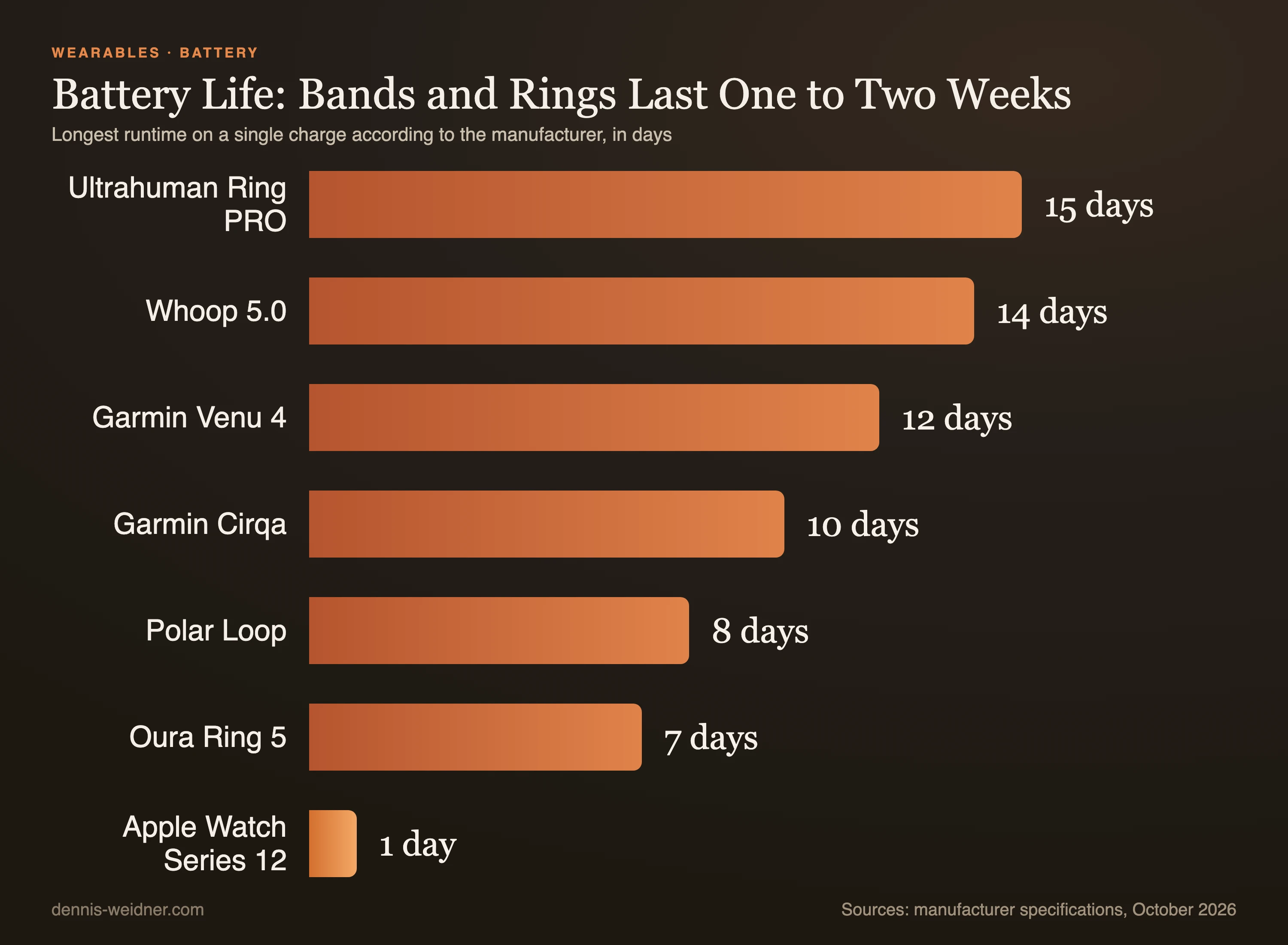
- Battery: if you want to track sleep, you need a device that is not on the charger at night. Bands and rings last one to two weeks, an Apple Watch about one day.
- Subscription: Whoop only works with a membership, Oura is heavily limited without one, Apple, Garmin, Polar and Fitbit work without.
- Medical features: ECG and heart rhythm notifications are cleared as medical devices on some products and meant purely as wellness features on others.
- Sleep analysis: rings and bands come out ahead in comparison studies, but no watch replaces a sleep lab.
- Ecosystem: the Apple Watch needs an iPhone, the Pixel Watch and Galaxy Watch work best with Android, Garmin, Whoop, Polar and Oura work with both.
- Data: if you don't want your health data in the cloud of a US corporation, check where it is stored.
Many manufacturers now sell an AI coach that turns the numbers into sentences. That is handy, but it doesn't replace your own judgement. Which AI tools I really use day to day is in my AI stack.
Whoop Alternatives Compared: The Key Wearables of 2026
The table shows the devices most often named as Whoop alternatives in Germany in 2026, with German price, subscription cost, battery life and the strength you buy them for.
| Device | Price | Subscription per year | Battery | Strength |
|---|---|---|---|---|
| Whoop 5.0 / MG | in membership | €199 to €399 (mandatory) | 14 days | recovery and strain, ECG with Life |
| Apple Watch Series 12 | from €449, retailers from €420 | €0 (Fitness+ optional) | 24 hours | ECG, hypertension and sleep apnoea notifications |
| Apple Watch SE 3 | from €269, retailers from €232 | €0 | 18 hours | entry level with iPhone, sleep apnoea notifications |
| Garmin Venu 4 | €549.99, retailers from €377 | €0 (Connect+ €89.99 optional) | up to 12 days | ECG as a medical device, long battery life |
| Garmin Cirqa | €199.99 | €0 | 10 days | display-free band, direct Whoop rival |
| Polar Loop | €179.90 | €0 | 8 days | display-free band, Polar's training know-how |
| Fitbit Air | €99.99 | €0 (Premium optional) | up to 7 days | cheapest entry, atrial fibrillation alerts |
| Google Pixel Watch 5 | from €419, retailers from €333 | €0 (Premium €8.99 a month optional) | about 2 days | Android, ECG, AI coach |
| Oura Ring 5 | from €429 | €69.99 (practically required) | up to 7 days | sleep analysis, discreet |
| Ultrahuman Ring PRO | €479 | €0 (add-ons €39 to €49 optional) | up to 15 days | ring without mandatory subscription, long battery life |
| Withings ScanWatch 2 | €349.95 | €0 (Withings+ optional) | up to 30 days | classic look, ECG as a medical device |
Two more niche options: the Amazfit Helio Strap costs 99.90 euros and runs up to ten days without a subscription (notebookcheck). And from Oldenburg in Germany comes the Zyke Band, which stores data only on your own phone and needs no subscription; it is coming soon, and people on the waiting list get launch perks (Zyke).
Older Wearables Compared: Apple Watch Series 11, Fitbit Charge 6, Garmin Venu 3
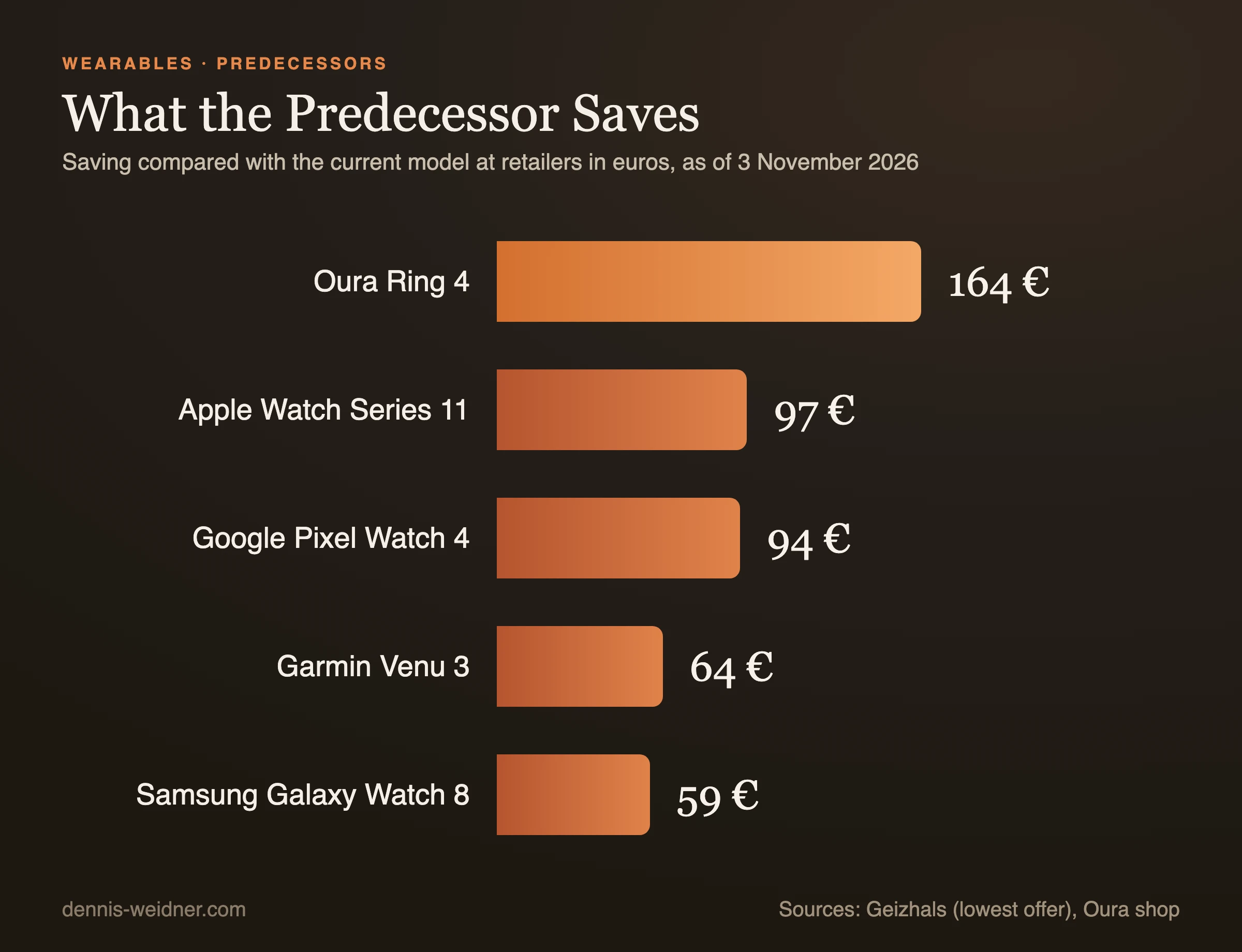
You do not have to buy the latest model, but the gap is smaller than list prices suggest. At retailers a predecessor usually saves around 60 to 100 euros, because the new models have long since dropped below the manufacturer price too: Garmin lists the Venu 4 at 549.99 euros, while retailers sell it from 377 euros. Right now you save the most on the Oura Ring 4. Steer clear only of models without a future, such as the Apple Watch SE 2 (no watchOS 27) and the Fitbit Charge 5 (update guarantee ended). Retail prices are the lowest offers on the German price comparison site Geizhals on 3 November 2026, marketplace sellers included, so check condition and warranty.
| Model | Year | From | Battery | My take |
|---|---|---|---|---|
| Apple Watch Series 11 | 2025 | €323.50 | 24 hours | best older Apple Watch |
| Apple Watch Series 10 | 2024 | €322.05 | 18 hours | only well below the Series 11 |
| Apple Watch SE 2 | 2022 | €210.87 | not stated | prefer the SE 3, no watchOS 27 |
| Fitbit Charge 6 | 2023 | €75.18 | up to 7 days | best value |
| Fitbit Inspire 3 | 2022 | €74.90 | up to 10 days | steps and sleep |
| Fitbit Versa 4 | 2022 | €119.00 | over 6 days | only for Fitbit fans |
| Fitbit Sense 2 | 2022 | €189.00 | over 6 days | Galaxy Watch 8 costs barely more |
| Garmin Venu 3 | 2023 | €313.00 | up to 14 days | more battery than the Venu 4 |
| Garmin Vivosmart 5 | 2022 | €124.99 | up to 7 days | no GPS, no ECG |
| Oura Ring 4 | 2024 | €265.30 | 5 to 8 days | worth it, subscription stays |
| Samsung Galaxy Watch 8 | 2025 | €198.96 | not stated | for Android, Watch 9 about 59 euros more |
| Samsung Galaxy Watch 7 | 2024 | €163.54 | not stated | Watch 8 costs about 35 euros more |
| Samsung Galaxy Ring | 2024 | €206.35 | up to 7 days | ring for Galaxy users |
| Google Pixel Watch 4 | 2025 | €239.00 | 30 to 40 hours | updates until October 2028 |
| Google Pixel Watch 3 | 2024 | €182.90 | up to 24 hours | updates only until October 2027 |
Apple Watch Series 11, Series 10, Series 9 and SE 2: Which Older Apple Watch Is Worth It
The best older Apple Watch is the Series 11. Apple no longer lists it in its own shop, but retailers sell it from around 324 euros. The Series 12 costs 449 euros at Apple and from 420 euros at retailers, so you save just under 100 euros. The Series 11 lasts up to 24 hours and brings ECG plus hypertension and sleep apnea notifications, which the Series 9 and 10 also have. These are notifications, not a diagnosis. The Series 10 currently costs almost the same as the 11 but only manages 18 hours, so I would take the 11. The Series 9 still runs watchOS 27, according to Apple, but sits at around 300 to 350 euros depending on the comparison site. For me it only becomes interesting well below 250 euros. The SE 2 from 2022 is no longer on the watchOS 27 list and has no ECG. The SE 3 costs 269 euros at Apple and from around 232 euros at retailers, so barely more.
Fitbit Charge 6, Inspire 3, Sense 2, Versa 4: Which Fitbit Still Fits in 2026
Fitbit is not only the new Air. The Charge 6 is listed at 159.95 euros in the Google Store, and retailers sell it from around 75 euros. To me that is the best value: up to 7 days of battery and an ECG app that Google lists for selected countries. The Inspire 3 costs about the same, lasts up to 10 days and is enough for steps and sleep. The Versa 4 and Sense 2 are proper watches, but at 189 euros the Sense 2 costs almost as much as a Galaxy Watch 8. For all four, Google guarantees security updates until February 2028, and until May 2028 for the Fitbit Air. For the Charge 5 this guarantee ended in December 2025, and Geizhals currently shows no offers. One thing applies to all of them: you need a Google account, and the devices run through the Google Health app.
Garmin Venu 3 and Vivosmart 5: More Battery for a Little Less Money
The Venu 3 is a good buy, but no longer a bargain compared with the Venu 4. Garmin itself sells it as a previous model for 369.99 euros, and retailers start at 313 euros. The Venu 4 starts at 377 euros at retailers, around 64 euros more. In return the Venu 3 gives you up to 14 days of battery on the 45 mm model instead of up to 12 days on the Venu 4, and since January 2025 the ECG app has also worked in Germany. Garmin does not name a fixed update commitment. If battery matters most, take the Venu 3, everyone else should spend the 64 euros on the Venu 4. I would skip the Vivosmart 5: it costs around 125 euros but has no built-in GPS and no ECG.
Oura Ring 4 and Whoop 4.0: With a Subscription the Predecessor Saves Only Partly
The Oura Ring 4 currently costs from 265.30 euros instead of 379 euros in the Oura shop, the Ring 5 from 429 euros. The Ring 5 is around 40 percent smaller and lasts 6 to 9 instead of 5 to 8 days, but according to Oura new software features also reach older rings from Gen3 onwards. The membership at 69.99 euros a year applies either way. Oura no longer sells the Gen3, and with leftover stock the condition is often unclear. The Whoop 4.0 is not worth it: Whoop now only offers the 5.0 and MG, the current band is included in the membership from 199 euros, and an old band saves nothing on that.
Samsung Galaxy Watch 8, Pixel Watch 4 and Budget Bands: For Android and Small Budgets
With an Android phone these two are the strongest predecessors. The Galaxy Watch 9 starts at 409 euros at Samsung and from around 258 euros at retailers, the Watch 8 from around 199 euros. According to Samsung, ECG and blood pressure require a compatible Galaxy smartphone. The Pixel Watch 4 starts at 239 euros at retailers, the Pixel Watch 5 from around 333 euros, and in the Google Store it is 399 against 419 euros. The blood pressure trends stay reserved for the Pixel Watch 5. Google guarantees updates until October 2028, and only until October 2027 for the Pixel Watch 3. If rough tracking is enough, look at the Xiaomi Smart Band 10 from 44.99 euros. The Polar Ignite 3 from 2022 costs around 173 euros, almost as much as the newer Polar Loop, so I would take the Loop.
What Wearables Cost Over Three Years: Subscription or Purchase Price
Over three years, Whoop is the most expensive option in this comparison because the membership is mandatory: 597 euros with One, 792 euros with Peak and 1,197 euros with Life, band included (prices according to nextpit). An Apple Watch Series 12 costs 449 euros once, a Garmin Cirqa 199.99 euros.
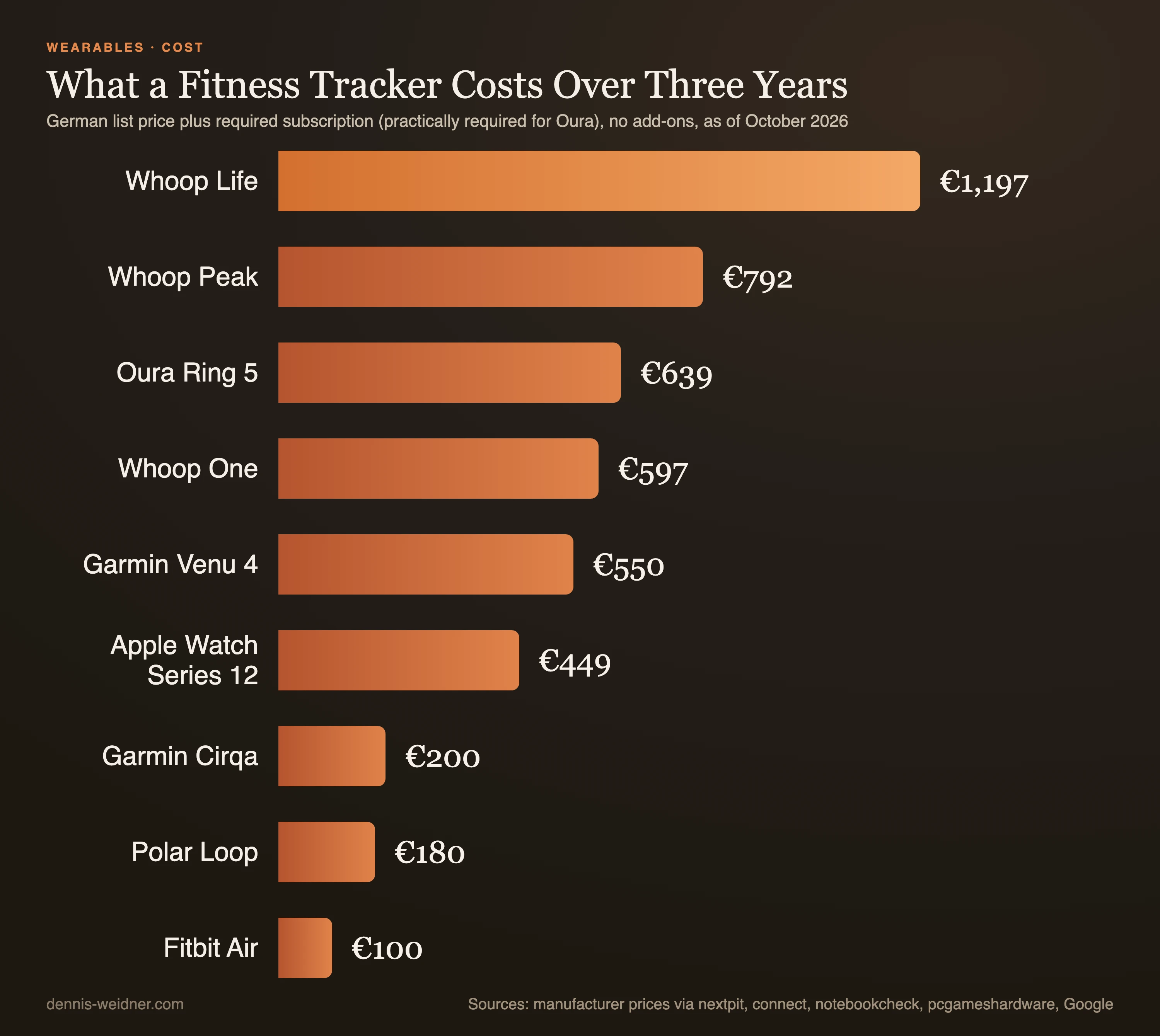
Behind the numbers sits a business model that is interesting for anyone who sells something. Whoop practically gives away the hardware and earns from the recurring membership. If you want to move from Whoop 4.0 to 5.0, you either extend your membership or pay a one-off 59 euros, 89 euros with Life. Oura sells the ring plus a subscription for 5.99 euros a month or 69.99 euros a year. Apple and Garmin earn on the device and offer subscriptions only as extras, Garmin Connect+ for example at 89.99 euros a year (WinFuture). Customers pay either way, only the timing differs. For me, what counts in the end is whether I actually use the data. A subscription you never look at is the most expensive of all.
The difference in battery life is even clearer, and that is exactly my problem with the old Apple Watch:
Heart Attack Warnings From a Watch? What Wearables Really Detect
No wearable can predict a heart attack. The German Heart Foundation makes clear that smartwatches cannot detect a heart attack and cannot indicate a narrowed coronary artery either; with chest pain, always call the emergency number (German Heart Foundation).
That is exactly why the advertising currently running on YouTube and Instagram deserves a closer look. Particularly loud is Hume Health, a company with a registered address in the US state of Delaware, with its Hume Band, currently sold as version 2.0. It measures heart rate, heart rate variability, blood oxygen and skin temperature, among other things (check-app). On 17 June 2026, the UK Advertising Standards Authority ruled against four ads for the band and the Hume Health Pod, including "This band caught the stroke before I could" and claims about cardiac events; all three issues raised in two complaints were upheld. Hume Health did not respond to the ASA, and according to the ASA the device is not registered with the UK medicines regulator (ASA ruling). In Germany, the Therapeutic Products Advertising Act sets tight limits on such promises: anyone advertising the detection of diseases may not claim effects that are not proven (Section 3 HWG).
What wearables can demonstrably do, on the other hand, is remarkable once you know the limits:
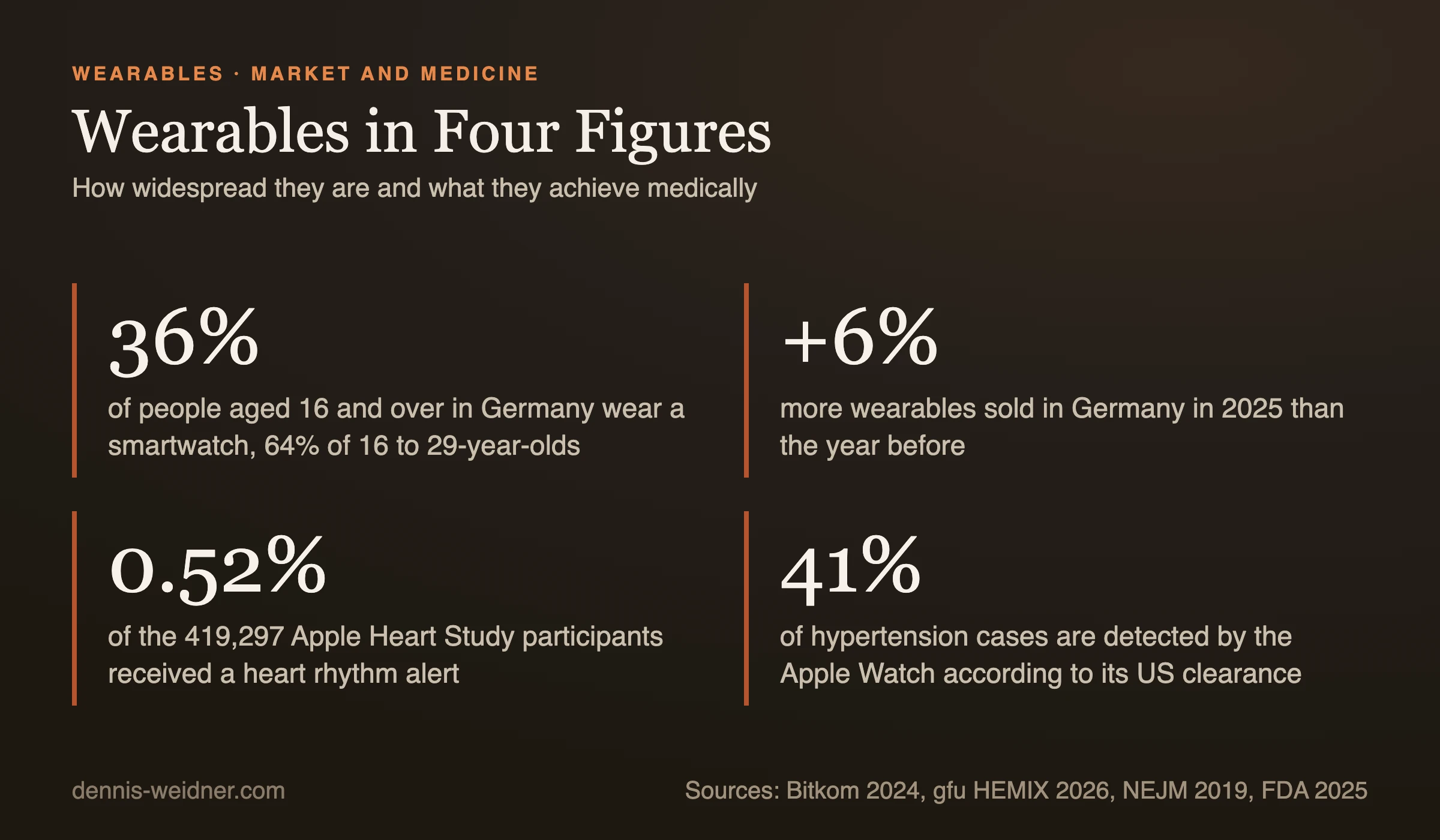
- Atrial fibrillation: in the Apple Heart Study with 419,297 participants, 0.52 percent received an irregular rhythm alert. Where an ECG patch was running at the same time, it confirmed the suspicion in 84 percent of cases (New England Journal of Medicine 2019).
- Hypertension: the Apple Watch notifications have been available in Germany since September 2025 (Macwelt). According to the US clearance they detect 41.2 percent of cases and are correct for 92.3 percent of people without hypertension. They do not replace a cuff measurement.
- Sleep apnoea: the Apple Watch and the Samsung Galaxy Watch flag breathing disturbances during sleep, and Samsung's feature carries a CE mark (Samsung). A diagnosis still requires a doctor.
- Blood oxygen: Whoop itself names 95 to 100 percent as normal and below 90 percent as low (Whoop). A wrist reading is a trend, not a clinical measurement. If you keep seeing low night-time values, have it checked.
- Calories and sleep stages: no device measures energy expenditure accurately across all activities (British Journal of Sports Medicine). For sleep stages, Oura, Apple and Fitbit reached moderate to good agreement with a sleep lab in one comparison (Sensors 2024).
Whoop also had to learn where the line is: the US Food and Drug Administration sent a warning letter about the Whoop MG blood pressure insights in July 2025 and closed the matter in June 2026 after Whoop had adjusted the product and its labelling (MedTech Dive).
Which Fitness Watch for Which Age and Type
The right fitness watch depends less on age than on daily life, but a few patterns are clear:
- In your twenties and ambitious about sport: a Garmin Forerunner from 249.99 euros or the Polar Loop. Training data, GPS and battery count for more than any health alert.
- Thirty to fifty, office job, little time: a display-free band like Whoop, Garmin Cirqa or Polar Loop tracks sleep and recovery without disrupting your day. If you already have an iPhone, take an Apple Watch, which also gives hypertension and sleep apnoea notifications.
- Fifty plus or with heart issues in the family: a device with a cleared ECG, such as the Apple Watch Series 12, the Garmin Venu 4 or the Withings ScanWatch 2, which is especially practical thanks to its classic look and up to 30 days of battery life.
- Android users: the Pixel Watch 5 or the Galaxy Watch9, both with ECG, the Galaxy also with a sleep apnoea feature.
- Sleep as the main topic: a ring like the Oura Ring 5 or the Ultrahuman Ring PRO, which you barely notice at night.
- Privacy first: the Zyke Band, which keeps data local, as soon as it ships.
Black Friday 2026: How to Find Real Wearable Deals
Black Friday falls on Friday, 27 November 2026, Cyber Monday on 30 November. Wearable discounts in Germany were noticeable in 2025: Whoop offered Whoop 5.0 including twelve months of Peak for 219 instead of 264 euros for Black Friday 2025 (Dealdoktor). The Oura Ring 4 was up to 170 euros cheaper (notebookcheck), and the Apple Watch SE 3 cost 199 to 244 euros. The Garmin Venu 4 was already down to 401.99 euros instead of 549.99 euros on Amazon in October 2026.
How retailers themselves plan their way through Black Friday week is in my piece on Black Friday and Cyber Monday. As a buyer, three rules help you tell real deals from bait prices:
- Check the price history: on idealo or Geizhals you can see whether the price was artificially raised beforehand.
- Look at the 30-day low: under German price labelling rules, anyone advertising a price reduction must refer to the lowest price of the past 30 days.
- Factor in the subscription: with Whoop and Oura, what matters is not the discount on the first month but what happens after twelve months. Renewal is automatic.
My Verdict: Which Whoop Alternative I Am Looking At
For me, the question is not "Whoop or Apple Watch" but what my everyday life needs. I want to track sleep and recovery without thinking about the charger at night, and I want the features my old watch lacks: hypertension and sleep breathing notifications. An Apple Watch Series 12 covers that without a subscription, and a band like Whoop or Garmin Cirqa delivers the sleep data with two weeks of battery. If you only want to wear one device, the Garmin Venu 4 is the best compromise of watch, ECG and battery life.
More important to me than the perfect device is something else: a tracker is a mirror, not a doctor and not a coach. It helps you see patterns, and it gets annoying if you chase every number. More articles on products, prices and business models are in E-Commerce and Live Commerce.
Now it's your turn: which watch or band do you wear, and what really made a difference for you? Feel free to write to me via my contact page, and I will include the best experiences in my next article.
Frequently Asked Questions About Whoop Alternatives
Which is better, Whoop or Apple Watch?
It depends on your goal. Whoop is a display-free band with 14 days of battery life that specialises in sleep, recovery and strain and only works with a membership from 199 euros a year in Germany. The Apple Watch Series 12 costs a one-off 449 euros and up, shows messages and workouts, offers ECG, hypertension and sleep apnoea notifications, but lasts only about one day. That is why many people wear both.
Which Whoop alternative has no display and no subscription?
The best-known bands without a display and without a mandatory subscription are the Garmin Cirqa at 199.99 euros with up to ten days of battery, the Polar Loop at 179.90 euros with up to eight days, the Fitbit Air at 99.99 euros and the Amazfit Helio Strap at 99.90 euros.
Why is Whoop so expensive?
Whoop doesn't sell hardware but a membership that includes the band. Depending on the tier it costs 199, 264 or 399 euros a year in Germany. Over three years that adds up to 597 to 1,197 euros, more than most watches without a subscription.
Can a smartwatch detect a heart attack?
No. According to the German Heart Foundation, smartwatches can neither detect a heart attack nor indicate a narrowed coronary artery. They can give hints of atrial fibrillation, hypertension or breathing pauses during sleep, which a doctor then needs to check. With chest pain, always call the emergency number.
Can you use Whoop without a subscription?
No. The Whoop band only works with an active membership. It renews automatically at the end of the term, so if you don't want to continue, cancel in time before the term ends.
Is the Polar Loop better than Whoop?
The Polar Loop costs a one-off 179.90 euros and needs no subscription, Whoop starts at 199 euros a year. Both skip the display and track sleep, heart rate and recovery. Whoop lasts longer at 14 days and offers more health features in its higher tiers, while the Polar Loop is much cheaper over the years.
Is an older Apple Watch or Fitbit still worth it?
Yes, as long as it still gets updates. At Apple the Series 11 from around 324 euros is the best choice, just under 100 euros below the retail price of the Series 12. The SE 2 is no longer on the watchOS 27 list. At Fitbit the Charge 6 from around 75 euros is worth it, and Google guarantees security updates until February 2028. For the Charge 5 this guarantee ended in December 2025.
Note: This article is not medical advice. Prices are German manufacturer list prices, and retailers may differ.
Best,
Dennis Weidner
Note: AI tools supported me in writing this article, and some images were edited with AI. I stand behind its content and every statement with my name.