Since 1 July 2026, the EU no longer has a 150 euro customs duty exemption for small parcels, and since 1 November 2026 a handling fee has come on top. Every tariff line in a low-value consignment sold through the Import One-Stop Shop or sent by post from outside the EU now carries 3 euros in customs duty and 2 euros in fees. With VAT included and both passed on in full, a 12 euro item bought online costs around 20 euros instead of just over 14. If you compete online with platforms from outside the EU, the price gap narrows sharply for cheap goods. I work through what it costs, who pays and where competition is moving next.
As of 3 November 2026. Not legal advice, see the note at the end.
More on this topic: E-Commerce & Live Commerce, with background, practice and every article in one place.
The EU De Minimis Threshold of 150 Euros: What Applies Since 1 July 2026
Until the end of June 2026, goods in consignments worth up to 150 euros in total, sent directly from a non-EU country to a recipient in the EU, were exempt from customs duty. The Council removed that relief with Council Regulation (EU) 2026/382 of 11 February 2026. Recital 2 gives the reason: the threshold had led to "systematic abuse" through undervaluation and artificial splitting of consignments.
It took almost a year. On 13 November 2025, EU finance ministers reached a political agreement to end the threshold. On 12 December 2025 they agreed on the interim flat rate of 3 euros, on 11 February 2026 the regulation was formally adopted, and on 18 February it was published in the Official Journal. VAT is not the new part: the VAT exemption for goods up to 22 euros already ended on 1 July 2021. Since then, every order from a non-EU country has been subject to VAT, usually collected at checkout through the Import One-Stop Shop (IOSS), the scheme through which non-EU sellers declare and pay EU VAT.
The 3 Euro Customs Duty Per Item: How the Flat Rate Is Counted
The flat rate is charged neither per parcel nor per piece, but per tariff line in the customs declaration. Germany's customs administration, the Zoll, explains it in its press release of 29 June 2026 (in German) with socks: four pairs of socks in one consignment cost 3 euros once. Add a soft toy and a phone charging cable, and it is 9 euros.
Under Article 2 of the regulation, the 3 euro rate applies in two cases: when the import is exempt from import VAT because the seller uses IOSS, and when the goods travel in a postal consignment. All other low-value consignments, for example courier shipments without IOSS, pay the normal EU customs tariff, because the threshold is gone for them too. Under IOSS the duty is owed by the declarant, meaning the seller or its representative. The buyer only pays it directly if the seller leaves customs clearance to them.
What matters for pricing: the flat rate does not depend on value. On a 150 euro item, 3 euros is two percent. On the average value of a low-value item of 8.82 euros, which the Commission reports for 2025, it is 34 percent.
The 2 Euro EU Customs Handling Fee: What Applies Since 1 November 2026
The second step has applied since 1 November 2026. The big customs reform, Regulation (EU) 2026/2108 of 16 September 2026 establishing the new Union Customs Code, introduces in Article 20(2) a Union handling fee "of a fixed amount per item" for all distance sales from non-EU countries, regardless of value. The amount is set by Commission Delegated Regulation (EU) 2026/2152 of 21 September 2026: 2 euros per item. It was published in the Official Journal on 22 October 2026 and, under its Article 2, applies from 1 November 2026.
According to the Zoll (in German), the fee generally arises when the customs declaration is accepted, is charged per line of the declaration and is not refunded. Duty and fee both count towards the import VAT base. Since 1 November, customs declarations for consignments up to 150 euros must also carry a product identifier, such as the marketplace's item number, the model number or the GTIN. Three points remain open:
- The fee for customs warehouses: goods for distance sales that are first placed in an EU customs warehouse will pay a lower fee from 1 July 2028. Its amount has not been set.
- Extending the 3 euros: since October 2026 the Commission must assess every month whether sellers leave IOSS to avoid the flat rate. If it finds such trade diversion, it can propose covering all consignments up to 150 euros (Article 3(1) of Regulation 2026/382). Its preliminary assessment of 30 October 2026 does not yet contain such a proposal.
- An extension in time: by 1 December 2027, the Commission must assess whether the EU Customs Data Hub will run by July 2028. If not, it may propose extending the flat rate (Article 3(2)).
Low-Value Consignments Into the EU: 5.88 Billion Items in 2025
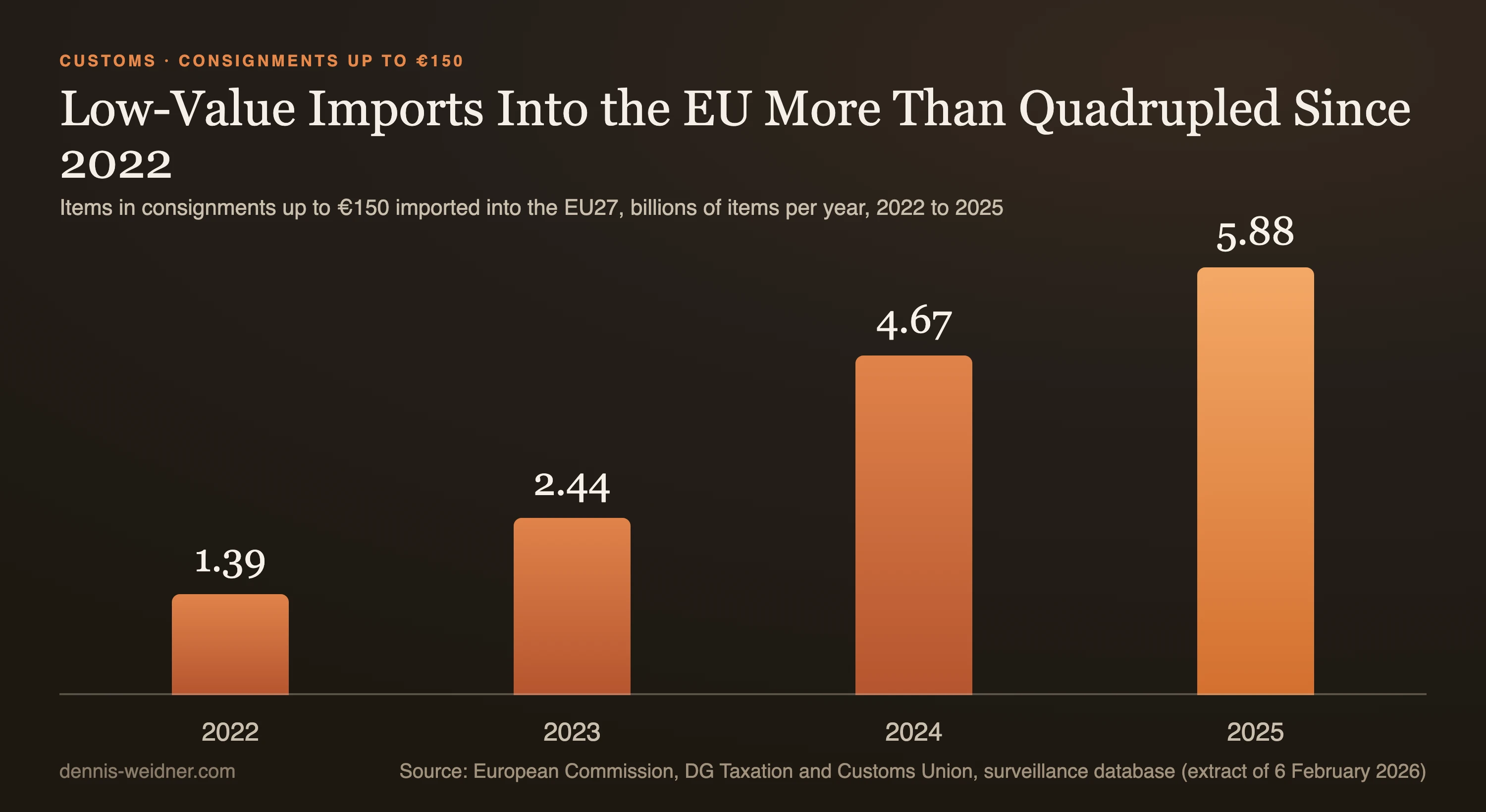
The volume explains why the EU acted. According to the "Goods bought online" page of the Commission's Directorate-General for Taxation and Customs Union, 1.39 billion items in consignments up to 150 euros entered the EU in 2022. In 2025 it was 5.88 billion, more than four times as many. They made up 98 percent of all imported items but only 2.1 percent of import value. 93 percent of the items came from China.
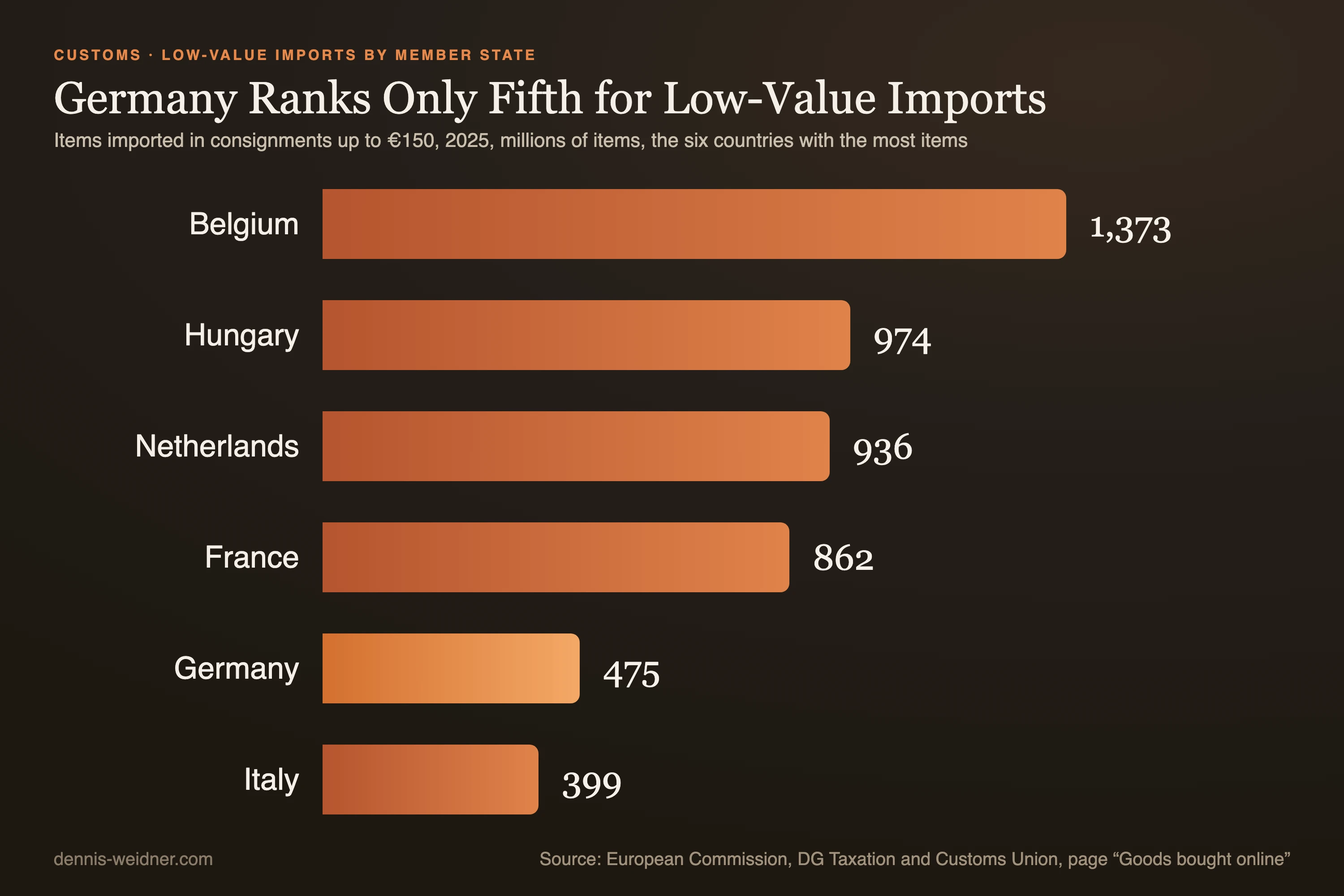
Germany cleared around 475 million such items in 2025, up from 278 million a year earlier. That is only part of what arrives there: Belgium, Hungary and the Netherlands together cleared more than half of all low-value items in the EU. Customs authorities cannot keep up with these volumes: according to the Commission's cost report, they checked 65 in every million items in 2025, down from 203 in 2022.
The flat rate is already having an effect. According to the Commission's preliminary assessment of 30 October 2026, around 555 million items in low-value consignments entered the EU in the third quarter of 2026, compared with just over 1.5 billion in the third quarter of 2025. That is more than 60 percent fewer. The Commission also observes that some cheap goods now appear to be imported in bulk with duty paid, stored in the EU and distributed from there. Customs still has plenty to do: at least 5 million items shipped directly to consumers arrive every day, around ten times the number in normal goods trade. The 2 euro fee is not yet reflected in these figures, as it only started in November.
Worked Example: What a 12 Euro Item From Outside the EU Costs Now
The table calculates an item worth 12.00 euros before tax, sold through a marketplace using IOSS to a customer in Germany, shipping included, one tariff line. Assumption: the seller passes duty and fee on in full, and Germany's standard VAT rate of 19 percent applies to the resulting price.
| Item | Until 30 Jun 2021 | Jul 2021 to Jun 2026 | Jul 2026 to Oct 2026 | Since 1 Nov 2026 |
|---|---|---|---|---|
| Value of goods | €12.00 | €12.00 | €12.00 | €12.00 |
| Customs duty | €0.00 | €0.00 | €3.00 | €3.00 |
| Union handling fee | €0.00 | €0.00 | €0.00 | €2.00 |
| VAT at 19% | €0.00 (exempt up to €22) | €2.28 | €2.85 | €3.23 |
| Price for the customer | €12.00 | €14.28 | €17.85 | €20.23 |
| Mark-up on the value of goods | 0% | 19.0% | 48.8% | 68.6% |

Compared with the situation until June 2026, the price first rose by 3.57 euros; since November the increase has been 5.95 euros, or 42 percent. The shopping basket changes the picture a lot. Three identical items worth 36 euros in total form one tariff line and carry 5 euros in duty and fee, just under 14 percent. Three different items are three lines and carry 15 euros, almost 42 percent. That hits exactly the business model of the large platforms: many different small things in one parcel.
What the End of the De Minimis Exemption Means for Online Retailers in Germany
A German retailer importing goods by the container pays the normal duty rate on the purchase value and deducts import VAT as input tax. Neither the flat rate nor the fee applies. For such a retailer, a gap that has cost margin for years is closing. In my view, though, competition shifts rather than ends, in three directions.
First, platforms move into EU warehouses. Goods that are already in the EU at the time of sale are not a distance sale from a non-EU country, so neither the flat rate nor the fee applies. The Commission's assessment of 30 October hints at exactly this move. Anyone working this way imports in bulk at the normal tariff and falls under the same rules as German retailers, from product safety to liability. What the EU General Product Safety Regulation requires of every listing is covered in GPSR for Online Sellers. Customs has a new anti-abuse clause for this (Article 243 of the implementing regulation to the Customs Code): it describes cases in which a distance sale is still assumed, looking among other things at how the goods are packaged.
Second, it hits dropshippers at home. Anyone in Germany who has goods shipped directly from a manufacturer in China to customers pays the same flat rate and the same fee per line as a Far Eastern marketplace seller. With margins in the single-digit euro range, the model barely works for cheap single items anymore. Sellers on TikTok Shop should check this before setting promotional prices, see TikTok Shop for Small Retailers.
Third, the price gap remains for more expensive goods. At 80 or 120 euros, 5 euros is a minor item. There, service, delivery time and trust still decide, and there lie the obligations EU retailers carry and distant sellers often take lightly, from the withdrawal button to returns. How retail in Germany is shifting overall is described in E-Commerce Germany: Where Retail Is Growing. More topics are collected under E-Commerce and Live Commerce.
What Comes Next Until 2028: the EU Customs Data Hub and Normal Duty Rates
The flat rate is a bridge. It applies until 1 July 2028 because today's customs systems often classify goods only roughly and cannot calculate an exact duty rate per item. From July 2028, the new EU Customs Data Hub is due to run for e-commerce. Each item will then pay the duty rate of its tariff code, often less than 3 euros for very cheap items and more for pricier ones. The handling fee stays. For all other importers, the hub becomes voluntary from 2031 and mandatory from 2034. Retailers adjusting their pricing today should therefore plan in two stages: the flat rate until mid-2028, and after that the real tariff of their product group.
Frequently Asked Questions
Do I have to pay customs duty on a parcel from China now?
Yes, since 1 July 2026 also below 150 euros. For orders via IOSS or by post it is 3 euros per tariff line, usually already included in the price. Without IOSS via a courier, the normal duty rate applies, plus import VAT and often a service charge from the carrier. Since 1 November 2026, online purchases from outside the EU also carry a handling fee of 2 euros per tariff line.
Is the 3 euro flat rate charged per parcel or per item?
Per tariff line in the customs declaration. Several identical items count once, different items count several times. Four pairs of socks cost 3 euros, socks, a soft toy and a charging cable together cost 9 euros.
When does the 2 euro EU handling fee start?
Since 1 November 2026. The Commission set the amount in Delegated Regulation (EU) 2026/2152, published in the Official Journal on 22 October 2026. The fee is charged per tariff line regardless of the value of the goods and is not refunded.
How long will the flat customs duty apply?
Until 1 July 2028. After that, the EU Customs Data Hub calculates the regular duty rate per item. If the hub is not ready in time, the flat rate can be extended; the Commission assesses this by 1 December 2027.
Does the end of the de minimis exemption affect EU-based retailers?
Only if they have single consignments shipped to customers from outside the EU themselves, for example in dropshipping. Anyone importing goods in bulk and selling from a warehouse in the EU pays normal duty on the import value, not the flat rate or the fee.
Note: This article is not legal or tax advice. It describes the legal situation as of 3 November 2026 and simplifies: excise goods, reduced VAT rates, origin of goods, shipping costs in the customs value and carrier charges change the result. Anyone importing goods from outside the EU or having them shipped should clarify classification and procedure with the competent customs office or a customs adviser.
Best,
Dennis Weidner
Note: AI tools supported me in writing this article, and some images were edited with AI. I stand behind its content and every statement with my name.