The first time you stumble into a live shopping stream, you often think: this is just teleshopping on a phone. And then you stay anyway. Twenty minutes, sometimes half the evening. That is no accident, it is applied psychology. I took a close look at the mechanisms behind it, because anyone who sells or builds a platform should understand why this format grips people and where manipulation begins.
With Slabhit I am building in this field myself, so my interest is practical, not theoretical. And the numbers show this is more than a passing hype: McKinsey reports conversion rates of up to 30 percent in live formats, up to ten times higher than in conventional e-commerce. A gap like that is not created by better technology. It is created in the mind.
More on this topic: E-Commerce & Live Commerce, with background, practice and every article in one place.
Parasocial closeness: a person who talks to you
The biggest difference from a normal online shop is both banal and powerful: there is a real person, speaking in real time, reacting, answering questions. Our brains are tuned to faces and voices, not to product tiles. When the host reads your name out of the chat and responds to your comment, researchers call the result a parasocial relationship: a felt personal bond with someone you only know from a screen. The concept dates back to 1950s television research, but a livestream adds a new quality: the relationship is no longer one-sided. The host actually answers.
Research has measured this effect. A study in Frontiers in Communication shows that parasocial interaction and social presence, the feeling of facing a real human being, significantly increase impulsive purchases in livestream commerce. Trust forms cognitively first, then becomes emotional. That closeness is also the heart of what I describe in Trust as a Business Model: people buy from people they believe.
Scarcity, FOMO, and the power of the moment
Live means it is happening now. The offer holds in this moment, the quantity is limited, in a second it is gone. This scarcity activates the fear of missing out, backed by one of the best-documented findings in behavioral economics: losses weigh roughly twice as heavily as equally large gains. Daniel Kahneman won the Nobel Prize for this research. A livestream makes loss aversion tangible like no other format: you watch the inventory shrink while others grab what is left.
The crucial distinction is between real and staged scarcity. With trading cards, scarcity is real: of a particular card in a particular condition, often only a handful of copies exist. Once gone, it is gone. An invented countdown for a product that is back in stock tomorrow works just as well short term, but it is a lie. And lies come out fast in the age of screenshots.
Social proof: the chat buys with you
An underrated factor is the group. In the chat, everyone sees the same comments, the same purchases, the same excitement. That is social proof in real time: if others are buying, it must be good. In a classic shop you read reviews strangers wrote months ago. In a livestream you watch someone make the same decision you are facing, right now. That reduces felt uncertainty dramatically.
On top of that comes a sense of us that no online shop can create. Regulars know each other, greet each other, share inside jokes with the host. For collector communities, this sense of belonging often matters more than the price. You are not just buying a product, you are part of something.
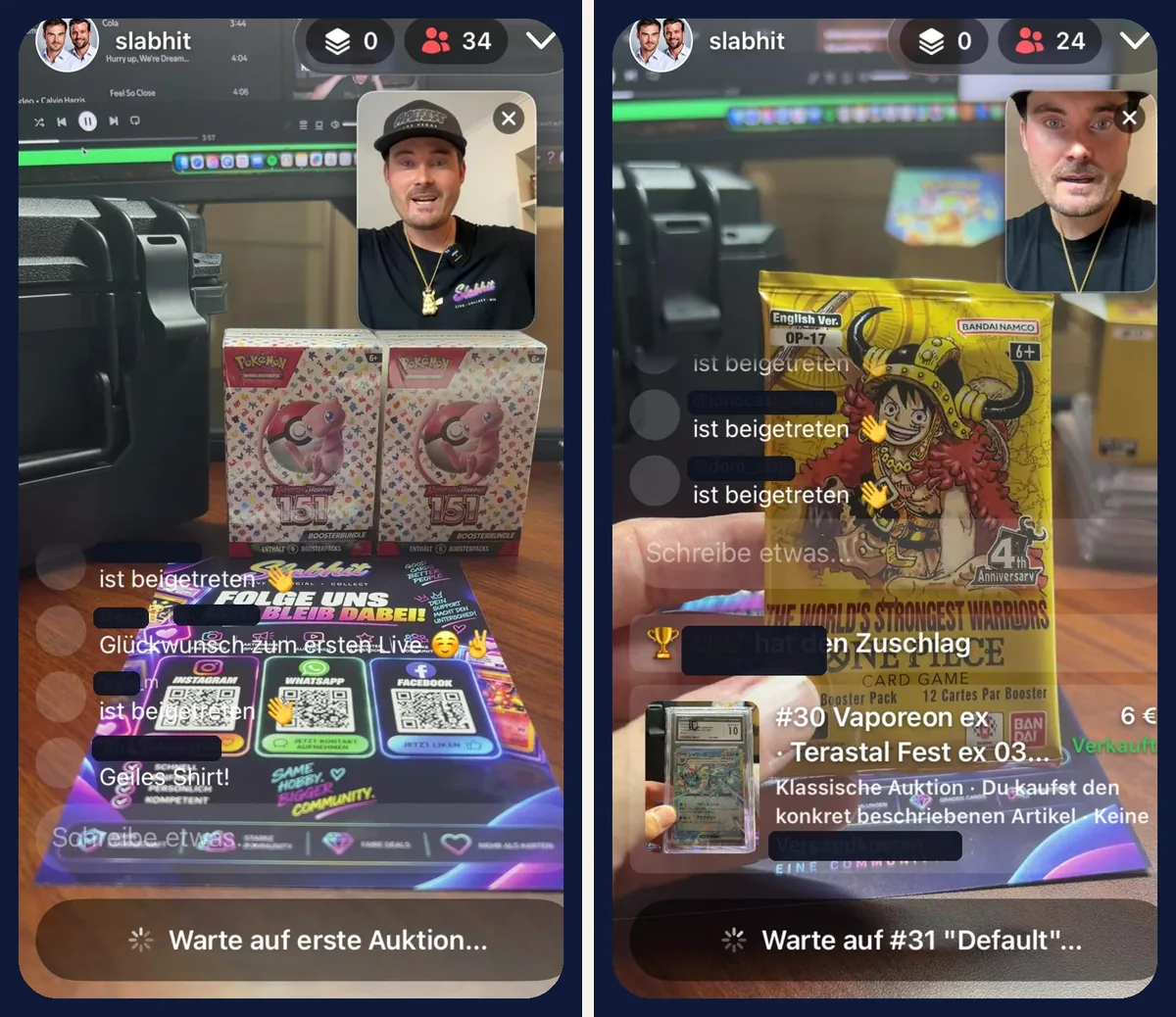
The live event as a shared ritual
The fourth mechanism is almost always overlooked: a livestream is an appointment. It starts at 8 p.m. whether you are there or not. That sounds like a disadvantage, but psychologically it is the opposite. A fixed time turns consumption into an event, and recurring events become rituals. The Wednesday evening stream becomes the campfire a community gathers around.
Watch time proves the point. On a normal product page, visitors spend seconds. The live shopping platform Bambuser, by contrast, measures an average viewing time of 11 minutes per broadcast; more than 15 percent of viewers comment in the chat, about a quarter hand out likes, and 12.5 percent add a product to the cart. People do not stay 11 minutes because they are looking for a product. They stay because they are sharing an experience.
Variable rewards: why pack opening is so thrilling
In my world of trading cards, a fifth mechanism comes into play, the strongest of them all: the variable reward. When a display box is opened in the stream, nobody knows what is inside. Mostly average pulls, sometimes a hit, very rarely the big one. Since the experiments of psychologist B. F. Skinner, this unpredictable reward pattern has been known as the most powerful reinforcer of behavior. It is not the guaranteed reward that grips us, it is the possible one.
In a livestream this becomes a collective experience. Hundreds of people hold their breath together as the foil tears open, and the cheering in the chat belongs to everyone. That is what makes breaking formats so successful, and one of the reasons we are building Slabhit as a live shopping platform for trading cards. Chance turns from a lonely thrill into a shared moment.
Impulse buying: the downside of live shopping
Anyone who understands these mechanisms also has to talk about their dark side. The same combination of closeness, scarcity, and variable rewards that creates a great evening can trigger impulse purchases people regret the next morning. Research on impulse buying in livestream commerce is growing quickly for a reason. The mechanism tips where scarcity is invented, where countdowns lie, where hosts build targeted buying pressure, or where heavy buyers showing compulsive patterns are egged on instead of slowed down.
This is where I see the platforms as responsible. Honest quantities, transparent prices, clear rules for hosts, and the willingness to address conspicuous buying behavior instead of exploiting it. That costs short-term revenue and builds the long-term trust this business model lives on. Why the German market is setting its standards right now, I described in Live Commerce in Germany. Live shopping grips us because it speaks to the oldest social instincts: closeness, belonging, the pull of the moment, and the thrill of chance. Use that respectfully and you build something lasting. Exploit it and you make a quick sale and lose the trust. I know which side I want to be on.
Frequently asked questions
Why is live shopping so captivating?
Because it activates several psychological mechanisms at once: parasocial closeness to a real person, scarcity and the fear of missing out, social proof through the chat, the ritual of a fixed appointment, and the variable reward of pack openings. This combination creates a bond a classic online shop cannot offer.
What is a parasocial relationship in live commerce?
The felt personal bond between viewer and host. Studies show that this relationship builds trust and significantly influences purchase decisions, because in a livestream the host actually responds to individual viewers, so the relationship is no longer one-sided.
Is live commerce manipulative?
It can be, but it does not have to be. Real scarcity and honest urgency are legitimate, invented countdowns and artificial scarcity are manipulation. Serious platforms rely on transparent quantities, clear rules for hosts, and a responsible approach to conspicuous buying behavior.
How do I protect myself from impulse purchases in live shopping?
Set a budget before the stream and stick to it. Ask yourself with every purchase whether you would still want the product tomorrow. And be skeptical of formats that work with constant time pressure: real scarcity does not need a permanent drumbeat.
Warmly,
Dennis Weidner
Note: AI tools supported me in writing this article, and some images were edited with AI. I stand behind its content and every statement with my name.