Since 13 December 2024, the EU General Product Safety Regulation (GPSR) has applied to every business that sells goods to consumers online, second-hand goods included. Every listing must show four items: the manufacturer with postal and email address, an EU responsible person if the manufacturer is based outside the EU, product identification with a picture, and the warnings in the buyer's language. If one is missing, sellers in Germany have faced fines of up to 10,000 euros since 19 February 2026.
As of 25 September 2026. Not legal advice, see the note at the end.
More on this topic: E-Commerce & Live Commerce, with background, practice and every article in one place.
What the GPSR Is and Which Online Sellers It Covers
Regulation (EU) 2023/988 on general product safety was adopted on 10 May 2023 and, under Article 52, has applied directly in every member state since 13 December 2024. It replaced the old General Product Safety Directive 2001/95/EC. It covers all consumer products except food, medicines and a few other categories. Where specific EU safety rules exist, for toys or electrical equipment for example, the GPSR fills the gaps.
Two points are regularly overlooked. First, Article 2(3) expressly covers new, used, repaired and reconditioned products. Anyone reselling second-hand goods as a business is fully in scope. Second, the European Commission's guidelines on applying the GPSR of 21 November 2025 state that purely consumer-to-consumer transactions fall outside the regulation.
Goods placed on the market under the old rules before 13 December 2024 benefit from a transitional provision (Article 51). It concerns the goods themselves, not the online listing. The listing duties apply to every product offered today. If you are reworking your shop anyway, check accessibility at the same time, which I covered in Germany's Accessibility Act for Online Shops.
GPSR Mandatory Information: What Every Online Listing Must Show
Article 19 GPSR requires every distance-sales offer to contain at least four items of information, shown clearly and visibly. The benchmark is the physical store: online buyers should see the same safety information they could read on the packaging in a shop. A link to the seller's legal notice, the Impressum German websites must carry, is therefore not enough. What the law asks for is the manufacturer of the product.
The language is set by each member state. In Germany, Section 6 of the Product Safety Act (Produktsicherheitsgesetz, ProdSG) requires warnings and safety information under Article 19(d) to be in German. The Commission's guidelines draw one important line: safety information is only needed if the product cannot be used safely without it. For products whose risks are common knowledge, the Commission cites the knife as an example.
The table sums up what a seller must do per listing and in the process, with the legal reference and the fine ceiling under Section 28 of the German Product Safety Act.
| Duty | Legal basis | What to do in practice | Fine up to (Germany) |
|---|---|---|---|
| Name the manufacturer | Art. 19(a) | Name, registered trade name or trademark, postal address and email address in the listing | €10,000 (Sec. 28(2) no. 26) |
| EU responsible person | Art. 19(b), Art. 16 | Only for manufacturers outside the EU: name, postal address and email of the responsible person in the EU | €10,000 (no. 26) |
| Make the product identifiable | Art. 19(c) | Picture, product type and an identifier such as type, batch or serial number | €10,000 (no. 26) |
| Warnings in the local language | Art. 19(d), Sec. 6 no. 3 ProdSG | Copy the warnings from product or packaging into the listing, such as age limits on toys | €10,000 (no. 26) |
| Check goods before selling | Art. 12(1) and (3) | Identifier, manufacturer and importer details, instructions on the product? If not, do not list it | €10,000 (no. 21) |
| Danger identified | Art. 12(4) | Inform the manufacturer, ensure corrective action, notify authorities via the Safety Business Gateway | no separate offence in Sec. 28(2) |
| Accident reported | Art. 20(3) | Inform the manufacturer without delay; the manufacturer files the notification | no separate offence for the seller |
The four items under Article 19 share one offence, no. 26: if even one is missing, making the product available is an administrative offence, whether intentional or negligent. The higher tier of 100,000 euros mainly targets manufacturers and importers who fail to take necessary corrective action such as a recall in time (Section 28(3) in conjunction with (2) nos. 7 and 19).
Distributor Obligations Under Article 12 GPSR: Check, Store, Stop
Article 12 turns the seller into the second checkpoint behind the manufacturer. Before offering a product, a distributor must verify that the manufacturer and, where relevant, the importer have met their labelling duties: a type or serial number, name and address on the product or packaging, and instructions and safety information in the local language. While the goods are in the seller's hands, storage and shipping must not compromise their safety.
If the seller has reason to believe a product is dangerous, action must follow without delay. The seller informs the manufacturer, makes sure corrective action is taken up to and including a recall, and reports the case through the European Commission's Safety Business Gateway. If the seller learns of an accident, Article 20(3) requires passing it on to the manufacturer, who reports it to the authority or instructs the seller to do so.
One trap for small sellers sits in Article 13: anyone selling a product under their own name or brand counts as its manufacturer. The full manufacturer duties then apply, including an internal risk analysis and technical documentation kept for ten years.
Online Marketplaces and Live Shopping: What the GPSR Asks of Platforms
Platforms are governed by Article 22. Online marketplaces must register on the Safety Gate portal, name one single point of contact for authorities and one for consumers, and handle product safety notices within three working days. Under Article 22(9), they must design their interface so that sellers can enter the four mandatory items per product and buyers see them in the listing. According to the European Commission's press release of 5 March 2026, more than 1,200 online marketplaces had registered by the end of 2025.
The platform provides the fields; the seller fills them in. The same applies to live shopping: selling in a livestream is a distance sale, and the offer behind the stream needs the same information. Anyone starting out on TikTok Shop as a small retailer should have manufacturer data in the product master data before the first stream, not after it.
Germany's Product Safety Act 2026: Fines and Recalls
Germany wired the GPSR into national law more than a year late. A first bill lapsed when the parliamentary term ended in 2025. The act amending the Product Safety Act (Federal Law Gazette 2026 I no. 29) was signed on 3 February 2026 and took effect on 19 February 2026. It adds a new Section 28(2) to the ProdSG with 32 offences that point directly at GPSR articles. Breaches by online marketplaces under Article 22(7) to (9) are handled in the Digital Services Act implementation law (Digitale-Dienste-Gesetz).
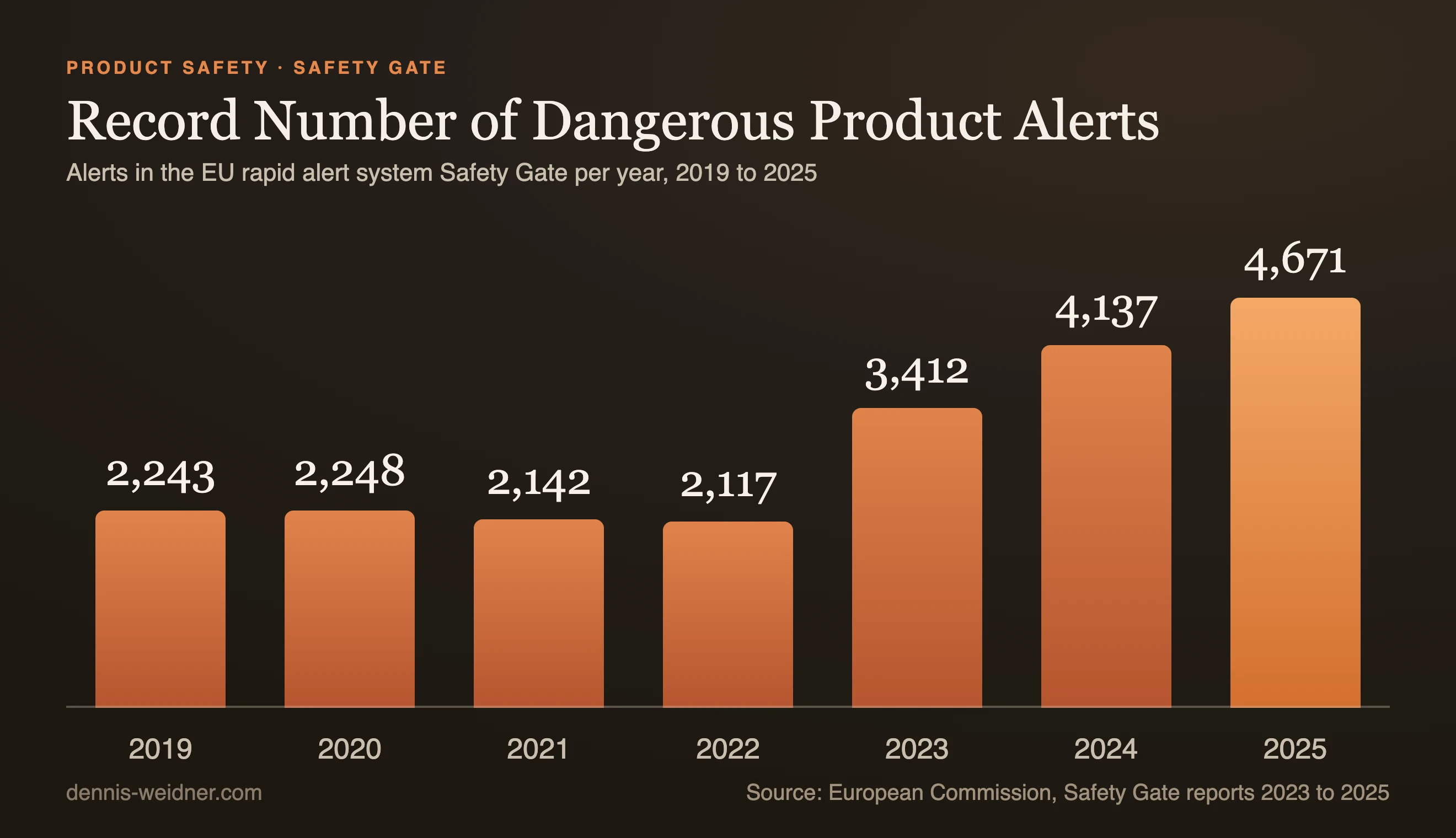
How seriously enforcers take this shows in Safety Gate, the EU's rapid alert system for dangerous non-food products. In 2025, authorities notified 4,671 alerts there, the highest number since the system started in 2003. That is 13 percent more than in 2024 and more than twice the 2022 figure. Cosmetics made up 36 percent of alerts, toys 16 percent.
If a recall happens, Article 36 GPSR prescribes the format. The recall notice carries the heading "Product safety recall", describes the product, the hazard and what to do, and must not play down the risk with words such as "voluntary" or "precautionary". Under Article 37, the business responsible must offer a free remedy and give buyers a choice of at least two out of three: repair, replacement or an adequate refund.
Trading Cards, Toys and Antiques: Where the GPSR Draws Lines for Online Sellers
For trading card sellers, the market I am building SLABHIT for, the boundaries are tricky. Under the Toy Safety Directive 2009/48/EC, a toy is any product designed or intended for play by children under 14. A trading card game made for children to play falls under it and needs the CE marking and the prescribed warnings. Annex I exempts products for collectors, but only if the product or its packaging visibly states that it is intended for collectors aged 14 and over. Under Article 11(2) of the directive, warnings that matter for the purchase decision, such as the minimum age, must be visible before purchase, including online.
The new Toy Safety Regulation (EU) 2025/2509 of 26 November 2025 carries over this collector exemption almost word for word. It applies from 1 August 2030 and then replaces the directive. The GPSR still applies alongside it: Article 2(1) exempts products with their own EU safety rules only from the manufacturer duties in Chapter III Section 1, not from Article 19. The listing information is therefore required for toys too.
Antiques are excluded entirely under Article 2(2)(i). Recital 18 sets a high bar, though: collectors' items must be sufficiently rare and of historical or scientific interest, antiques of exceptional age. A current single card from retail does not qualify just because people collect it. How the platforms for trading cards compare in other respects is covered in Live Shopping for Trading Cards.
GPSR for Small Online Sellers: What to Tackle First
In my view, the GPSR is above all a master data task for small sellers. Most fine risks do not come from dangerous goods but from empty fields. I would work in this order:
- Record manufacturer data for each item. Name, postal address and email are usually on the packaging or label. For manufacturers outside the EU, add the EU responsible person.
- Copy warnings, do not paraphrase them. Whatever is on the packaging belongs in the listing word for word, in the buyer's language, as text and not only in a photo.
- Check incoming goods. Do not list goods without an identifier or manufacturer details at all. That is the duty under Article 12(1).
- Set up EU Login and learn the reporting route. Anyone looking for the Safety Business Gateway only in an emergency loses the time that "without delay" demands.
- Log complaints and accidents. A simple record is enough.
More on online retail and live commerce is collected under E-Commerce and Live Commerce.
Frequently Asked Questions
Does the GPSR apply to second-hand goods?
Yes. Article 2(3) of Regulation (EU) 2023/988 covers new, used, repaired and reconditioned products as soon as a business offers them. Only sales between private individuals and goods sold expressly as needing repair are excluded.
Is my legal notice enough as manufacturer information?
No. Article 19 requires the manufacturer's name, postal address and email address in the listing itself. The legal notice names the seller. Only those selling under their own brand are also the manufacturer under Article 13.
What is the fine for missing GPSR information in Germany?
Up to 10,000 euros under Section 28(2) no. 26 and (3) of the German Product Safety Act, in force since 19 February 2026. Up to 100,000 euros apply if necessary corrective action such as a recall is not taken.
Are trading cards toys under EU law?
It depends on the intended use. A card game made for play by children under 14 is a toy requiring CE marking and warnings. Collector products are only exempt if they are visibly labelled as intended for collectors aged 14 and over.
What is the Safety Business Gateway?
The European Commission's reporting portal through which businesses notify dangerous products and accidents to market surveillance authorities. Access runs through an EU Login account, and each report is immediately available to all relevant authorities.
Note: This article is not legal advice. It describes the legal situation in Germany as of 25 September 2026 and simplifies: electrical equipment, cosmetics and other product groups carry additional labelling duties, and whether a product is a toy is decided case by case. Next review of this article: when the Commission's planned European Product Act is published, or by October 2027 at the latest.
Best,
Dennis Weidner
Note: AI tools supported me in writing this article, and some images were edited with AI. I stand behind its content and every statement with my name.