I talk about live commerce a lot, and I often hear the same thing: nice idea, but is this actually a market? The short answer: it is one of the fastest-growing areas in all of retail. Let's look at the numbers, because they are exactly why we are building Slabhit right now.
How big the market in China already is
If you want to know where live commerce is headed, look at China, the most mature market in the world. There, according to Statista, livestream commerce exploded from 0.42 trillion RMB in 2019 to roughly 5 trillion RMB in 2023, more than twelvefold in four years. By now, livestreaming accounts for almost a third of all online retail there.
More on this topic: E-Commerce & Live Commerce – background, practice and every article in one place.
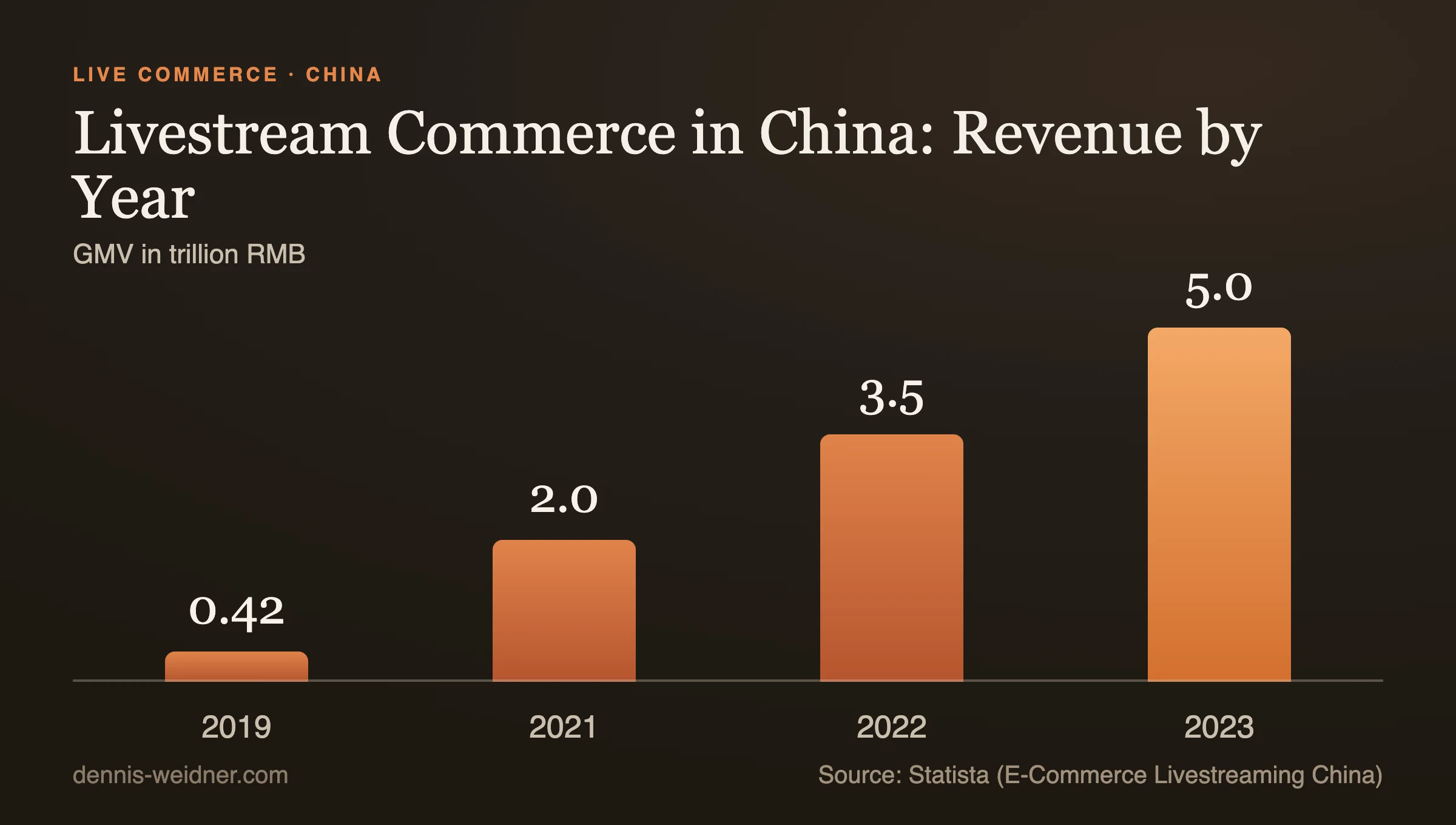
That is the proof that the format is no gimmick but a distinct, enormous form of commerce in its own right, once trust and platforms are in place. And this exact level of maturity is still ahead of Europe.
Why China is not a special case
The most common objection goes like this: China works differently, and none of this transfers. A look at the United States proves otherwise. There, Coresight Research puts livestream commerce at roughly 32 billion dollars in 2023, up from about 20 billion the year before. By 2026 the figure is expected to more than double to around 68 billion dollars and then account for over five percent of all e-commerce. This is no longer a Chinese phenomenon. It is Western everyday life in the making.
What is interesting is what sells. In the US, according to the same research, most live purchases fall into fashion, followed by beauty, accessories and personal care. These are exactly the categories where a person showing and explaining something makes the decisive difference. A photo in a shop sells a product. A good show sells the trust that the product delivers what it promises.
And where Germany stands
Worldwide, analysts at Grand View Research see double-digit annual growth rates, and for Germany around 27 percent per year. That means the market roughly doubles every three years. You almost never see curves like that in established retail. German online retail as a whole is growing at only low single-digit rates, according to the industry association bevh. So live commerce is not moving with the market, it is outrunning it several times over.
Anyone who builds a trustworthy position early in that kind of growth will be sitting at a very different table within a few years. I have written up the details on the German market and my thesis in more depth in The Live Commerce Market in Numbers and in the overview of live commerce in Germany.
Why growth alone is not enough
A big market attracts a crowd, and most of them fail at the same point: trust. In live auctions with goods worth hundreds to thousands of euros, the decisive question is not whether the technology works, but whether the buyer feels safe. That is exactly where we come in, with curation, clean shows and genuine knowledge of the German market, instead of translating a US product.
Here is an example that makes the point tangible: a single trading card can change hands in a live auction for a four-figure sum, in a matter of seconds, in front of hundreds of viewers. Whether someone places a bid in that moment does not hinge on the livestream itself, but on three things. Is the card valued fairly? Will it arrive in the condition it was shown in? And is there a real person standing behind it? Whoever answers those three questions convincingly wins the market, not whoever has the loudest reach.
The bridge
We are starting deliberately in the cluster of trading cards and collectibles, because that is where community, spending power and the need for trust all come together. But the stage carries further: sneakers, watches, vinyl and many more categories. At its core, live commerce is the digital extension of retail, decoupled from opening hours and floor space. There is more on how we approach this in my piece on Slabhit and the beta launch.
The numbers say the market is tipping. The only question is who builds the trustworthy platform before everyone else tries.
Frequently Asked Questions
How big is live commerce really?
In China, the most mature market, roughly 5 trillion RMB in revenue (2023) and almost a third of all online retail. In the US, Coresight Research estimates around 32 billion dollars for 2023, on track for roughly 68 billion by 2026. Worldwide the market is growing at double-digit rates, in Germany at about 27 percent per year.
Is live commerce only a Chinese phenomenon?
No. China is furthest ahead, but the US shows the same pattern, with the market doubling between 2022 and 2026. The format works wherever trust, spending power and the right category come together.
Why Germany, and why now?
Because for the first time mature technology, communities with real spending power and the expectation of "shopping as an experience" all come together, while a platform with trust and market knowledge is still missing.
What decides success?
Not reach, but trust: curation, clean settlement, real people instead of an anonymous crowd.
Warm regards,
Dennis Weidner
Note: AI tools supported me in writing this article, and some images were edited with AI. I stand behind its content and every statement with my name.