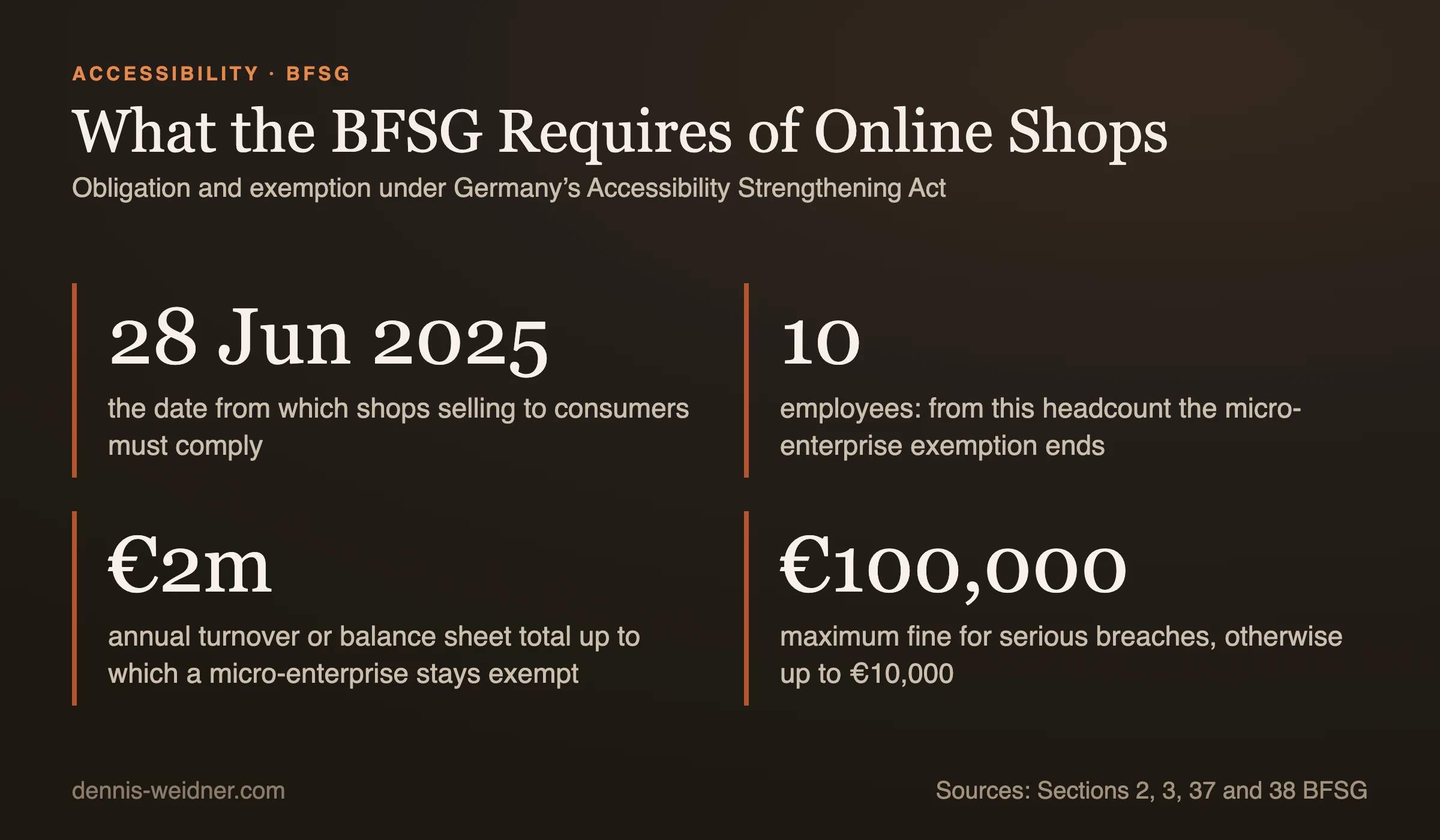
Since June 28, 2025, online shops that sell to consumers in Germany must be accessible under the Accessibility Strengthening Act (Barrierefreiheitsstärkungsgesetz, BFSG). Only microenterprises are exempt: fewer than ten employees and either annual turnover of no more than €2 million or a balance sheet total of no more than €2 million. That "or" is often overlooked, and in the worked example below it alone decides whether a shop with €3.2 million in turnover is covered. Purely B2B shops fall outside the law. Shops that are covered need an accessible website and public information about it, and violations can lead to fines of up to €100,000.
As of September 11, 2026.
More on this topic: E-Commerce & Live Commerce, with background, practice and every article in one place.
What the BFSG Is: Germany's Implementation of the European Accessibility Act
The BFSG implements Directive (EU) 2019/882, known as the European Accessibility Act. According to Section 1 BFSG, its purpose is to ensure the accessibility of products and services in the interest of consumers and users. People with disabilities should be able to use digital offerings just like everyone else.
The law covers two groups. On one side, products such as computers, smartphones, e-book readers and self-service terminals. On the other, services, including, under Section 1(3), banking services for consumers, e-books and, most importantly for retail, services in electronic commerce. That covers every online shop, every booking flow and every app through which consumers conclude a contract.
Unlike many funding or tax topics, there is no longer a transition period for the website itself. The obligation has applied since June 28, 2025. The transitional rule in Section 38 BFSG concerns products used to provide a service, such as a terminal that was already in use before the deadline: it may continue to be used until June 27, 2030.
Which Online Shops Fall Under the German Accessibility Act
The key is the definition in Section 2 No. 26 BFSG. Services in electronic commerce are digital services offered via websites and apps and provided electronically at the individual request of a consumer with a view to concluding a consumer contract. Three features, then: digital, at a consumer's request, aimed at a contract.
Two things follow. First, almost every classic online shop that sells to private customers is covered, whether it sells fashion, electronics or trading cards. Appointment bookings with a contract, ticket sales and subscription flows are covered too. Second, a shop that is explicitly and verifiably aimed only at businesses is not covered, because no consumer contract is intended. A sentence in the footer is unlikely to be enough if consumers can still place orders without restriction.
Anyone who sells exclusively through third-party marketplaces does not operate their own shop; obligations for the interface fall primarily on the platform operator. Your own content, such as product images without descriptions, remains a weak spot all the same. How the platforms for trading cards differ is shown in the comparison of live shopping platforms.
The Microenterprise Exemption: Ten Employees and Two Million Euros
Under Section 3(3) BFSG, the obligation does not apply to microenterprises that offer or provide services. What counts as a microenterprise is defined in Section 2 No. 17: a company that employs fewer than ten persons and either has an annual turnover of no more than €2 million or an annual balance sheet total of no more than €2 million.
Three points are regularly misread:
- The headcount is a hard limit. Fewer than ten means that the exemption ends with the tenth person, however small the turnover.
- Turnover or balance sheet, not both. It is enough if one of the two values is below €2 million. A retailer with high turnover but a lean balance sheet, because it holds little stock and hardly any fixed assets, can be exempt.
- The exemption applies only to services. Anyone who manufactures or places products within the meaning of the law on the market, such as hardware, has no exemption for those products.
The law refers to persons employed, not full-time positions. Whether part-time staff count proportionally is not expressly regulated. Anyone close to the limit should get this clarified rather than rely on the more favorable reading.
Worked Example: Which Online Shops Are Exempt From the BFSG
Five fictitious shops; the thresholds come from Section 2 No. 17 and Section 3(3) BFSG:
| Shop | Employees | Annual turnover | Balance sheet total | Result |
|---|---|---|---|---|
| A: tea shop | 4 | €0.9 million | €0.4 million | exempt |
| B: fashion shop with dropshipping | 8 | €3.2 million | €1.6 million | exempt, because the balance sheet total is below €2 million |
| C: electronics shop with its own warehouse | 8 | €3.2 million | €2.4 million | covered, both values above €2 million |
| D: trading card dealer | 12 | €1.5 million | €0.6 million | covered, ten or more employees |
| E: wholesaler for business customers only | 30 | €20 million | €8 million | not covered, as long as no consumer contract is intended |
Cases B and C have the same turnover and the same workforce. The only difference is the balance sheet, which essentially means the stock. That has an uncomfortable consequence: a growing shop can lose the exemption without any change in turnover or staff, simply because it buys goods in advance. Anyone planning close to the thresholds should therefore not rely on the exemption but build accessibility in from the start.
What Accessibility Means in Practice for an Online Shop
The technical requirements are not in the law itself but in the ordinance issued under Section 3(2) BFSG. In practice, audits follow the European standard EN 301 549, which refers to the Web Content Accessibility Guidelines (WCAG) 2.1 at level AA for web content. Their four principles are: perceivable, operable, understandable and robust.
Translated into an online shop, this mainly means:
- Product images, icons and buttons have text alternatives that a screen reader can read aloud.
- Text and controls have sufficient contrast with the background.
- The entire purchase process works with the keyboard, from the cart to payment.
- Form fields are labeled, and error messages explain what is wrong and how to fix it.
- The page remains usable at 200 percent zoom without content being cut off.
- Time limits in checkout can be extended, and a security check has an accessible alternative.
On top of that comes an information obligation that many shops have not yet met. Under Section 14 BFSG, a service provider may only offer its service if it has prepared the information set out in Annex 3 of the law and made it available to the public in an accessible form. This means a description of how the shop meets the requirements. Many shops publish it as a separate page linked in the footer.
Enforcement and Fines: Market Surveillance in Magdeburg
Responsibility lies with a joint authority of the German states: the Market Surveillance Office of the Federal States for the Accessibility of Products and Services, MLBF for short, a public-law institution based in Magdeburg. Under Section 32(1) BFSG, consumers can file an application there when they encounter a barrier. The authority therefore does not have to search on its own; it receives reports from those affected.
Fines are governed by Section 37 BFSG. Depending on the violation, the range goes up to €10,000 or up to €100,000. Whether competitors can additionally issue cease-and-desist letters for violations is legally disputed. For planning purposes, that is secondary: a shop that meets the requirements has nothing to fear from either question.
Accessibility as a Business Case: Why the Switch Pays Off Even Without the Law
The law is often described as a cost item. That falls short, because almost every requirement improves the shop for all customers. Clear contrast helps anyone using a phone in the sun. Labeled form fields and understandable error messages reduce checkout abandonment. Text alternatives for images and a clean heading structure help search engines understand the shop. And an aging customer base appreciates large type and simple navigation long before anyone would have a disability.
The pattern is familiar from other regulation: the obligation hits everyone at the same time, and the advantage goes to those who take it seriously before their competitors do. Anyone working on their shop anyway, for instance when entering new channels as described in the article on TikTok Shop for small retailers, should write accessibility into the specification from day one. Retrofitting is almost always more expensive than building it in. More articles on retail can be found in the overview of e-commerce and live commerce.
Checklist: Pre-Check Your Online Shop in One Afternoon
- Put headcount, annual turnover and the balance sheet total from the last financial statements side by side and check the exemption honestly.
- Clarify whether the shop targets consumers or verifiably only businesses.
- Run through an entire purchase using only the Tab and Enter keys.
- Zoom the page to 200 percent and check that everything still works.
- Measure contrast with a free checking tool and count images without text alternatives.
- Ask your theme, plugin and payment providers in writing about the accessibility of their components.
- Publish the information required by Annex 3 BFSG as a separate page.
Frequently Asked Questions About the BFSG for Online Shops
Does the BFSG apply to every online shop?
Since June 28, 2025, it has applied to online shops through which consumers can conclude a contract. Microenterprises and shops that verifiably target only businesses are exempt.
Which companies are exempt from the BFSG?
Microenterprises that offer services: fewer than ten employees and either annual turnover of no more than €2 million or a balance sheet total of no more than €2 million (Section 2 No. 17 and Section 3(3) BFSG).
Does the BFSG apply to B2B shops?
No, if the shop does not aim to conclude contracts with consumers. The law refers to services provided at a consumer's request with a view to a consumer contract (Section 2 No. 26 BFSG).
What fines can be imposed under the BFSG?
Depending on the violation, up to €10,000 or up to €100,000 (Section 37 BFSG). The competent authority is the Market Surveillance Office of the Federal States (MLBF) in Magdeburg.
What must the accessibility information contain?
Under Section 14 BFSG and Annex 3, the shop describes how its service meets the requirements. The information must be available to the public in an accessible form, usually as a separate page.
Note: This article is not legal advice. The examples are simplified; borderline cases concerning headcount or the B2B nature of a shop belong with a law firm. Next review of this article: June 2027.
Best,
Dennis Weidner
Note: AI tools supported me in writing this article, and some images were edited with AI. I stand behind its content and every statement with my name.