For the first time since the series began in 2016, promotion-day revenue is shrinking while more people take part. So the occasion still pulls; it is the basket that is getting smaller.
For the First Time Since 2016, the Peak Is Shrinking
The German Retail Association has tracked Black Friday and Cyber Monday revenue since 2016. Until 2023 the curve pointed upwards; in 2024 it stalled at 5.9 billion euros. For 2025 the association forecast 5.8 billion euros on 17 November, a decline of just under 2 percent year on year. It is the first decline since the series began.
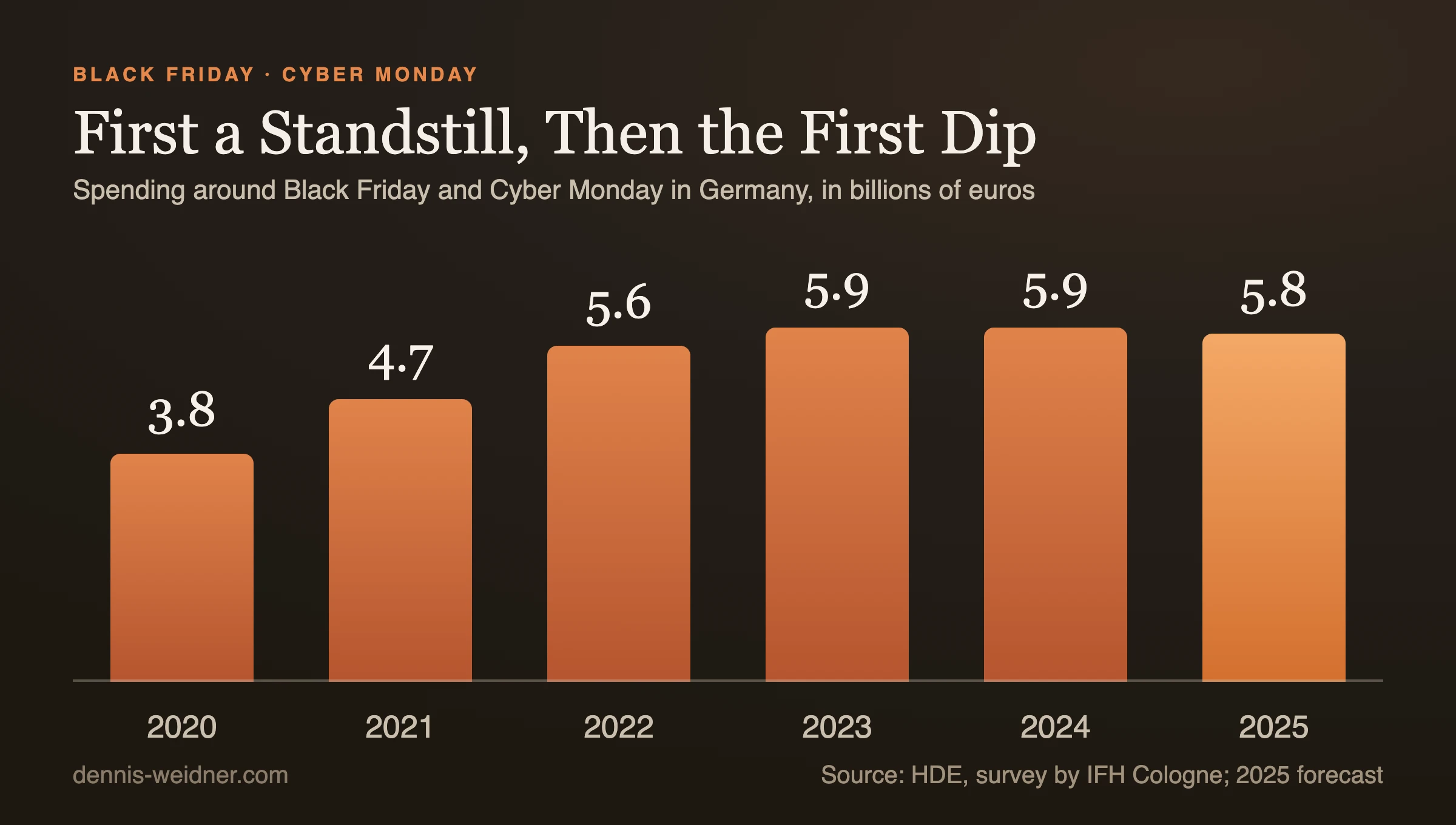
That alone would be a story. But the same survey also shows: participation is rising. 48 percent of respondents planned to buy discounted products on Black Friday, more than a third on Cyber Monday. Slightly more people than the year before intended to take part.
When more people take part and revenue falls, the basket is getting smaller. The occasion still pulls, the budget per person shrinks. That is a different finding from „Black Friday is over", and it leads to different decisions.
The Number That Cuts the Promotion Days Down to Size
5.8 billion euros sounds like an event that shapes a retail year. For the Christmas season as a whole, November and December 2025, the same association forecast 126.2 billion euros.
From those two HDE figures it follows that the promotions around the two days account for 4.6 percent of the Christmas season. An occasion that dominates the coverage carries less than a twentieth of it.
That puts the excitement in proportion, and it puts the discounts in proportion too. Anyone granting twenty or thirty percent off in November to take part in those 4.6 percent pays for it with margin across a much larger share of the season, because the price anchor is set. A customer who learned on Black Friday what a product „really" costs will not pay list price on 15 December.
What the 5.8 Billion Are Spent On
The HDE reports that around 1.6 billion euros of promotion-day revenue goes on Christmas shopping. That is 27.6 percent. A good quarter is passed on as a gift, close to three quarters stays with the buyer.
The survey supports this: 54 percent intended to use Black Friday for Christmas shopping, 42 percent Cyber Monday. Both figures sit well below a hundred, meaning that for most purchases on those days Christmas is not the reason but the opportunity.
For range planning that is the genuinely useful piece of information. Treat the promotion days as a gifting season and you plan past the larger part of demand. What sells is what people buy for themselves when the price is right.
Where the Figure Comes From and What It Can Carry
The forecast comes from a survey by IFH Cologne on behalf of the HDE, conducted in October 2025 among more than 1,000 online shoppers.
It is a sound survey of purchase intentions. People were asked four to six weeks before the event what they planned to do. Between plan and receipt sit two effects that pull in opposite directions: those short of money intend more than they spend, and those who see a good offer buy more than they intended.
As an order of magnitude and a direction the figure holds. The till reading came from the official statistics in January: in November 2025 retail sales were 1.9 percent higher in nominal, calendar- and seasonally adjusted terms than a year earlier, and 5.7 percent higher for internet and mail-order retail. The promotion days themselves are not broken out.
Why the Decline Still Matters
Minus two percent is small; what counts is the sign, after seven years of growth and one year of standstill. A series that had never fallen since 2016 has turned negative.
The rest of the season fits. The HDE interim assessment of 21 December 2025 reported 62 percent of retailers dissatisfied with revenue, 66 percent dissatisfied with the season so far and 71 percent seeing weaker footfall. The promotion days were therefore the earliest visible point of a season that ran weak throughout.
The HDE expected online to grow 3.3 percent in the 2025 Christmas season to 22.2 billion euros, total retail 1.5 percent nominally, meaning no growth in real terms. The channel grows while the event shrinks. That is the real shift.
For 2026 the HDE projects the same pattern. Its annual forecast of 2 February 2026 expects 697.4 billion euros for German retail as a whole, 2.0 percent more than in 2025 in nominal terms and half a percent after inflation. In its Online Monitor of 3 June 2026 the association expects online sales to grow by 4.3 percent and store-based retail by 1.6 percent.
What I Take From It
I am not writing this as an observer. With Slabhit we are building live shopping for trading cards, and the question of whether to join such promotion days is a concrete one for us.
First: the discount buys reach, not margin. At 4.6 percent of the Christmas season, Black Friday is an attention day rather than a revenue day. Treat it that way and you discount what brings new customers, not the range as a whole.
Second: the price anchor outlives the day. What is learned as the normal price on Black Friday holds for that customer until Christmas. That is the real cost of the promotion, and it appears in no campaign calculation.
Third: a smaller basket is a range question. When more people arrive with less money, whoever has a good entry size wins. For us that means not putting the most expensive card into the stream, but the one on which someone bids for the first time.
On retail in general and where it is shifting, I write continuously on my topic page on e-commerce and live commerce. Why the fourth quarter weighs so heavily in the first place is in Why the Fourth Quarter Decides the Retail Year.
Frequently Asked Questions
How much revenue do Black Friday and Cyber Monday generate in Germany?
The German Retail Association forecast 5.8 billion euros for the promotions around both days in 2025. That was a decline of just under 2 percent year on year and the first decline since the series began in 2016.
What share of the Christmas season do the promotion days represent?
By HDE figures, 5.8 of 126.2 billion euros of Christmas revenue fall on the promotions around the two days, which is 4.6 percent. The promotion days that dominate the coverage carry less than a twentieth of the season.
Why is revenue falling when more people take part?
Because the basket is getting smaller. 48 percent of respondents planned purchases on Black Friday, slightly more than the year before, while forecast total revenue fell. The occasion still pulls, the budget per person shrinks.
How much of it is Christmas gifts?
Around 1.6 of the 5.8 billion euros, or 27.6 percent. A good quarter is passed on as a gift, close to three quarters stays with the buyer. Planning the promotion days purely as a gifting season means planning past the larger part of demand.
How reliable is the forecast?
It comes from a survey by IFH Cologne for the HDE among more than 1,000 online shoppers in October 2025 and measures purchase intentions, weeks before the event. As an order of magnitude and a direction it is sound.
Is discounting on Black Friday worth it for retailers?
Only if it brings new customers. At 4.6 percent of the Christmas season the day is an attention day rather than a revenue day. The heavier cost appears in no campaign calculation: the price a customer learns on the promotion day holds for them until Christmas.
Warm regards,
Dennis Weidner
Note: AI tools supported me in writing this article, and some images were edited with AI. I stand behind its content and every statement with my name.