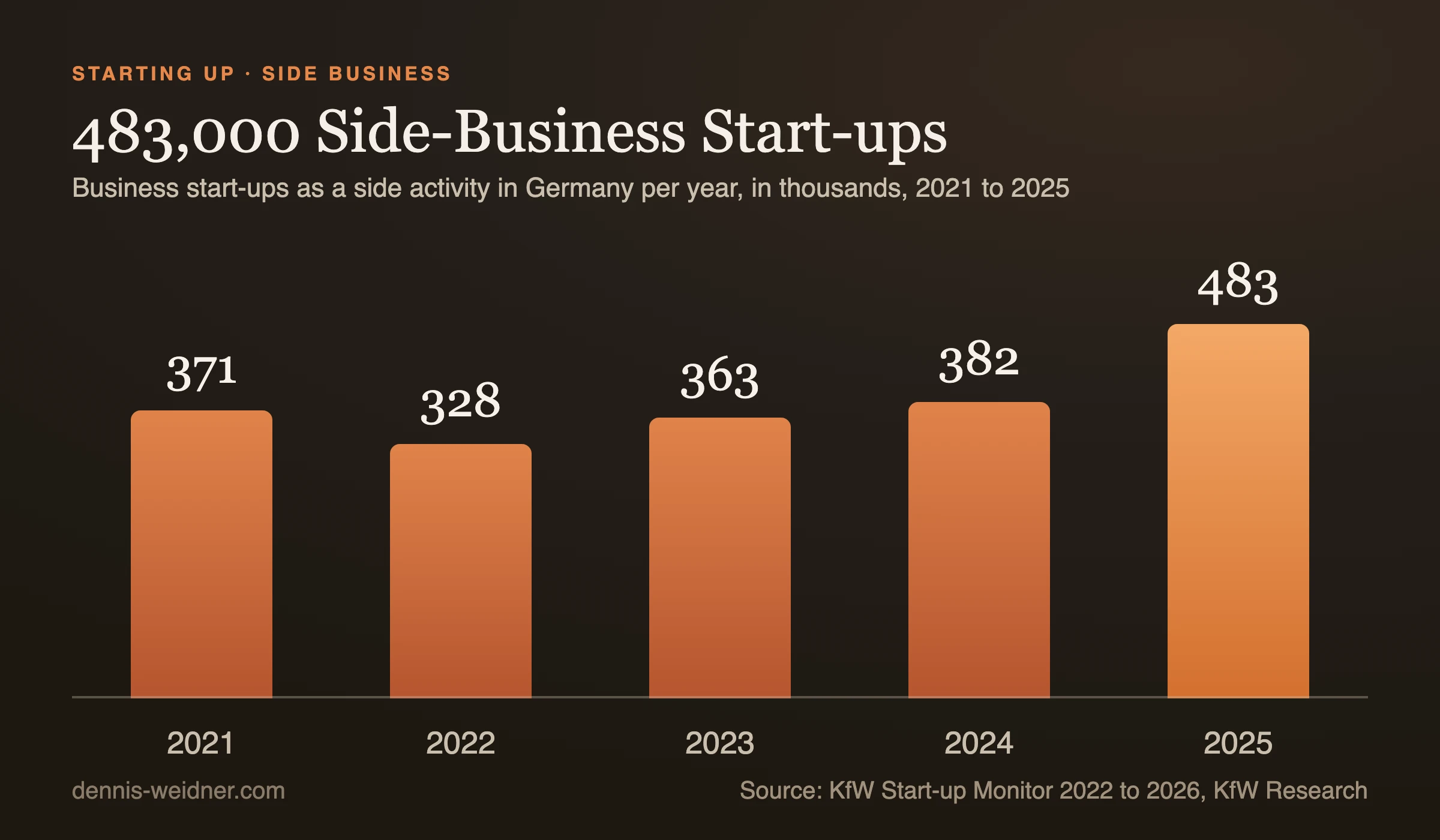
70 percent of all start-ups in Germany now begin as a side activity, around 483,000 in 2025. If you become self-employed alongside your job, your employer, the tax office, your health insurer and sometimes the pension insurance need to know. Here is how to start cleanly, and how to tell when a side business becomes your main occupation.
A Side Business in Germany: How Most Founders Now Start
Starting a business alongside a job has become the standard way to found a company in Germany. According to the KfW Start-up Monitor 2026, around 690,000 people became self-employed in 2025, around 483,000 of them as a side activity. That is 70 percent of all start-ups, more than ever before. Full-time start-ups were practically unchanged at 206,000.
The reasons make sense. Starting on the side tests a business model in the market before the salary stops, and keeps health insurance and pension rights from the main job. According to KfW, 40 percent of side-business founders name additional income as their main motive, and 15 percent want to try out a specific business idea. Both are good reasons. For a clean start, however, up to six institutions need to know, and the order matters.
| Who | What | When |
|---|---|---|
| Employer | notify the side activity if the contract requires it; no competition | before starting |
| Trade office | register a trade (not needed for liberal professions) | when the activity starts |
| Tax office | tax registration questionnaire via ELSTER | within one month |
| Health insurer | report changes relevant to compulsory insurance | without delay |
| Pension insurance | check whether Section 2 SGB VI applies, e.g. as a lecturer or with a single client | at the start |
| Employment agency | only if receiving unemployment benefit: report activity and hours | before starting |
The Employer: Notification, Competition, Working Time
A side activity is permitted in principle; freedom of occupation applies to employees too. Many employment contracts do require prior notification of side activities, and some make them subject to consent. Under case law, the employer may only refuse if legitimate interests are affected. Notification is therefore usually a formality, whereas failing to notify can lead to a formal warning.
Competition is a hard limit. For commercial employees it is set out in Section 60 of the Commercial Code: without consent, no trading business of one's own and no deals in the employer's line of business. Labour courts derive the same prohibition for all employees from the duty of loyalty. If you work for an energy supplier and want to broker solar systems on the side, talk to your employer first.
The Working Hours Act, in Section 2, only adds up working time with several employers. Your own self-employment does not count there. But performance in the main job must not suffer, otherwise the side activity affects exactly the interests the employer may protect.
The Tax Office: Registration, the €410 Limit and Hardship Relief
If you run a trade, you register it with the trade office, as described in registering a business in Germany. Liberal professions such as consulting, teaching or journalism notify the tax office directly. In both cases, the tax registration questionnaire follows via ELSTER within one month. It also decides whether the small business VAT scheme applies: no VAT as long as turnover did not exceed €25,000 in the previous year and does not exceed €100,000 in the current year.
Income tax has a special rule that helps employees with a small side business. Under Section 46 of the Income Tax Act, they only have to file a return once income without wage tax withholding exceeds €410 a year. If the side profit is between €410 and €820, the hardship relief under Section 70 of the Income Tax Implementing Regulation ensures that only part of it is taxed: the difference to €820 is deducted.
| Side profit per year | Hardship relief | Taxable | Additional income tax |
|---|---|---|---|
| €400 | no mandatory assessment for this reason | €0 | €0 |
| €700 | €120 | €580 | €194 |
| €820 | €0 | €820 | €275 |
| €2,000 | €0 | €2,000 | €675 |
| €5,000 | €0 | €5,000 | €1,713 |
The table assumes taxable income of €45,000 from the main job and the 2026 basic tariff, excluding solidarity surcharge and church tax. It shows two things: small side income barely matters for tax, and from around €1,000 of profit each additional euro is taxed at the personal marginal rate, here a good third. Factor that into your prices and your first tax return holds no surprises. The deadlines are in German tax return deadline 2026.
Trade tax rarely applies to a side business, because sole traders have an allowance of €24,500 of trade income.
The Health Insurer: When a Side Business Becomes the Main Occupation
Employees with compulsory statutory health insurance remain covered through their job, and self-employment on the side costs no additional contribution. That holds as long as it does not become the main occupation. Under Section 5(5) of Book V of the Social Code, anyone who is mainly self-employed is not subject to compulsory insurance. The compulsory cover through the job then ends, and contributions are based on all income.
Self-employment is the main occupation if it forms the economic and time focus. The law names one presumption expressly: anyone who regularly employs at least one employee more than marginally in connection with the self-employment is deemed mainly self-employed. The first permanent hire is therefore not only a business decision but also an insurance one.
Under Section 206 of Book V, changes relevant to compulsory insurance must be reported to the health insurer without delay. If you reduce your hours in the main job or hire staff, contact the insurer before it asks.
Pension Insurance: The Trap for Lecturers and Single-Client Freelancers
Most self-employed people are not subject to compulsory pension insurance. Section 2 of Book VI of the Social Code makes exceptions for some groups, and they catch side-business founders more often than expected: self-employed teachers and educators without insured employees of their own, including lecturers, trainers and coaches, as well as care workers, artists and journalists via the Artists' Social Insurance Fund, craftspeople in the craft register and self-employed people without staff who work permanently and essentially for one client.
There is relief for them: marginal self-employment is exempt under Section 5(2) of Book VI. The yardstick is the marginal earnings limit, €603 a month in 2026, which rises with the higher minimum wage in 2027. If you earn more as a lecturer on the side, clarify compulsory pension insurance before the first assignment. How the self-employed can build their own provision is covered in Germany's new retirement account for the self-employed.
Two everyday examples
The engineer who teaches evening classes. She works full-time as an employee and teaches courses at a training academy on a self-employed basis. She employs nobody and teaches, so she falls under Section 2 sentence 1 No. 1 of Book VI. If she earns more than the marginal earnings limit per month on average, she is subject to compulsory pension insurance on that income, even though her main job already pays contributions. Below the limit she stays exempt.
The employee with an online shop. He sells goods on the side through his own shop, registers a trade for it and remains a small business for VAT. Compulsory pension insurance does not apply to him, because retail is not among the groups in Section 2 and he works for many customers. What matters for him is mainly tax on the profit and whether the hours remain manageable alongside the job.
The difference lies not in the level of income but in the type of activity. That is exactly why the check before the first assignment pays off.
Unemployment Benefit and Side Work: The 15-Hour Limit
People receiving unemployment benefit may also work self-employed on the side. Under Section 138(3) of Book III of the Social Code, you remain unemployed as long as the activity covers less than 15 hours a week; several activities are added together. Income is offset under Section 155 after deducting taxes, contributions and an allowance of €165 a month. For the self-employed, a flat 30 percent of receipts is deducted as expenses unless higher costs are shown.
The activity must be reported to the employment agency beforehand. If you want to make the business your main occupation later, look at the start-up grant, which requires entitlement to unemployment benefit, as described in funding programs for founders.
The Right Moment to Go Full-Time
A side business is a beginning, not a permanent state. Three signals show that the switch is due: demand exceeds the available time, the side profit reaches a significant share of the net salary, and the first hire is coming up, which marks the main occupation for insurance purposes anyway. Keep these points in view and you plan the transition instead of being surprised by it.
Anyone who later runs more than one venture needs a clear structure early. How I build several companies in parallel is in how I build several companies at once. The changes for the self-employed in 2027 are summarised in what changes for businesses in 2027.
Frequently Asked Questions
Do I have to tell my employer about my side business in Germany?
If your employment contract requires notification or consent, yes. The employer may only prohibit the side activity if legitimate interests are affected, above all competition. For commercial employees, Section 60 of the Commercial Code sets out the non-compete rule expressly.
When do I have to pay tax on side income in Germany?
Employees must file a return once income without wage tax withholding exceeds €410 a year. Between €410 and €820, the hardship relief under Section 70 of the Income Tax Implementing Regulation reduces the taxable part; from €820 the full profit is taxed at the personal rate.
Do I have to register a side business?
Yes, if it is a trade, with the trade office when the activity starts, just like a full-time business. Liberal professions such as consulting, teaching or journalism do not register a trade. In both cases the tax registration questionnaire follows within one month.
Do I pay extra health insurance for a side business?
Not as long as the self-employment is not your main occupation. Employees remain insured through their job. Under Section 5(5) of Book V of the Social Code, a main occupation is presumed if at least one employee is regularly employed more than marginally; then compulsory cover through the job ends.
Do I have to pay into pension insurance as a part-time lecturer?
Possibly. Self-employed teachers and educators without insured employees are subject to compulsory pension insurance under Section 2 of Book VI, even on the side. Marginal self-employment up to the marginal earnings limit, €603 a month in 2026, remains exempt.
Can I work self-employed while receiving unemployment benefit?
Yes, as long as the activity covers less than 15 hours a week. Income is offset after taxes, contributions and a €165 monthly allowance, with a flat 30 percent expense deduction for the self-employed. The activity must be reported to the employment agency beforehand.
Warm regards,
Dennis Weidner
Note: AI tools supported me in writing this article, and some images were edited with AI. I stand behind its content and every statement with my name.