Since 1 January 2026, Germany's electricity tax for manufacturing companies and for agriculture and forestry has been permanently set at the EU minimum of 0.05 euro cents per kilowatt hour. Retailers, online sellers, service firms and offices still pay 2.05 cents. The 6.5 billion euro federal subsidy to transmission grid fees, by contrast, reaches every customer: on the Munich city utility's grid, it cuts a small business's grid fee by about 2.7 cents per kilowatt hour.
As of 25 September 2026. Not tax advice, see the note at the end.
More on this topic: Battery Storage & Energy, with background, practice and every article in one place.
Germany's Electricity Tax Cut in 2026: What Actually Changed for Businesses
What is new in 2026 is the duration, not the rate. The standard electricity tax (Stromsteuer) is 20.50 euros per megawatt hour under Section 3 of the Electricity Tax Act (StromStG). Manufacturers and farm and forestry businesses get 20 euros per megawatt hour back under Section 9b (2) StromStG. That leaves 0.50 euros, or 0.05 cents per kilowatt hour. The same relief already applied in 2024 and 2025, but only temporarily. The Third Act Amending the Energy Tax and Electricity Tax Acts, published in the Federal Law Gazette on 22 December 2025 (BGBl. 2025 I No. 340), made it permanent from 1 January 2026. Before 2024, the refund was only 5.13 euros per megawatt hour.
Two details decide the amount. First, there is a threshold: relief is granted only to the extent that it exceeds 250 euros in a calendar year, so a business using less than 12.5 megawatt hours gets nothing. Second, the company pays the full tax on its power bill and claims it back from its regional main customs office (Hauptzollamt). No application, no relief. The German parliament expects around 600,000 companies to benefit, including most skilled trades.
Who Does Not Benefit From Germany's Electricity Tax Cut: Retail, Services, Online Sellers
Everyone who does not make things. Under Section 2 No. 3 StromStG, only businesses classified in sections C to F of the German classification of economic activities count as manufacturing: mining, manufacturing, energy and water supply, construction. Retail, logistics, hospitality, agencies, law firms, software and e-commerce are out. They pay 2.05 cents per kilowatt hour, the same as a private household.
Classification follows the company's main activity, not individual machines. A bakery with its own production counts as a manufacturer of baked goods. If its chain of shops and cafés grows until selling becomes the main activity, the classification can flip. Power used for electric vehicles is explicitly excluded under Section 9b, even at a manufacturer. So far, the federal government has no plans to extend the cut to all sectors in 2027.
Grid Fee Subsidy 2026: What 6.5 Billion Euros Means per Kilowatt Hour
The subsidy reaches every power customer, but with very different force. Under Section 24c of the Energy Industry Act (EnWG), Germany's four transmission system operators receive a total of 6.5 billion euros from the federal Climate and Transformation Fund in 2026 and must use all of it to lower their fees. At extra-high voltage, the energy charge for customers below 2,500 hours of use per year fell from 5.46 to 2.36 cents per kilowatt hour, according to the nationwide transmission price sheet.
What a mid-sized company sees depends on how much its local distribution grid operator passes on. In its draft law for the following years, the federal government says household grid fees fell "by an average of around two cents per kilowatt hour" in 2026, with regional differences. One real grid makes this concrete. In the 2026 price sheet of SWM Infrastruktur in Munich, the energy charge for customers without demand metering fell from 9.28 to 6.47 cents, while the annual standing charge rose from 42.18 to 63.27 euros. At medium voltage below 2,500 hours, the energy charge fell from 6.62 to 4.95 cents and the demand charge from 21.78 to 15.88 euros per kilowatt. How demand charges work is explained in Load Profile and Demand Charges.
Whether the cut reaches your invoice depends on your supply contract. If the supplier lists grid fees as a pass-through item, the bill falls automatically. With a fixed all-in price and no adjustment clause, the supplier may keep the difference.
Worked Example: Business Electricity Costs in Germany in 2026 for Three Companies
The table models three businesses on the Munich grid using the 2025 and 2026 price sheets. Assumptions: all connected at low voltage; the bakery is billed with demand metering and an annual peak of 75 kilowatts, i.e. 2,000 hours of use; the online seller and the office are billed without demand metering. All figures net, excluding metering, concession fee and levies.
| Item | Bakery, 150 MWh | Online seller with warehouse, 60 MWh | Office, 20 MWh |
|---|---|---|---|
| Electricity tax at standard rate | €3,075.00 | €1,230.00 | €410.00 |
| Relief under Section 9b (€20/MWh minus €250 threshold) | €2,750.00 | €0.00 (retail) | €0.00 (services) |
| Value of making it permanent vs. the old €5.13/MWh | €2,230.50 | €0.00 | €0.00 |
| Grid fee 2025 | €13,724.25 | €5,610.18 | €1,898.18 |
| Grid fee 2026 | €11,114.25 | €3,945.27 | €1,357.27 |
| Grid fee saving 2026 vs. 2025 | €2,610.00 (1.74 ct/kWh) | €1,664.91 (2.77 ct/kWh) | €540.91 (2.70 ct/kWh) |
| Electricity tax and grid fee 2026 combined | €11,439.25 | €5,175.27 | €1,767.27 |
The numbers turn the usual reading upside down. Compared with 2025, the bakery saves only on its grid fee, because its electricity tax was already low in 2025. Making the relief permanent protects it from a setback of more than 2,200 euros a year, but it brings no fresh money. The online seller and the office actually save more grid fee per kilowatt hour than the bakery, because the energy charge without demand metering fell further. On electricity tax, they stay where they were, at 1,230 and 410 euros. The higher standing charge claws back 21 euros of the office's saving.
Business Electricity Prices in Germany 2026: Why the Relief Barely Shows on Average
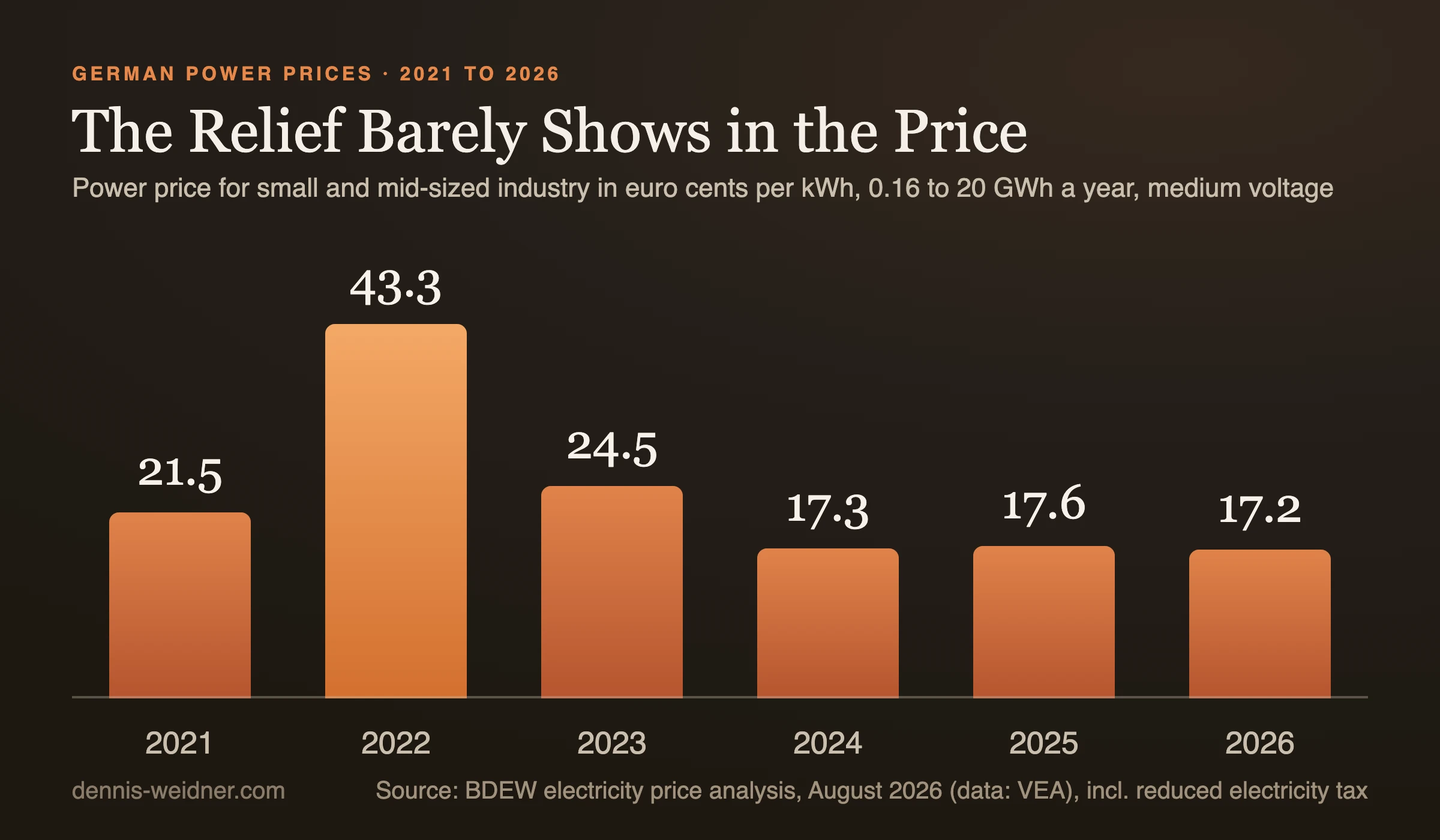
Because other items went up. According to the BDEW electricity price analysis of August 2026, published by the German energy industry association, small and mid-sized industrial firms connected at medium voltage pay 17.2 cents per kilowatt hour on average in 2026, after 17.6 cents the year before. Procurement, grid and sales fell from 15.5 to 14.7 cents. Taxes, charges and levies rose from 2.2 to 2.5 cents, partly because the offshore grid levy climbed from 0.82 to 0.94 cents. On top of that, BDEW sees wholesale prices rising most recently as a result of the Iran war.
The abolition of the gas storage levy on 1 January 2026 does not belong in this calculation. At 0.289 cents per kilowatt hour, it applied only to natural gas. Companies that heat or run process heat with gas save there as well, but their power price is unaffected.
Industrial Power Price 2026: Who Germany's CISAF Subsidy Is Meant For
A small group of power-intensive sectors, not the broad mid-market. The European Commission approved the German scheme on 16 April 2026 under the Clean Industrial Deal State Aid Framework, CISAF (decision SA.120495). From 2026 to 2028 it covers half of the wholesale price for half of a company's consumption, without pushing the price below 50 euros per megawatt hour. The budget is 3.8 billion euros. At least half of the aid must go into assets that lower electricity system costs. Only companies in the sectors listed in Annex 1 of the EU guidelines on climate, environmental protection and energy aid qualify, meaning particularly power-intensive and trade-exposed industries. A bakery, an online seller or an office are not among them. The scheme is run retroactively by the federal office BAFA, and applications for 2026 are filed in 2027.
Grid Fees 2027 and What a Business Can Do Now
For 2027 to 2029, the federal government plans a subsidy of 5.525 billion euros a year, according to its draft law of September 2026, almost one billion less than in 2026. Transmission operators publish their provisional fees by 1 October, distribution operators by 15 October. The relief in 2027 will therefore be somewhat smaller. In my view, four steps belong in this quarter:
- File the claim. The Section 9b refund uses form 1453 in the customs portal. The deadline is normally 31 December of the following year, so for 2025 it is 31 December 2026. Once the refund reaches 1,000 euros, claims within the year are possible too.
- Check the classification. Businesses close to the line between production and trade should confirm their sector C to F classification with their tax adviser before customs asks.
- Check the invoice. Did grid fees fall from 2025 to 2026? If not, ask the supplier or renegotiate at year end. For a direct contract with a solar park, see PPAs for Mid-Sized Companies.
- Cut the peaks. With demand metering, the highest quarter hour of the year sets the demand charge. Load management often achieves more there than any tax relief. For small connections with a heat pump or wallbox, Germany's dynamic grid fees under Module 3 are worth a look.
My conclusion: the 2026 relief is real, but it is distributed differently from the headlines. The grid fee subsidy reaches everyone and is the bigger lever for retailers and service firms in 2026. The electricity tax stays low for manufacturers and unchanged for everyone else. More on storage and energy costs is collected under BESS and Energy Storage.
Frequently Asked Questions
How high is Germany's electricity tax for businesses in 2026?
The standard rate is 2.05 cents per kilowatt hour. Manufacturing, agriculture and forestry businesses get 2 cents refunded on application and effectively pay 0.05 cents, minus an annual threshold of 250 euros.
Do online sellers get the German electricity tax cut?
No. E-commerce counts as retail, not as sections C to F of the classification of economic activities. Online sellers keep paying 2.05 cents per kilowatt hour, but like everyone they benefit from lower grid fees.
Which form do I need for the electricity tax refund in Germany?
Form 1453, filed electronically via the customs portal with the responsible main customs office. On request, a description of the business activity on form 1402 is added.
How much does a small business save on grid fees in 2026?
It depends on the grid operator. For households, the federal government cites around two cents per kilowatt hour on average. On the Munich grid, a small business without demand metering saves about 2.7 cents, or just over 1,660 euros a year at 60 megawatt hours.
Will the grid fee subsidy continue in 2027?
It is planned. The government's draft law provides 5.525 billion euros a year for 2027 to 2029, almost one billion less than in 2026. Provisional grid fees for 2027 are published in October 2026.
Note: This article is not tax or legal advice. It describes the situation in Germany as of 25 September 2026 and simplifies: the worked example uses the price sheets of a single grid operator, leaves out metering, concession fee, levies and VAT, and assumes the supplier passes grid fees on unchanged. Whether a business counts as manufacturing is decided case by case by the main customs office. Next review of this article: January 2027, once the final grid fees are published.
Best,
Dennis Weidner
Note: AI tools supported me in writing this article, and some images were edited with AI. I stand behind its content and every statement with my name.