Many young people in Germany do not want a career at any price, but a secure life with a family, enough money to travel and time for themselves. That does not mean they do not want to start businesses: according to the KfW Start-up Monitor 2026, 36 percent of 18 to 29 year olds would rather be self-employed than employed, more than in any older age group, and 40 percent of all start-ups in 2025 came from people under 30. In the early 2000s, however, more than half of young people preferred self-employment.
As of 25 September 2026.
More on this topic: AI in the Founder's Working Day, with background, practice and every article in one place.
A generation that wants to live differently
When I look at many younger people, I see a pattern. They do not necessarily want to build a company or climb the ladder in a large corporation. They want to live a secure life in peace, start a family, earn enough to travel, and have work that leaves them time. Many think first of themselves rather than of Germany, and some mainly of how to avoid having to serve in the armed forces. That is a description, not an accusation, and they have every right to plan that way.
I do not condemn that. These are different ideas of a good life, and they meet the expectations of a political system that needs more start-ups, more working hours and more readiness to defend the country. That tension is the real subject, and appeals will not resolve it. Why I follow politics closely as an entrepreneur is explained in the opening piece of this series, Entrepreneurs and Politics.
What the numbers say about young people's entrepreneurial spirit
Every year, the state development bank KfW asks whether people, regardless of their situation, would rather be employed or self-employed. According to the KfW Start-up Monitor 2026, 26 percent of all 18 to 67 year olds said so in 2025, after 25 percent the year before. By age, the values differ clearly.
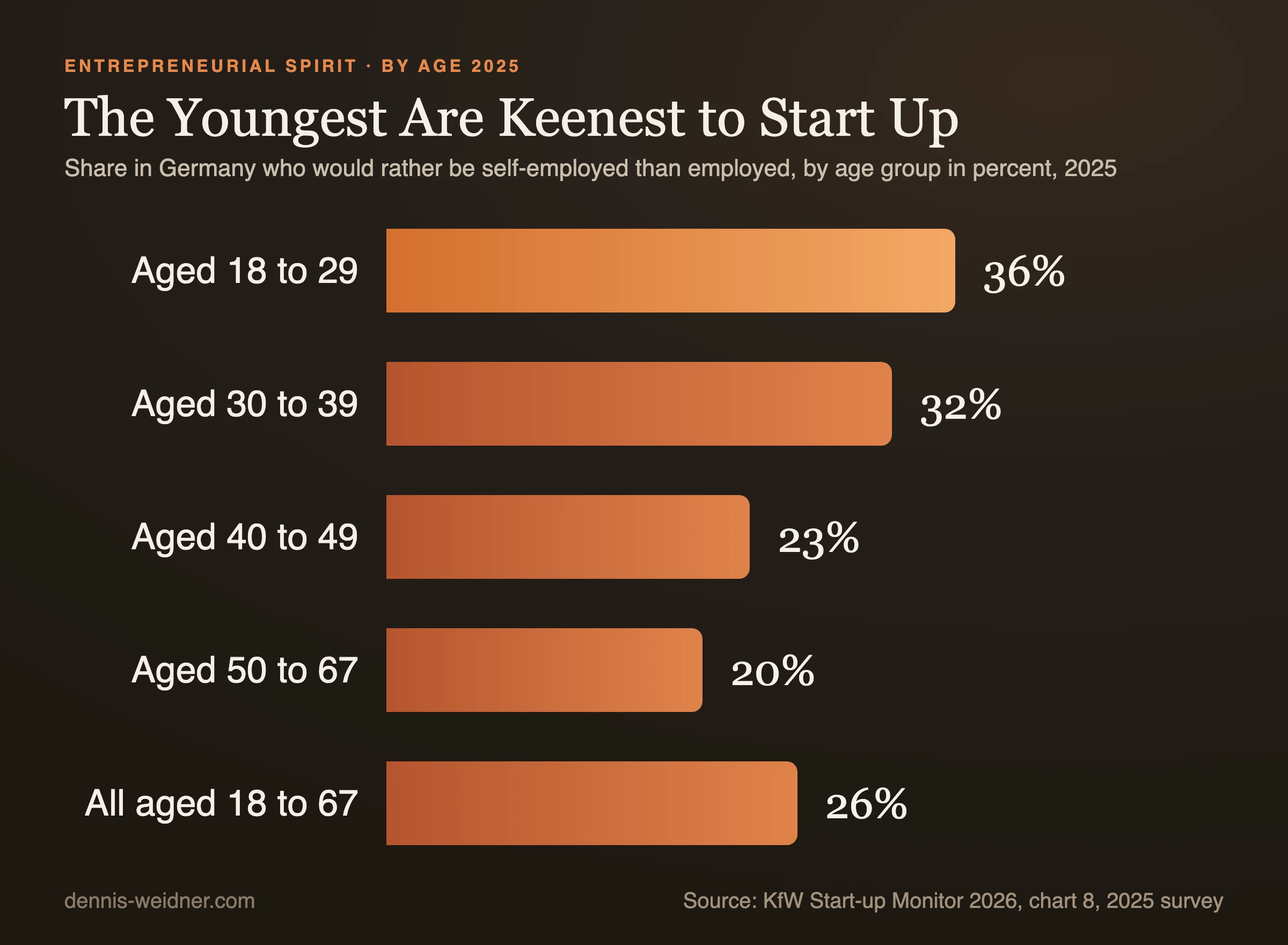
Two things stand out. First, young people are not tired of starting businesses; on the contrary, at 36 percent they lead. Second, the figure has still fallen sharply. In the early 2000s, according to KfW, more than half of under-30s preferred self-employment to a job. KfW explains this with the long boom in the labour market: a young person who gets good offers for a permanent position has less reason to take the risk of starting a business.
There is also a clear gap between the sexes. Thirty-one percent of men but only 22 percent of women would choose self-employment in 2025. KfW attributes this partly to gender stereotypes in school and upbringing. Anyone who wants more young founders gains most by narrowing this gap, because this is where the largest untapped potential lies.
Starting young today often means starting on the side
Young people do start businesses, but differently from earlier generations. The KfW Start-up Monitor shows what this looks like.
| Indicator, 2025 | Value |
|---|---|
| Share of under-30s among all business start-ups | 40% |
| Young founders who started straight out of university | 22% |
| Average age of all founders | 34.2 years |
| Average age, part-time start-ups | about 32 years |
| Average age, full-time start-ups | about 38 years |
| Share of part-time start-ups in all start-ups | 70% |
| 18 to 29 year olds who would rather be self-employed | 36% |
The picture is clear: young people often start on the side, test an idea, keep their security and decide later whether to make the leap. That fits exactly with the wish for a secure life. A part-time start-up is not half an entrepreneur; it is the sensible answer of a generation that weighs risks very consciously.
What drives young founders
Motives have shifted too. Among part-time founders in 2025, 40 percent named higher or additional income as their main motive, according to KfW, up from 32 percent a year earlier. Independence and self-fulfilment, the classic founder motives, were named less often: 26 and 21 percent among full-time founders, down from 33 and 23 percent. At the same time, 44 percent of start-ups offered digital products or services, and a quarter of founders would call their company a start-up, four times as many as actually meet the usual criteria. The self-image is more ambitious than the statistics, and the motives are more sober than the cliché of the founder who wants to change the world.
Security, work-life balance and the new military service
Since January 2026 a new question has been added. According to the German federal government, all 18-year-old men and women receive a questionnaire used to assess their suitability and motivation for military service. Men must answer it; for women it is voluntary. Men born in 2008 are called for a medical and aptitude examination, which is mandatory, including for those who intend to refuse service. The service itself is voluntary, lasts at least six months and pays at least 2,600 euros gross a month. If the situation requires it, the Bundestag can pass a law introducing conscription on demand.
For many young people this is the first time their life planning faces such a concrete question. I think it is right that the state asks it, and I think it is just as legitimate that young people answer it differently for themselves. Anyone who dismisses one answer as neglect of duty and the other as naivety is talking past a whole generation.
What this means for start-ups in Germany
If a generation seeks security, starting a business has to become safer, not more heroic. In my view this means three things. First, entry through a part-time start-up must be easy, with a legal form that limits liability without requiring a balance sheet and a tax adviser from the first euro. The calculation is in Sole Trader or GmbH in Germany. Second, there needs to be support for the moment someone quits their job and goes full-time. Which programmes exist for founders today is covered in the overview Funding Programs for Founders. Third, failure must remain a step and not a fall.
Honesty also requires a warning. Many start-ups do well for a year or two, and in the third or fourth year a tax audit or an assessment that does not stand up ties up exactly the money and time that growth needs. Anyone starting young should know early how to challenge an incorrect tax assessment. A nation of founders only emerges if the state supports young companies in this phase instead of slowing them down.
According to the Deutschland-Monitor 2025, willingness to bear burdens rises when they are seen as socially and generationally fair. That applies to military service as much as to taxes, pensions and start-up support.
Entrepreneurship as a way of life
For me, being an entrepreneur is a profession, not a calling, with a lot of passion and just as much endurance. That has a price, and I understand anyone who does not want to pay it. But I would tell young people that entrepreneurship and a calm life do not have to be opposites. Many businesses start small, on the side and without great risk, and some of them turn into something that gives you independence for years. How much feeds and algorithms shape young people's picture of business and politics is the subject of Social Media Algorithms and Radicalisation.
Frequently Asked Questions
Do young people in Germany still want to start businesses?
Yes, more than older people. According to the KfW Start-up Monitor 2026, 36 percent of 18 to 29 year olds would rather be self-employed, compared with 20 percent of 50 to 67 year olds. In the early 2000s, though, it was more than half of young people.
How old are founders in Germany on average?
In 2025 the average age was 34.2 years, about 32 for part-time and about 38 for full-time founders. Forty percent of founders were under 30.
Do I have to fill in the German armed forces questionnaire?
Since January 2026 men must answer it; for women it is voluntary. Men born in 2008 are also called for a mandatory examination.
Is Germany's new military service compulsory?
The service itself is voluntary. For men, the questionnaire and the examination are mandatory. The Bundestag can only introduce conscription on demand by law if the situation requires it.
Can I start a business on the side and stay employed?
Yes, it is even the most common route. Seventy percent of start-ups in 2025 were part-time, and six in ten part-time founders keep their job. Check your employment contract beforehand for rules on side activities.
Best,
Dennis Weidner
Note: AI tools supported me in writing this article, and some images were edited with AI. I stand behind its content and every statement with my name.