Singles Day began in 2009 with 27 merchants and became the largest shopping event in the world. In 2022 it stopped naming its number. That is the more interesting story, and it contains a trap present in almost every year-on-year comparison.
Somebody Invented Every One of These Events
Black Friday is not a public holiday. Neither is Cyber Monday, nor Prime Day, and Singles Day on the eleventh of November is a marketing team's invention built on a student joke: four ones as a symbol of being single, a counterpart to Valentine's Day.
Out of that joke came the 11.11 Global Shopping Festival in 2009, launched with 27 participating merchants. Today it is the largest shopping event in the world. That is the story always told, and it is correct.
What came afterwards is more interesting, and it is rarely written about. A ritual that works for long enough eventually loses its metric. With Singles Day the year can be named exactly.
Singles Day Sales: What Lies Behind the Record Figures
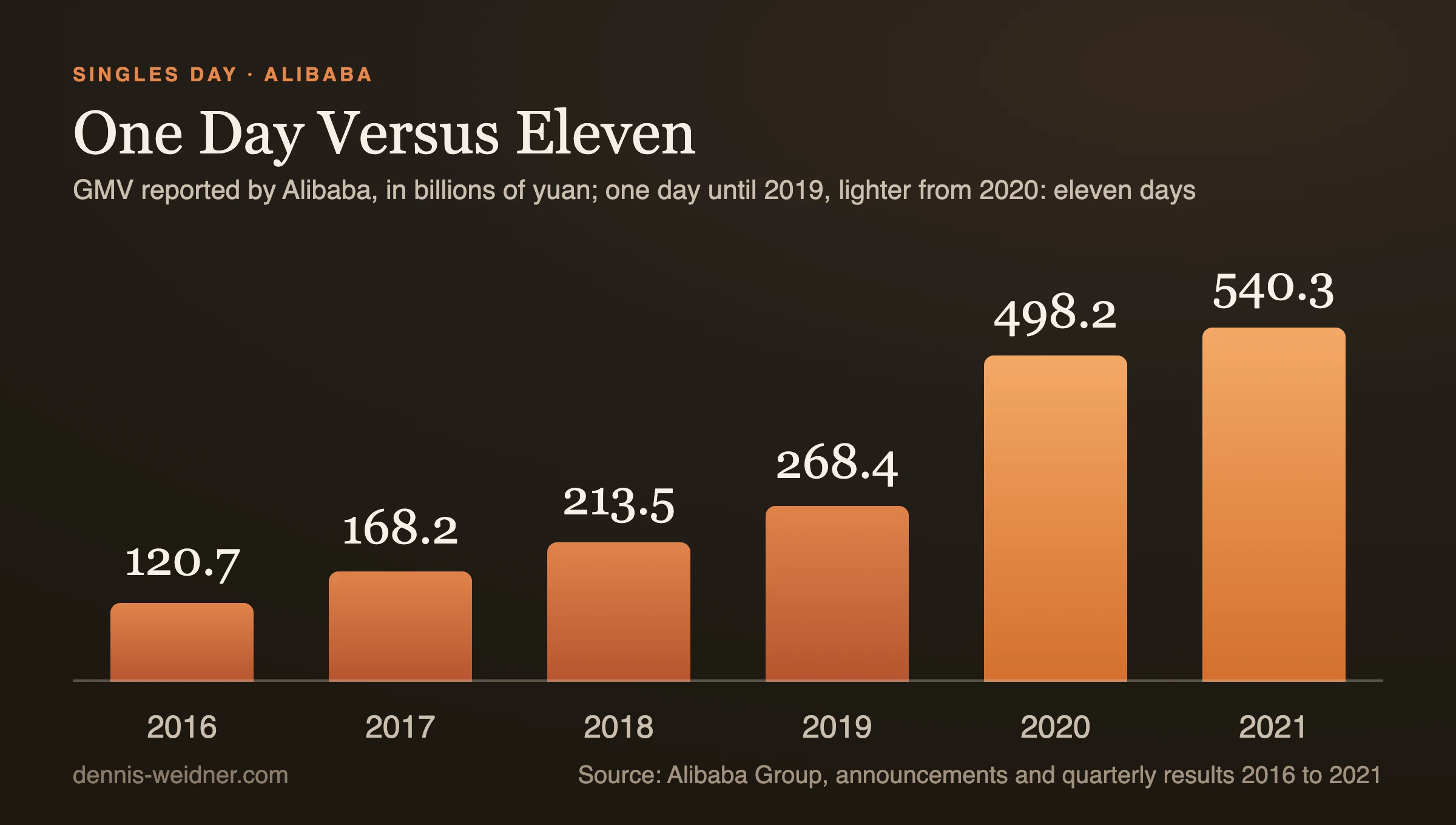
First the values as they are quoted everywhere. Alibaba reported gross merchandise value for Singles Day of 38.4 billion US dollars in 2019, 74.1 billion in 2020 and 84.5 billion in 2021.
Placed side by side that looks like a doubling followed by a slowdown. They are not the same periods, though. Up to and including 2019, Singles Day was a 24-hour promotion with some pre-sales. Since 2020 it has been an eleven-day event, and by now longer still: in 2025 Tmall started on 15 October.
The jump from 38.4 to 74.1 billion therefore coincides exactly with the year the measurement window multiplied. How much of it is real growth is in Alibaba's own announcement: against the same eleven days of the previous year, gross merchandise value rose 26 percent. An apparent doubling becomes a gain of a quarter, and more than half of the jump simply comes from additional selling days.
Alibaba communicated the extension openly; the error only arises in the quoting. Stacking two figures from the same house assumes both measure the same thing. Here they do not, and a chart with those three points compares one day with eleven.
The Year the Number Disappeared
In 2022 something happened that went largely unnoticed in German coverage. Alibaba and JD.com published no gross merchandise value at all for Singles Day, for the first time ever.
Alibaba stated instead that the result was "in line with last year's GMV performance". JD said its own growth rate had exceeded the industry average. Both are statements that cannot be disproved, because neither contains a number.
The silence is the news. An event whose sole purpose had long been to produce a larger number every year stopped naming that number. To learn how a ritual is doing, watch not what gets reported but what stops being reported.
Where the Growth Went That Year
Third parties filled the gap, and their breakdown explains the silence better than any speculation. For 2022 the whole Chinese market was put at 1.1 trillion yuan, roughly 157 billion US dollars, up 13.7 percent. Split out it looked like this:
- the classic marketplaces, led by Tmall: 934 billion yuan, up 2.9 percent
- the livestream platforms, led by Douyin ahead of Alibaba's Diantao and Kuaishou: 181.4 billion yuan, up 146.1 percent
The market grew, then, but not in the classic shopping basket; it grew in livestreaming, and by more than double. Even Alibaba earned there. The event stayed; the growth changed format.
Anyone looking only at the missing Alibaba figure in 2022 saw a setback. Anyone reading the breakdown saw a shift of channel. Those are two very different stories, and only the second helps with a decision. What follows for the format I have written up in live commerce in the holiday season.
The German Case, and How It Differs From China
In Germany the picture is soberer and the figures are more accessible. Revenue from the promotional days around Black Friday and Cyber Monday fell for the first time since 2016 according to the HDE's forecast for 2025, to 5.8 billion euros. The context, including what that figure is and is not, is covered in Black Friday and Cyber Monday. And the Chinese platforms are long since part of the German calendar: according to the HDE Online Monitor of 3 June 2026, foreign online retailers take almost eleven billion euros in Germany, around 4.7 billion of it Temu and Shein.
The contrast with China is instructive. There the event was stretched until the word "day" no longer applied. Here it is the number of events that keeps rising: Singles Day, Black Friday, Cyber Monday, Prime Day, plus each retailer's own promotional weeks. In both cases the same purchasing volume is spread across more occasions.
For the merchant an uncomfortable consequence follows: an additional promotional day rarely brings additional demand. It moves purchases that would have happened anyway, only at a worse price. An event pays off only when it brings customers who would not otherwise have come, and that is a question you can measure rather than assume.
What Retailers Can Learn From Singles Day and Black Friday
Three things, and the third reaches far beyond retail.
First: a longer event is not a growing event. Change the period and the number changes without the market changing. Before any year-on-year comparison belongs the question of whether both values cover the same duration.
Second: a promotional day must bring new customers, not new revenue. Revenue on a promotional day proves nothing on its own, because part of it would have occurred later and at a better price without the promotion. The honest metric is the share of first-time buyers.
Third: when a metric disappears, that is information. A company that celebrated a number for years and then stops naming it has communicated something. The observation costs nothing and works for quarterly reports, user counts and growth announcements just as it does for a shopping festival.
How the fourth quarter is built is covered in why the fourth quarter decides the retail year, and what comes back afterwards in returns after the peak.
Frequently Asked Questions
Where does Singles Day come from?
From a student joke about the four ones of the eleventh of November as a counterpart to Valentine's Day. Out of it came the 11.11 Global Shopping Festival in 2009, launched with 27 participating merchants, and from there the largest shopping event in the world.
Why can the Singles Day figures not be compared?
Because the measurement window changed. Up to and including 2019 Singles Day was a 24-hour promotion; since 2020 it has been an eleven-day event, by now one of several weeks. The jump from 38.4 to 74.1 billion dollars coincides exactly with that extension. Against the same eleven days of the previous year Alibaba itself reported growth of 26 percent, so more than half of the jump comes from additional selling days.
What happened at Singles Day 2022?
Alibaba and JD.com published no gross merchandise value at all, for the first time ever. Alibaba stated instead that the result was "in line with last year's GMV performance", and JD said its growth rate had exceeded the industry average. Both are statements without a number and therefore without any way to check them.
Did Singles Day shrink in 2022?
The market as a whole did not. Third parties put 2022 at around 1.1 trillion yuan, up 13.7 percent. The breakdown shows a shift, however: The classic platforms together managed plus 2.9 percent, while the livestream platforms grew 146.1 percent. The growth moved to the livestream platforms.
Is an additional promotional day worth it for retailers?
Only if it brings customers who would not otherwise have come. Revenue on a promotional day is no proof in itself, because part of it would have occurred later and at a better price without the promotion. The honest metric is therefore the share of first-time buyers, not the day's takings.
What does it mean when a metric is no longer reported?
Usually more than the number itself. A company that celebrated a value for years and then stops publishing it has communicated something. The observation costs nothing and works for quarterly reports, user counts and growth announcements just as it does for a shopping festival.
Warm regards,
Dennis Weidner
Note: AI tools supported me in writing this article, and some images were edited with AI. I stand behind its content and every statement with my name.