On a promotional day an online shop simply pushes more people through the same page. A show has a duration, and more viewers do not extend it. Everything else follows from that banal difference, including a figure that looks at first as though it does not fit.
The One Difference That Explains Everything Else
Every retail channel responds to the Christmas season the same way: more people arrive, so more gets sold. On a promotional day an online shop pushes ten times as many visitors through the same page, and apart from the server bill nothing changes.
Live commerce works differently, and the difference is both banal and consequential: a show has a duration. Start at eight in the evening and stop at ten, and you have sold for two hours. Bring ten times the viewers and it is still two hours, and the number of items that can cross the table in that time barely moves.
Live commerce scales through time, not through traffic. That is the sentence the rest of this piece follows from, including the figures that look at first as though they do not fit together.
What Happens on the Biggest Selling Day of the Year
Whatnot, currently the largest live shopping platform, reported more than 75 million US dollars in sales on Black Friday 2025, roughly three times the previous year, with first-time buyers up fourfold. For the full year 2025 the company states gross merchandise value of 8 billion US dollars.
Now the calculation nobody seems to run: 75 million out of 8 billion is 0.9 percent. The biggest selling day of the year therefore carries less than one hundredth of this platform's annual business.
For contrast, from an entirely different direction: the German Retail Association puts November and December at 18.5 percent of annual revenue for German retail as a whole, and just under 25 percent for toys. Broken down to the promotion days, the difference is smaller than one might think: for Black Friday and Cyber Monday 2025 the HDE estimated 5.8 billion euros in sales; against 683.7 billion euros for the whole year that is 0.85 percent, for both days combined. For 2026 the HDE, in its annual forecast of 2 February 2026, expects 697.4 billion euros in sales, 2.0 percent more than in 2025 in nominal terms and half a percent after inflation.
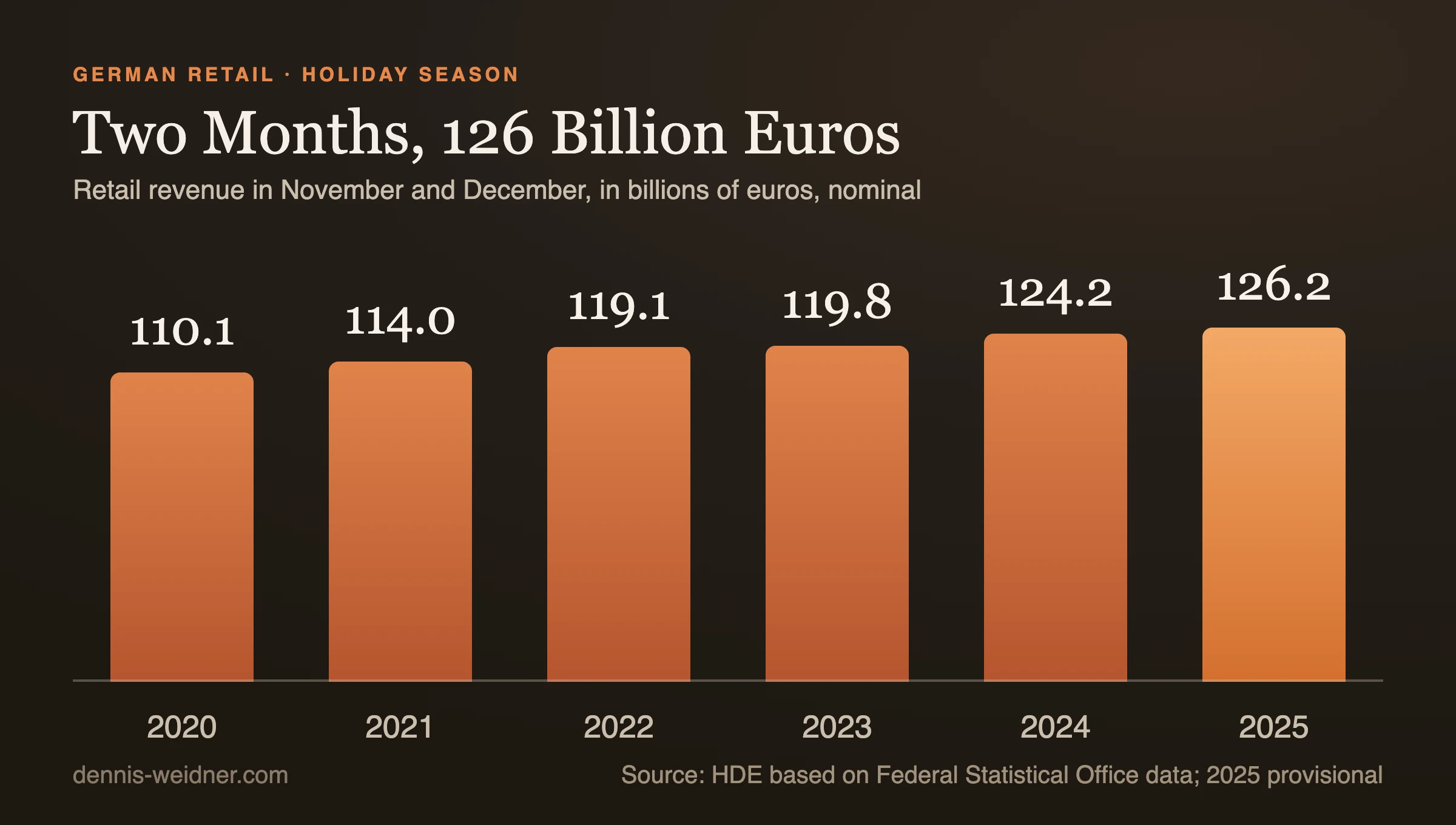
So even in the rest of retail the biggest day is no large slice of the year. The difference lies elsewhere: an online shop could sell any amount more on that day if more customers arrived. A show cannot. You cannot broadcast more hours in a day than the day contains.
How a Live Format Grows Regardless
If airtime is the ceiling, there are exactly three levers, and all three can be read off how the platforms behave.
First: more shows at the same time. TikTok Shop reported 760,000 livestream sessions and 1.6 billion views for its 2025 US campaign from 12 November to 1 December; over the Black Friday to Cyber Monday weekend alone the platform sold more than 500 million US dollars. That is a great many parallel shows, and the channel scales through the number of broadcasters.
Second: more sellers going live at all. The same report puts revenue growth for sellers who went live during the promotional period at 84 percent. For the platform, then, its own reach counts for less than the number of merchants willing to face a camera.
Third: more completed sales per hour. This is the unglamorous lever and the only one that belongs to the individual merchant. It is settled in preparation: how many items are within reach, how fast the changeover, how short the description.
760,000 sessions in just under three weeks is about 38,000 a day. That is typical of a format made of very many small events rather than a few large ones.
Live Shopping Revenue: What the Platform Figures Show
Every figure in this text is a company statement. Whatnot and TikTok publish them themselves, and whoever reports a record also picks the period and the metric. "Gross merchandise value" is not revenue, and a year-on-year comparison only holds when both years rest on the same base. Platform figures therefore always come with the question of who counted and who would have an interest in a different number.
Such statements do not establish market share. Their strength lies in orders of magnitude and in the ratios between the values, and those ratios are the news here: the biggest day of the year carries less than one hundredth of Whatnot's annual business, and TikTok Shop's promotional campaign in the US was spread across 760,000 livestream sessions. Both come from the platforms' own figures, and both describe a format that grows through many small events rather than one big day.
What This Means for Planning a Season
The time ceiling produces a plan that looks different from online retail, and an uncomfortable one.
The broadcast schedule is the capacity plan. Anyone wanting to sell more in December has to decide in November how many hours can be broadcast and by whom. That decision cannot be made up in the week before Christmas, because it depends on people rather than servers.
The bottleneck is preparation, not demand. If an hour of broadcast allows a fixed number of items, set-up time decides revenue. A lot sorted and described before the show sells in seconds. One searched for during the show costs minutes, and minutes are the scarce good here.
And the season does not end on 24 December. Experience shows the week between Christmas and New Year is strong again in retail, and it suits a live format particularly well: people have time, and time is what this format asks of a viewer.
How Slabhit Plans Its Live Shopping Season
With Slabhit we are building live shopping for trading cards, and for us the time ceiling is the starting point of every plan.
First: we plan hours, not revenue. A revenue figure is a result; a broadcast hour is a decision. Only the second can be taken in advance.
Second: set-up time is the real competition. Show a lot in fifteen seconds instead of a minute and you sell four times as much in the same hour. That is decided by the logistics at the table.
Third: a small peak day is good news. A format whose biggest day sits below one percent of the year lives on every single broadcast week. That is harder work and steadier.
Which platforms exist in Germany and how they differ is covered in live shopping platforms for trading cards, and the assessment of Whatnot in the Whatnot valuation. Why the fourth quarter weighs so heavily is covered in why the fourth quarter decides the retail year.
Frequently Asked Questions
How much does live shopping sell on Black Friday?
Whatnot reported more than 75 million US dollars in a single day for Black Friday 2025, roughly three times the previous year. TikTok Shop stated over 500 million US dollars in the US across the promotional weekend. Both are statements by the companies themselves, not independently audited surveys.
Why doesn't live commerce simply grow with the Black Friday rush?
Because the format scales through time rather than traffic. An online shop can push any number of people through the same page on a promotional day. A show lasts what it lasts, and more viewers do not extend it. Calculated from Whatnot's own figures, the biggest selling day carries 0.9 percent of annual gross merchandise value, less than one hundredth.
How does a live shopping platform grow, then?
Through three levers: more shows at the same time, more sellers going live at all, and more completed sales per hour. TikTok Shop reported 760,000 livestream sessions across the promotional campaign, meaning many parallel ones rather than a few long ones, and 84 percent revenue growth among sellers who went live.
What is the bottleneck for a merchant selling live?
Set-up time, not demand. If a broadcast hour allows a fixed number of items, preparation decides revenue: a lot sorted and described before the show crosses the table in seconds, one searched for during the show costs minutes.
How do you plan a live season?
In broadcast hours, not in revenue. A revenue figure is a result, a broadcast hour a decision, and only the latter can be taken in advance. Anyone wanting to sell more in December settles in November how many hours get broadcast and by whom, because that depends on people rather than servers.
How reliable are the live shopping platforms' figures?
Limited. They are company statements throughout, with no independent counter-calculation. Whoever reports a record picks the period and the metric, and "gross merchandise value" is not the same as revenue. They serve for orders of magnitude and ratios, not as evidence of market share.
Warm regards,
Dennis Weidner
Note: AI tools supported me in writing this article, and some images were edited with AI. I stand behind its content and every statement with my name.