Nine euros extra for one hour of earlier entry: that single number tells you how the German trading card market works offline. An overview of the 2026 show landscape, the real prices, and what a show day teaches you about price formation.
The 2026 Landscape
In Germany, trading card shows have gone from gym-hall swap meets to arena events within a few years. Look at the 2026 dates and you find a surprisingly dense field, spread across the whole country.
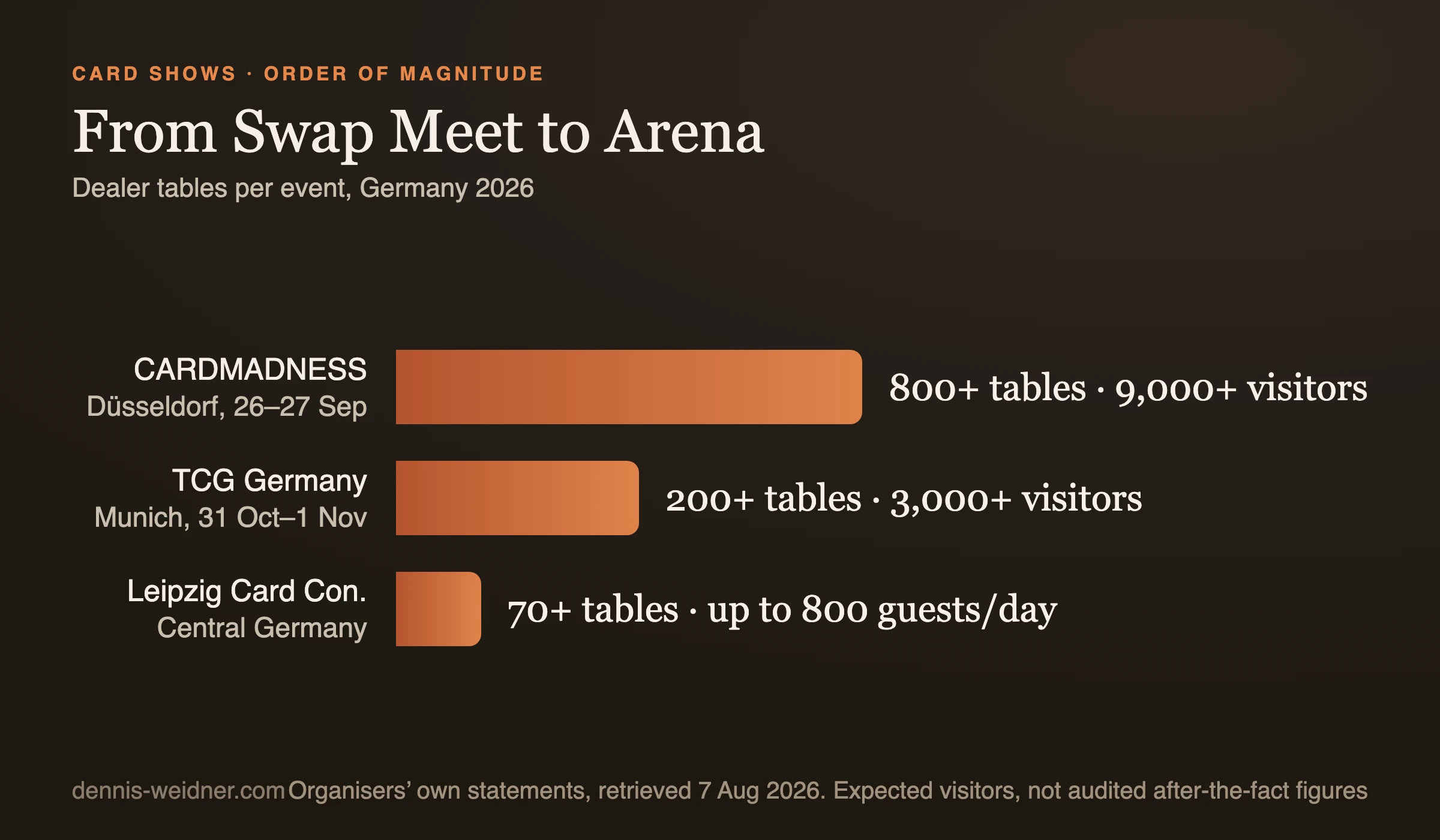
The largest event is CARDMADNESS, held twice a year, in Frankfurt and in Düsseldorf. The Düsseldorf date on 26 and 27 September 2026 runs at the Mitsubishi Electric HALLE and advertises more than 800 tables and over 9,000 expected visitors. That is a scale at which nobody calls it a swap meet any more.
Considerably smaller but different in character is the Halloween Special by TCG Germany in Munich on 31 October and 1 November 2026 at the MTC World of Fashion. Over 3,000 visitors are expected at more than 200 tables, open from 10am to 6pm, with a range from Pokémon through Yu-Gi-Oh!, Magic, One Piece and Lorcana to sports cards from Topps and Panini.
For central Germany, the Leipzig Card Convention has launched, with up to 800 guests per day and over 70 dealer tables. On top of that come regional formats such as the Tradingcard Convention Hamburg in April and the Förde Convention in Kiel in August.
What Admission Costs
Ticket prices sit closer together than you would expect, and almost everywhere they follow the same pattern. The Leipzig Card Convention publishes its full scale, and it is representative of the field:
A weekend pass costs 29 euros, a day ticket 16 euros, and getting in an hour early costs 25 euros for early access. Children aged seven to thirteen pay 14 euros for the weekend, 7.50 euros for a day and 16.50 euros for early entry. Children up to six get in free. All prices include advance sale and processing fees.
The premium for early entry is the most interesting number on the whole price list. Nine euros more for a one-hour head start says everything about how this market works: the good deals are made in the first hour. Arrive at eleven and you buy what nobody wanted at ten.
What a Table Costs
The booth fees of the large German card shows are not publicly available. The dealer sections of the organisers' websites all route through an enquiry form rather than a price list. Any dealer wanting to run the numbers has to ask.
What is public is the area: the Leipzig Card Convention states a table size of 1.80 by 0.80 metres. That is a useful figure, because it enables the actual calculation. A modest amount of stock fits on one and a half square metres, and whether a table pays for itself is decided by how much revenue you make on that area in two days.
Anyone who needs the number should clarify three things with the organiser: the price per table for both days, whether power and a second chair are included, and whether there is a cap on how many tables one dealer may book. The third point decides whether you stand next to a single seller or next to a retail chain.
What You Actually Learn There
I do not go to these events to buy. I go because one show day teaches you more about price formation in this market than a month in front of a screen. Four observations that hold up every time:
The marketplace price is the anchor, but not the price. Practically every dealer has the current online price on their phone and calculates in percentages of it. The real table price sits below it when the dealer needs space, and above it when the card is in a slab and the buyer can walk away with it. How that anchor price comes about is in Cardmarket, Broken Down.
Cash negotiates differently. Paying cash gets you a different price from paying by transfer. That is not a grey area, it is the absence of fees and default risk, and both sides know it.
The slab is an accelerator. With a graded card, the entire part of the conversation that would otherwise be spent arguing about condition simply disappears. You agree on a price, not on a description. Why that is, is in What a Slab Is.
Afternoons belong to collectors, mornings to dealers. Anyone paying the early access premium is usually buying to resell. After midday the composition of visitors changes visibly, and with it the willingness to pay.
How to Use a Show Day Properly
For buyers: make a list beforehand and set a limit per card. At a show you decide in thirty seconds, and without a limit set in advance, the mood decides. If you are after more expensive cards, pay the early access premium, because that is what it is for.
For sellers: label your prices. Tables without price tags demonstrably sell less, because every enquiry forces a conversation and most visitors will not start it. And sort your stock so that somebody walking past can tell what they are looking at.
For both: check certification numbers before money changes hands. It takes twenty seconds on a phone and is the only effective protection against counterfeit holders.
Why These Shows Are Growing Right Now
It is tempting to explain this with the Pokémon boom, but I think that falls short. The real reason is that online trading in this market is excellent at delivering a known card at the best price and poor at enabling discovery. At a show you see things you would never have searched for.
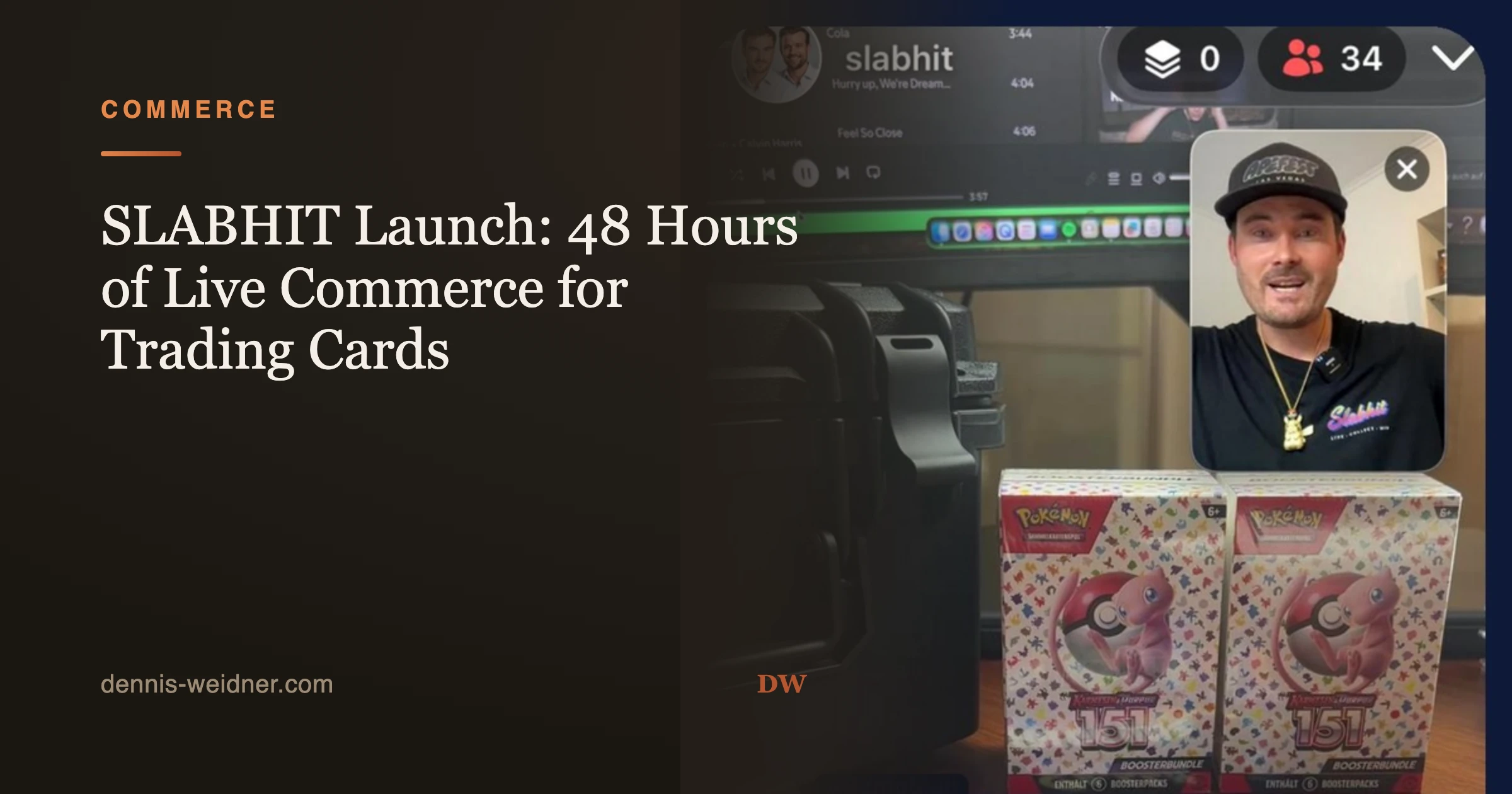
That gap is exactly why live formats in retail interest me, and why we are working on Slabhit. A live show is an attempt to bring the best of both worlds together: the discovery and the pull of a show table, without having to drive to Düsseldorf for it. Whether that works is not decided by the technology but by whether you can answer the same question of trust that a handshake answers at a show.
Frequently Asked Questions
Which trading card shows take place in Germany in 2026?
The largest is CARDMADNESS, with dates in Frankfurt and in Düsseldorf, where more than 800 tables and over 9,000 visitors are expected on 26 and 27 September 2026. Add to that the TCG Germany Halloween Special in Munich on 31 October and 1 November, the Leipzig Card Convention, the Tradingcard Convention Hamburg in April and the Förde Convention in Kiel in August.
What does admission to a card show cost?
At the Leipzig Card Convention, whose price list is fully published, a weekend pass costs 29 euros, a day ticket 16 euros and early access with a one-hour head start 25 euros. Children aged seven to thirteen pay 7.50 euros for a day, children up to six get in free. All prices include advance sale fees.
What does a dealer table at a card show cost?
That is not publicly available. The dealer sections of the large German organisers route through an enquiry form rather than a price list. What is public is the area: the Leipzig Card Convention states a table size of 1.80 by 0.80 metres. Anyone wanting to run the numbers has to ask, and should clarify the price for both days, power supply and the maximum number of tables per dealer.
Is the early access premium worth it?
For buyers of more expensive cards, yes, because that is what it is for. Nine euros extra for a one-hour head start shows how this market works: the good deals are made in the first hour. If you only want to browse, save the money.
Are prices at a show cheaper than online?
Not as a rule. Practically every dealer has the current online price on their phone and calculates in percentages of it. The table price sits below it when the dealer needs space and above it when the card is graded and can be taken away immediately. Paying cash usually yields a different price from a bank transfer.
What should I watch out for when buying at a show?
Make a list beforehand and set a limit per card, because on site you decide in thirty seconds. And with graded cards, always look up the certification number in the provider's database before money changes hands. It takes twenty seconds and is the only effective protection against counterfeit holders.
What is the point of a show when Cardmarket exists?
Online trading is excellent at delivering a known card at the best price and poor at enabling discovery. At a show you see things you would never have searched for, and in one day you learn more about real price formation than in a month in front of a screen.
Warm regards,
Dennis Weidner
Note: AI tools supported me in writing this article, and some images were edited with AI. I stand behind its content and every statement with my name.