Two months out of twelve carry 18.5 percent of annual revenue, in toys almost a quarter. The German Retail Association's figures also hide three billion euros between forecast and actual, and growth that is not growth at all.
Two Months That Count Differently From the Other Ten
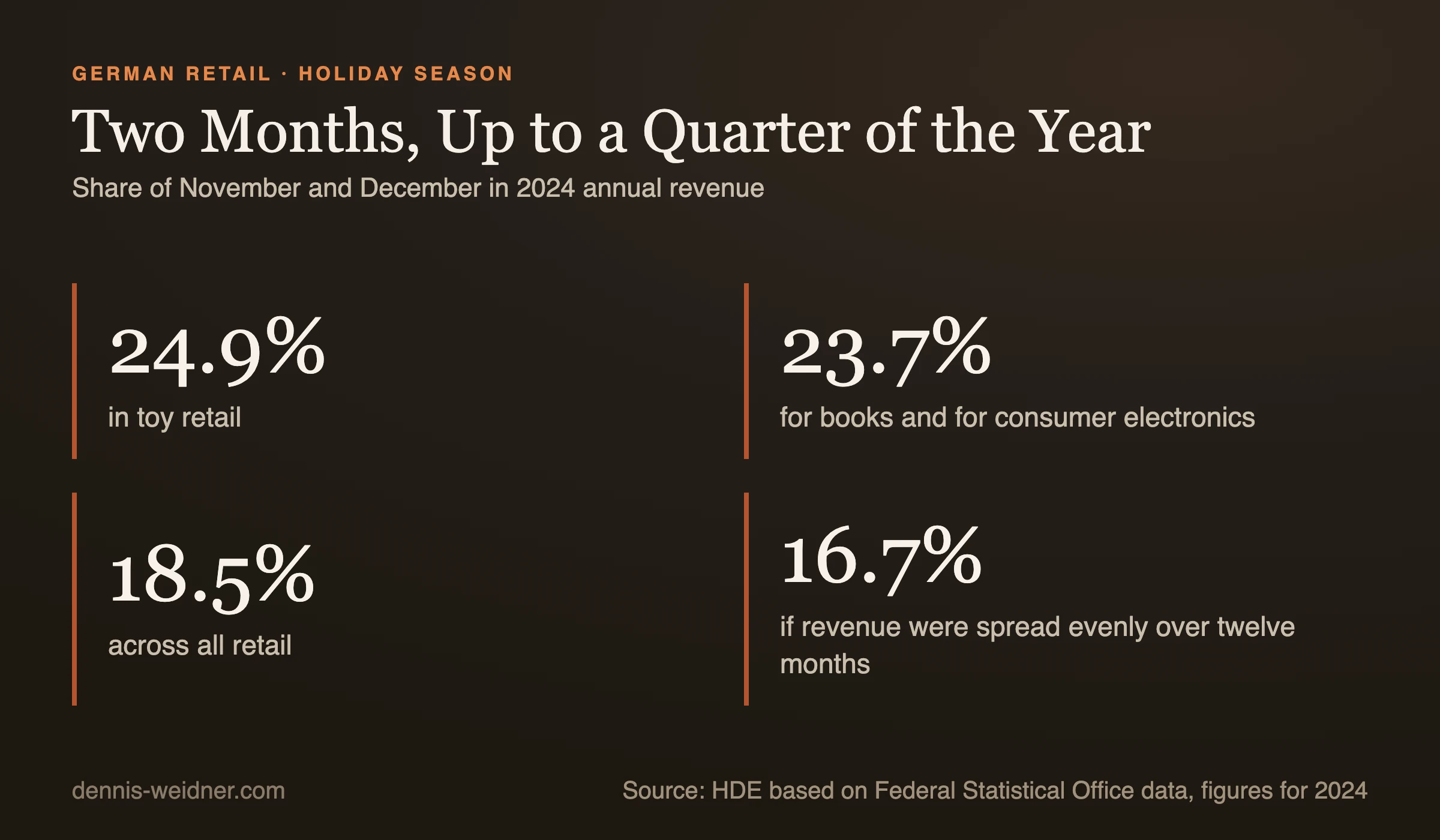
German retail earns 18.5 percent of its annual revenue in November and December. The figure comes from the German Retail Association (HDE) and covers the entire sector across all its segments. It sounds unremarkable, yet two months out of twelve are only 16.7 percent. The Christmas season therefore runs about eleven percent above what an evenly distributed year would produce.
Eleven percent of overweight is a lot, and the reason lies in the cost structure of retail. Rent, staff and logistics run for twelve months. The margin that becomes the year's profit is earned in a narrow window. Miss those two months and February will not give them back.
In Some Segments It Is Not Overweight, It Is Dependency
The average hides how unevenly this is distributed. The HDE reports the share by segment, most recently in its holiday season presentation of November 5, 2025 (in German) with figures for 2024, and there the overweight turns into a dependency:
- Toys: 24.9 percent of annual revenue in two months
- Books: 23.7 percent
- Consumer electronics: 23.7 percent
A toy retailer earns a quarter of the year in eight weeks. Measured against the 16.7 percent of an even distribution, that is an overweight of roughly 50 percent. For those retailers the fourth quarter is not a good season, it is the season. A rainy Saturday in Advent is an operating result.
It also explains why these segments discount first. Anyone earning a quarter of the year in eight weeks cannot afford to wait and see whether demand arrives on its own.
Three Billion Between Forecast and Actual at the HDE
On 6 November 2024 the HDE forecast 121.4 billion euros for November and December 2024, up 1.3 percent. A year later, on 5 November 2025, the same association forecast 126.2 billion euros for the same two months and called it a rise of 1.5 percent year on year.
Take 121.4 billion, add 1.5 percent, and you land at 123.2 billion, not at 126.2. The gap is three billion euros, larger than the entire forecast growth.
The answer sits in the time series the HDE showed at its annual press conference on 2 February 2026, calculated on the basis of Federal Statistical Office data. It puts November and December 2024 at 124.2 billion euros, up 3.8 percent instead of the forecast 1.3 percent. The actual figure therefore came in 2.8 billion euros above the forecast, and the 1.5 percent for 2025 refers to that actual figure, not to the previous year's forecast. That is why you cannot stack two forecasts from the same house into a time series. Do it anyway and you produce a gap or growth that nobody claimed. For comparisons across several years, only the series of actual figures will do.
Nominally It Grows, In Real Terms It Stands Still
The second number you have to read alongside is the inflation adjustment. On its 2025 forecast the HDE states explicitly that the nominal increase of 1.5 percent corresponds to zero growth in real terms. In units, parcels and shopping bags, nothing happens. What grows is prices.
This is where the usual reporting on the Christmas season falls apart. A headline like „retailers expect revenue growth" is correct and says the opposite of what happens in the shop. For a retailer's economics the real zero is the relevant figure, because their costs have risen nominally too.
What the Interim Assessment Showed Once It Got Serious
Forecasts are the market's statements of intent. What was measured afterwards is more interesting. On 21 December 2025, in the week before the fourth Advent, the HDE published an interim assessment, and it was blunt:
- 62 percent of retailers were dissatisfied with their revenue, 23 percent satisfied
- on the season so far overall: 66 percent dissatisfied, 17 percent satisfied
- 71 percent reported weaker footfall
HDE chief executive Stefan Genth said the Christmas season was stuck at the low level of previous weeks for most companies and that poor consumer sentiment was clearly noticeable in the year-end business. His conclusion: the Christmas season has to go into extra time. He meant the days between Christmas and New Year, which experience shows are strong for revenue once more.
Most plans underestimate that extra time. They treat 24 December as the final whistle. In fact a whole week follows in which vouchers are redeemed, gifts exchanged and people buy for themselves.
Online Shifts Differently From the Rest
The third figure almost always missing from the debate is the online share within the Christmas season compared with the online share across the rest of the year. Both can be calculated from HDE figures, and the difference is clear.
For Christmas 2025 the HDE reported online revenue of 22.2 billion euros against a total of 126.2 billion. That is 17.6 percent. For the full year 2026 the same association forecasts retail revenue of 697.4 billion euros and e-commerce revenue of 96.3 billion euros, which is 13.8 percent.
The Christmas season is therefore roughly a quarter more online-heavy than the annual average. Anyone planning for the fourth quarter is therefore not planning the same business at larger scale, but a different business.
The direction of growth fits: online rose 3.3 percent in the 2025 Christmas season while total retail stood at 1.5 percent nominal and zero real. The channel grows while the floor space stagnates.
What I Take From This for Our Own Planning
I am not writing this as an observer. With Slabhit we are building live shopping for trading cards, and for us the fourth quarter is not a chapter in an annual report but the period that decides whether a year held. Three things follow from the figures above.
First: the season starts earlier than the calendar. If two months carry 18.5 percent and footfall is already weak in November, October is not a run-up but the last month in which anything can still be changed. Whatever is not in place on 1 November will not be in place at all.
Second: nominal is not a target. Setting yourself a revenue increase below the rate of inflation means planning a real decline and calling it growth. The honest target in Q4 is units or order count, not revenue.
Third: plan for extra time. The week between the years is the part of the season in which customers buy for themselves, and it is lost precisely when warehouse and support go to minimum staffing from 23 December.
On retail in general and where it is shifting right now, I write continuously on my topic page on e-commerce and live commerce.
Frequently Asked Questions
How much revenue does German retail make in the Christmas season?
The German Retail Association forecast 126.2 billion euros for November and December 2025, a nominal increase of 1.5 percent year on year. Adjusted for inflation that is zero growth. For 2024 the association had forecast 121.4 billion euros; according to its annual press conference of 2 February 2026 the actual figure was 124.2 billion euros.
What share of annual revenue falls into November and December?
18.5 percent, calculated across the entire retail sector and all its segments. Two months out of twelve would be 16.7 percent under an even distribution, so the Christmas season runs about eleven percent above that. In individual segments the share is considerably higher.
Which segments depend most on the Christmas season?
Toys at 24.9 percent of annual revenue in two months, books and consumer electronics at 23.7 percent each. For these segments the fourth quarter is not a good season, it is the season.
Does online retail grow faster during the Christmas season?
Yes. Online Christmas revenue in 2025 was 22.2 billion euros according to the HDE and grew by 3.3 percent, while total retail rose 1.5 percent nominally and stagnated in real terms. That puts the online share at Christmas at 17.6 percent against 13.8 percent across the full year.
Why is nominal revenue growth in retail not good news?
Because it contains price movement. For Christmas 2025 the HDE states explicitly that the nominal increase of 1.5 percent corresponds to zero growth in real terms. Nothing happens in units and parcels, while the retailer's costs have risen nominally as well.
When does the Christmas season actually end?
Not on 24 December. In its interim assessment of 21 December 2025 the HDE pointed explicitly to the days between Christmas and New Year, which experience shows are strong for revenue once more: vouchers redeemed, gifts exchanged, and people buying for themselves. Anyone reducing warehouse and support from 23 December loses exactly that part.
Warm regards,
Dennis Weidner
Note: AI tools supported me in writing this article, and some images were edited with AI. I stand behind its content and every statement with my name.