The statistic everyone quotes only surveys companies from ten employees upwards. A team of three never appears in it. What it shows nonetheless, and why the real question is not whether the first agent pays off but whether you notice when the twentieth fails.
The Figure That Does Not Contain Small Teams at All
Whenever AI adoption in German companies comes up, the same figure appears. The Federal Statistical Office found that 26 percent of companies used AI in 2025, broken down by size: 23 percent among those with 10 to 49 employees, 36 percent at 50 to 249, and 57 percent from 250 upwards.
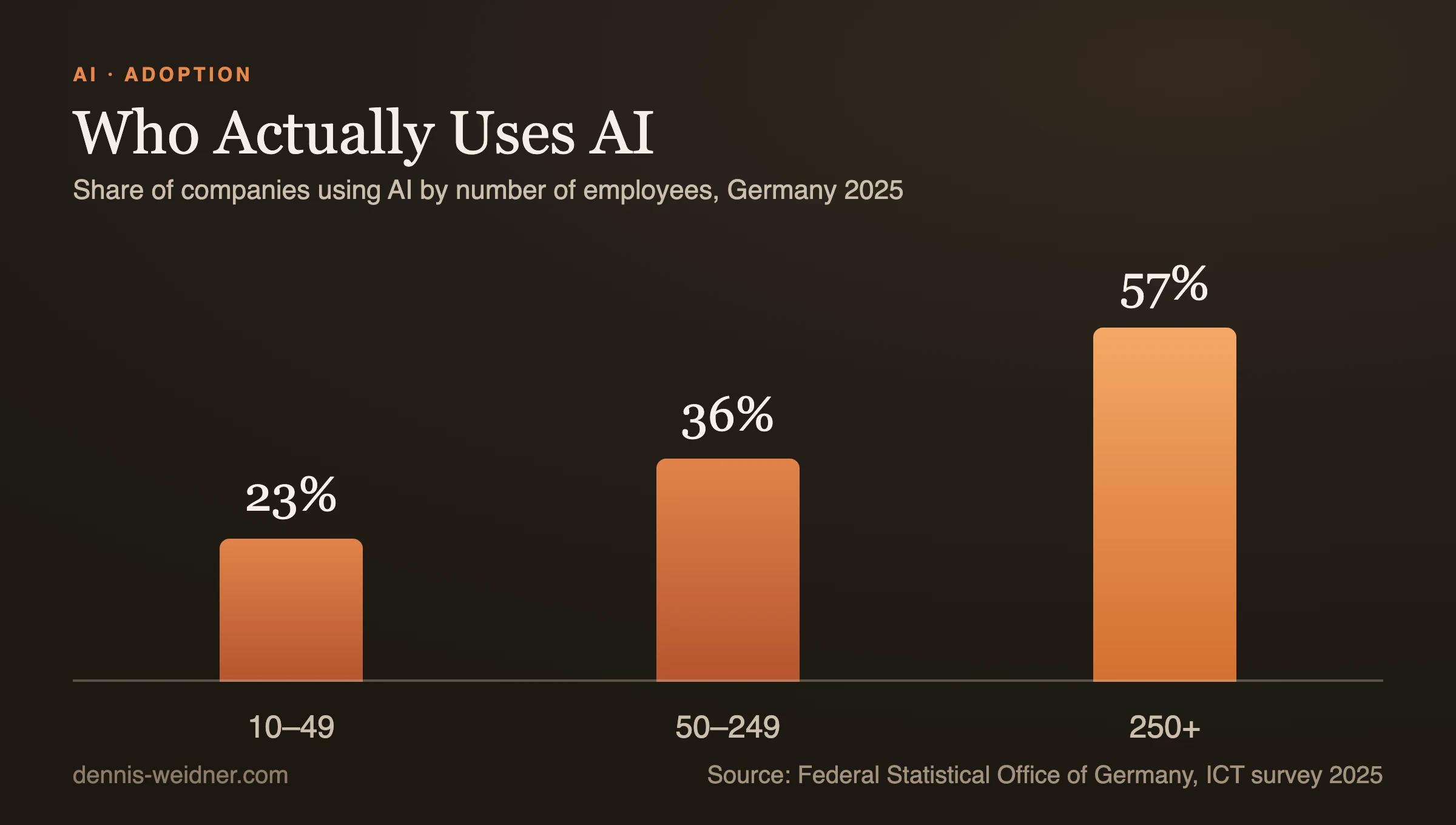
Those figures are cleanly collected and still regularly misused. The reason is in the methodology. The survey covers companies from ten employees upwards. Anything below does not appear. A team of three, which is the case this debate talks about most, shows up in none of those percentages.
Participation is also voluntary. Twenty thousand companies are surveyed annually under the Information Society Statistics Act, and nobody is obliged to answer. Those who answer have engaged with the topic; those who ignore it answer less often.
The error lies in how the statistic is used. "23 percent of small companies" means 23 percent of those that start at ten employees and chose to respond. About the three-person team next door, the number says nothing.
The Gap That Remains, Once You Read It Correctly
There is something solid in the figures nonetheless, namely the gap of 23 against 57 percent between the smallest companies covered and the large ones. That is roughly two and a half times.
The usual reading is that small firms are lagging. I think that is the weaker explanation. Access to these tools now takes a sign-up, at roughly the price of a lunch per person per month. What large companies have ahead is somebody whose job it is.
That is where the real question sits for small teams, and it is not whether getting started pays off. I answered that on my page about AI in daily work, including the four tests I run before handing anything over, and which tools take on which task is covered in my AI stack as a founder. The question that comes after is a different one, and almost nobody discusses it.
What Happens When One Agent Becomes Twenty
The first agent is an event. You watch it, check every result, enjoy it. The fifth runs alongside. By the twentieth something has shifted that you only notice too late: you have stopped watching.
That creates a problem a single agent never had. A person who fails to complete a task is noticed. They call in sick, they say so, or somebody asks. A routine that does nothing looks exactly like a routine that had nothing to do. Both report nothing, and from the outside a failure and a quiet day are indistinguishable.
This is where automation tips over. As long as a person reviews every result, an error is an annoyance. Once nobody is looking, an error becomes a condition, and it lasts until it is noticed by accident. In my case that has run to days.
Three Things I Therefore Attach to Every Routine
Three rules came out of that experience, and together they cost roughly half an hour per routine.
First: a sign of life that also arrives when there is nothing to do. Every routine reports that it ran, separately from whether it found anything. "Nothing to do today" is a message. Silence is not. Report only on hits and you have built monitoring that is quietest precisely during a total outage.
Second: the checker does not check itself. A monitor reporting green because it checked nothing at all is worse than no monitor, because it creates the feeling that the matter is covered. So I build into every check a case it must catch, and let it fail against that case regularly. If the monitor does not go red on its own test case, it is broken.
Third: a name beside it. Every automation has a person answerable for its output. They need not read every result, but they notice when it goes missing.
For a team of three, these three points sound like bureaucracy. In fact they are the reason three people can run twenty routines at all without it becoming a full-time job.
Why This Works Better for Small Teams Than for Large Ones
The actual reason I am betting on this set-up has little to do with technology.
An automation pays off when it takes over a recurring task with a verifiable result. In a large company that task must first be found, then described, then agreed, then approved, and it belongs to somebody for whom its automation is not good news. In a team of three, the same task is done by the person who also decides whether to automate it. The path from insight to implementation is not a process, it is an afternoon.
The second advantage is reversibility. The most expensive item in all of this, dearer than licences and training, is wrongly automated processes that later have to be dismantled. A small team can switch a routine off when it does not hold. It has no department that has meanwhile written the routine into its objectives.
A small team has no slack. If a routine fails silently for three days, nobody steps in, because there is nobody to step in. Which is why this set-up only works with the three points from the previous section. Without them, a team of three with twenty agents is not a lean company but an unsupervised one.
AI Agents in Small Teams: What I Expect for 2027
I expect three things for 2027.
The gap between large and small will not close through access but through the question of who can hand over a task cleanly. That is a skill, and it cannot be bought.
The number of routines per team will grow faster than the ability to supervise them. That is the mistake I made myself, and I see no reason others will be spared it. Anyone starting in 2027 should build the supervision before the second routine, not after the twentieth.
The bottleneck moves from execution to decision. Once preparation costs almost nothing, more proposals arise than a team can decide on. The value then no longer lies in producing something faster but in dropping something faster.
What I learn along the way in my own companies I write up continuously on my page about AI in daily work.
Frequently Asked Questions
How many companies in Germany use AI?
The Federal Statistical Office recorded 26 percent for 2025, with 23 percent at 10 to 49 employees, 36 percent at 50 to 249 and 57 percent from 250 upwards. The survey covers only companies from ten employees upwards, so smaller teams are not included.
Why does this statistic say nothing about very small teams?
Because the survey on the use of ICT in enterprises starts at ten employees. A team of three falls below that threshold and appears in none of the percentages quoted. On top of that, participation is voluntary: 20,000 companies are surveyed annually and nobody has to answer.
What is the main problem once many automations run in parallel?
Silent failure. A routine that does nothing looks exactly like a routine that had nothing to do: both report nothing. As long as a person reviews every result, an error is an annoyance. Once nobody is looking, it becomes a condition that lasts until noticed by accident.
How do you notice that a routine has failed?
By having it send a sign of life even when idle. "Nothing to do today" is a message; silence is not. Report only on hits and you have built monitoring that is quietest precisely during a total outage.
How do you spot a monitor that checks nothing?
By the fact that it never goes red. So every check should contain a case it must catch, and that case should be played through regularly. If the monitor does not go red on its own test case, it is broken, and it is then worse than no monitor because it creates the feeling that the matter is covered.
Why should small teams handle this better than large ones?
Because the path from insight to implementation is shorter: the same person does the task and decides on automating it. And because a routine can be switched off again when it does not hold, without a department having written it into its objectives. The drawback is the absence of slack, which is why supervision belongs in the build from the start.
Warm regards,
Dennis Weidner
Note: AI tools supported me in writing this article, and some images were edited with AI. I stand behind its content and every statement with my name.